This page was machine-translated and may differ from the original. View original
Interview / Song Yong-ho, Head of the Intelligent Semiconductor Promotion Team
I asked a pointless question: “Why do we need to pursue the intelligent semiconductor business?” Song Yong-ho, Head of the Intelligent Semiconductor Promotion Team, replied: “If we have relied on the export of (IT) sets for our livelihood until now, it is now about components. Intelligent semiconductors are ICT convergence components. We have entered an era where a single component constitutes a complete set.”
As he said, it was self-evident, and the message was clear. However, reality is not easy. The government is cutting the budget for foundational technologies like semiconductors and even demanding immediate results. It is not that we are unaware of this, as it involves taxpayer money, but we are simply rushing ahead until the project ends in 2020.
It is simply frustrating when asked which of the system semiconductors we have invested in so far are actually well-made. The nature of system semiconductors is custom design. This means that they are not products sold in a department store, but rather the ability to manufacture exactly what the customer demands.
Moreover, Director Song states that investment in system semiconductors is more important than ever now that the Internet of Things and wearable trends are mainstream, to the extent that the term IoT is prominently featured in commercial advertisements. He strongly argues that in the IoT era, many success stories of making system semiconductors and hitting the jackpot must be created.
True to his words, the scorching midsummer sun was beating down on the Hanyang University campus, where I visited for an interview about the system semiconductor business, which is currently no different from a 'fierce battlefield.'
The interview took place in his research lab at the College of Engineering. <Reporter Shin Yun-o>
The era of IoT and wearables is the era of intelligent semiconductors.
First, I think we need to clarify the concept of intelligent semiconductors. How do they differ from existing system semiconductors?
The core of intelligent semiconductors is the system semiconductor. It can be viewed as a slightly expanded concept of the system semiconductor. This expanded concept implies the incorporation of many software functions; to implement these software functions within the semiconductor, the hardware must perform more functions, and the software must also be significantly expanded.
Let's take dashcams as an example. In the past, dashcams only had camera functions, but nowadays they also include lane departure warning features. Additionally, a feature that notifies you if you do not start moving when the traffic light changes has been added. These are examples of additional functions being added to an existing system. You can think of intelligent semiconductors as a form in which intelligent services are added to the functions of existing system semiconductors in this way.
Services that were previously processed by software or provided by external systems connected to semiconductors have now essentially moved inside the chip. In other words, you can view it as being equivalent to the system semiconductor field, but with the functions incorporated within it becoming more advanced, intelligent, and high-performance.
Intelligent semiconductors are a slightly expanded concept of system semiconductors.
To put it simply, are you saying that there is no major problem in accepting intelligent semiconductors as system semiconductors?
Although intelligent semiconductors are a slightly more comprehensive field, saying that isn't much different.
- How is the Intelligent Semiconductor Promotion Team for Future Growth Engines progressing?
There are 19 task forces for each sector within the government's future growth engines, one of which is the Intelligent Semiconductor Task Force. The original purpose of the future growth engines, which began in earnest in 2014, is to determine how Korea will grow by 2020 and what the driving forces for that growth will be.
With the Ministry of Trade, Industry and Energy's projects for the 13 major growth engines already being pursued and the inter-ministerial projects for future growth engines being combined, there are now 19 major industrial sectors.
The problem was that the process of securing the budget was delayed. When the Intelligent Semiconductor Task Force was launched on April 30 of last year, its first task was to draw up a blueprint of what needed to be done by 2020. The task force drafted an implementation plan in late June 2014, but by then the budget allocation period had already passed.
Currently, semiconductor-related projects are being carried out by each ministry as they have been doing, and the project team is currently establishing the 2016 budget. Since the project team has not yet secured the budget, it may appear from the outside that there is no work being done this year.
What differentiates intelligent semiconductors from other growth engine sectors?
Fields such as robotics and autonomous vehicles in other task forces are currently in the initial stage, with the future set for activation. However, the intelligent semiconductor sector is already a battlefield. Revenue is being generated, and the business is in an active phase. This presents a different dynamic compared to other sectors. The challenge for intelligent semiconductors is how to revitalize existing businesses and how to overcome external obstacles.
- What specifically does the aforementioned external obstacle refer to?
Competition is already fierce for certain components. For example, foreign companies manufacture DTV components well and at low prices, and their performance is also excellent. Therefore, while it would be beneficial to create demand by developing premium chips, there are cases where this fails to serve as a differentiator if the technological level stagnates at a certain point.
In the past, PC performance was heavily influenced by the CPU, but now, a lower price does not necessarily mean significantly lower performance. This means that even if you buy a slightly cheaper option, you cannot feel a significant difference in performance. The same situation is occurring with components as well. If we do not respond by comprehensively analyzing competitors, product lifecycles, and other factors for each product, we will inevitably face increasing difficulties in the market.
The days of supplying tens of millions of chips are gone; now, we must create products specialized for niche markets.
Foreign semiconductor companies are advancing their technology very rapidly. There are many opinions saying that even if we work hard from now on, it will be difficult to catch up.
We talk about that a lot. In reality, China is catching up, and we are missing out on advanced technology. It is a headache trying to set targets. Our companies are also expanding their size through mergers or strengthening their competitiveness through diversification rather than vertical integration. The number of companies entering the Chinese market is increasing, and so are the companies showing interest in Korean firms. These changes are positive.
In the past, smartphones secured market share by supplying tens of millions of units, but this is no longer possible in the era of IoT and wearables. Products specialized for niche markets are bound to emerge. The time for supplying tens of millions of chips will pass.
The market is now demanding chips with diverse performance capabilities. From this perspective, an environment will be created where system semiconductors regain the spotlight. Markets such as IoT and wearables do not have a market volume large enough for large corporations to enter. A structure will naturally be established where small and medium-sized enterprises manufacture products for small volumes, while large corporations manufacture products capable of handling large volumes.
In that case, do you think there is a change in perception between large corporations and SMEs as they embrace new trends?
The issues regarding changing trends are similar for both small and medium-sized enterprises (SMEs) and large corporations. Until now, large corporations have led the market entry of system semiconductors, but recently, they seem to feel that this approach is no longer appropriate. As the market diversifies into various sectors, they appear to believe that they need to work together with SMEs.
Is there a change in the government's perception of intelligent semiconductors as well?
It seems that policies will also proceed within the framework of intelligent semiconductors. In fact, the budget is not substantial. I felt that the government's promotion of future growth engine projects was weak, but I understand that the government has set a policy to strengthen promotion starting this year. I hope it will be revitalized, even now.
-Due to changes in IT trends, it seems there will be areas required in addition to semiconductor technology.
While technical engineering is important, marketing capabilities are more critical than ever. Companies must possess the marketing ability to identify customer demand. That is the secret to surviving in the system semiconductor market going forward. Companies must significantly enhance their marketing capabilities. We are no longer in an era where we simply match prices to large corporations. We must listen to what customers need, create products, and provide tailored products to meet their demand.
Discussions on convergence plans are underway among the task forces for each sector.
Recently, the government has expressed a strong determination to foster fields such as IoT, 3D printing, and wearables. Are there any efforts to link these businesses with intelligent semiconductors?
Such work has recently begun. For example, until now, if robotics experts gathered to create an execution plan, semiconductor experts were not involved. They simply thought, "We can just buy the necessary parts and use them." With that approach, no connection is formed.
So, I raised the issue. I believe one of the government's roles is to create linkages between different industries. We conducted a survey on convergence strategies among the task forces in each sector and began investigating which committees need to work closely together. I heard there is an idea to prioritize budget allocation for convergence projects that emerge from this process.
The material of a semiconductor is 'people'
In carrying out the project, both budget and convergence are important. However, I think that workforce development is actually the biggest problem.
That is absolutely right. In reality, the core of technology is people. The semiconductor industry has no such thing as a material. What matters is who comes up with a creative idea first. In the sense that products are manufactured by designing based on ideas, 'people' are the material. People are the raw material for semiconductors and software. To grow the semiconductor industry, the key is 'people'.
Silicon Valley is not merely a physical collection of good companies; it is an environment where good products are developed and people are "circulated" within that environment. People who make a lot of money emerge. The fact that success stories appear implies that there is a continuous stream of people seeking out such stories. Ultimately, the creation of a channel for the "circulation of people" is the secret to Silicon Valley's growth. We, on the other hand, have a weak system for "people distribution." Our supply of personnel is also weak. It is crucial to build our own system capable of overcoming these limitations.
In that case, what do we think is the reason why there aren't many success stories?
As I mentioned earlier, I hope to see many success stories emerge from our sector as well. While the gaming industry seems to have some, we need more such stories in the system semiconductor industry. Therefore, I hope they are frequently featured in the media.
An engineer's dilemma is how to end their career as an engineer, starting from the moment they begin. The question of what kind of reward will be given to them in the future is important. For example, in Silicon Valley, a young person with a Ph.D. says they will only work at startups.
I believe that over the next 20 years, if I try four startups of five years each and succeed just once, I can retire. However, we do not believe in a one-in-four success rate. Many Silicon Valley-style examples must be created in Korea as well. Games must be developed where the probability of success increases.
Investment in workforce training is 'steadily' decreasing... remote learning must be expanded
Leaving aside success stories, it seems that investment in workforce development is also insufficient.
We requested priority investment and allocation. Although it is not yet finalized, I understand that the personnel budget is being prepared to some extent.
Around 2002, the annual budget for the system semiconductor workforce development project was 20 billion won, but it has 'steadily' decreased, falling to 2 to 3 billion won the year before last. It is important to expand the budget for workforce development going forward. I view workforce development as a game of making installment savings, rather than a deposit, in terms of future growth.
I think changes are also needed in the way manpower is trained.
That is correct. Several measures are currently under discussion. In the past, funding was provided to universities to foster manpower, followed by supporting companies, and then, through the concept of clusters, manpower was trained by gathering groups based on industrial sectors.
The essence of workforce development is to teach core technologies and enable these individuals to enter the industry. This fundamental nature cannot change. The issue, however, is how to respond to changing technological demands.
Therefore, we are considering a model where companies and universities can conduct research together and personnel can exchange frequently. It is a so-called industry-oriented, convergence-type workforce training model. It seeks ways for university and corporate personnel to work together for the long term.
To this end, the introduction of remote lectures for students must be expanded. There must be a system that enables corporate students to take real-time classes from remote locations without having to travel to school. The government must create and encourage remote education environments, even if it requires providing incentives to companies.
- How should companies interested in the intelligent semiconductor business respond?
The situation is not particularly favorable. With the overall R&D budget reduced, there is little room for new initiatives. At times like these, active participation from companies is essential. It requires active engagement with demand and securing technologies that meet that demand. Continuous demand surveys must be conducted beforehand.
Intelligent semiconductors are not inherently difficult. Since they encompass system semiconductors, it is appropriate for existing business operators to participate in the demand survey. The more active and diverse the demand, the easier it is for the government to secure funding. High demand provides momentum for the government. We need to instill in the private sector the awareness that such demand exists. Currently, comprehensive cooperation is required in the system semiconductor industry.
We must strengthen the foundation of the industrial sector, and if the foundation is solid, there will be more opportunities to make a living. We must work together to make the soil sound.
When asked what our appropriate survival strategy is, comparing ourselves to other countries is meaningless. We just need to stick to our own strategy. It is important to determine that quickly. We must move forward consistently. I think we need to refine that big picture now.
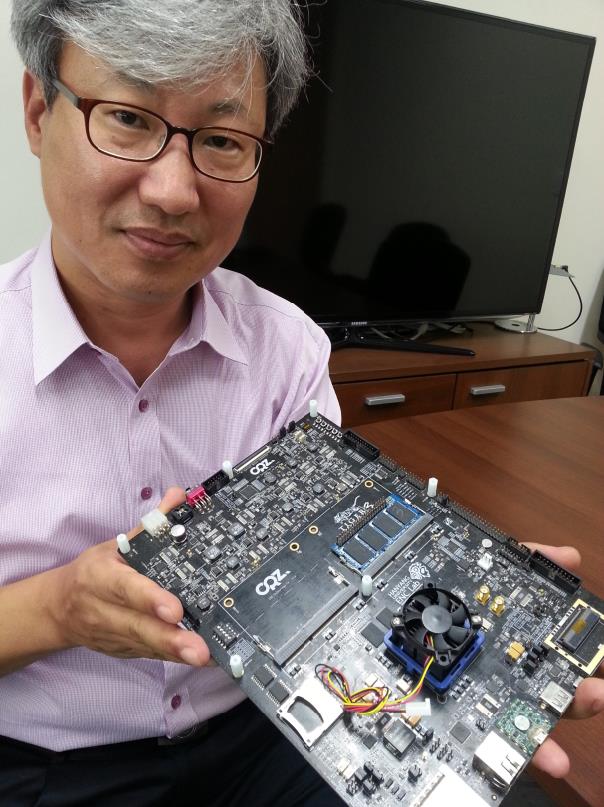
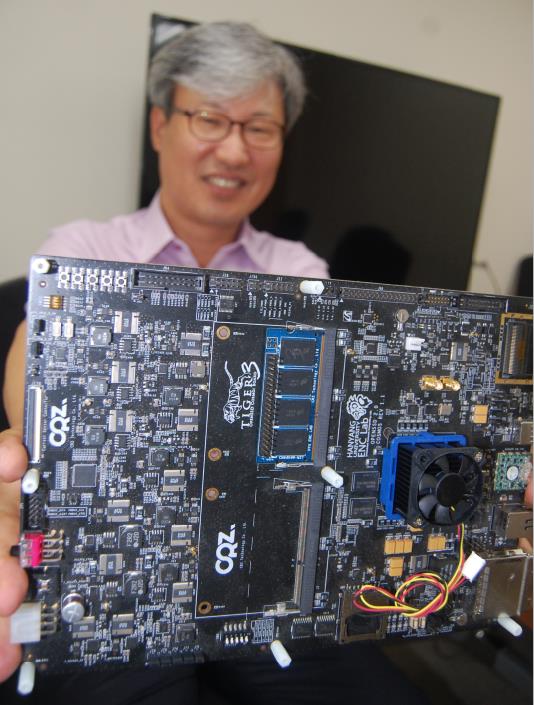
<Caption> Director Song Yong-ho is holding an SSD board developed at Hanyang University's Multimedia System Semiconductor Research Center. This board is the world's first to have both its hardware and software source code released so that anyone can build and test it.
본 기사에 대한 정정·반론·추후보도 청구는 보도 청구 안내를, 그간 게재된 보도문은 정정·반론보도 모아보기를 참고해 주세요.