This page was machine-translated and may differ from the original. View original
Sensor annual growth rate approaches 10%, reality is that most chips are imported

As the IoT (Internet of Things) era approaches, the proportion of advanced sensors is expected to increase from 19% (2010) to 49% (2020).
Advanced sensors that support consumer safety and convenience functions at the forefront of devices are a general term for devices that recognize the external environment and convert it into electrical signals that are easy for the upper system to process. In general, it refers to sensors that have dramatically improved external environment detection through the application of manufacturing technologies such as semiconductors and nano/MEMS, and intelligent sensors that have organically built-in signal processing such as data processing, automatic correction, self-diagnosis, and decision-making.
Sensors are becoming smaller, more complex, and more intelligent in line with the convenience of daily life and the intelligence of IT. They are gaining attention as a key technology for implementing a smart society as a mediator between humans and devices and for inter-industry convergence.
The intelligence of sensors is prominent in compasses, maps, GPS sensor maps, virtual/augmented reality, etc., and their complexity is
It appears as a single sensor module, a composite sensor module, and a one-chip composite sensor. Examples of miniaturization of sensors include gas detection using birds, gas sensors using thick-film processes, and MEMS-based gas sensors.
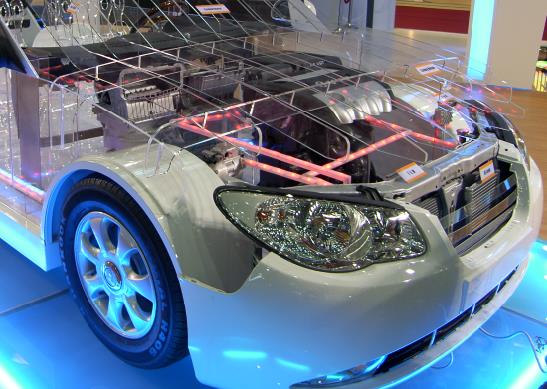
The extent to which sensors are being used becomes clear in examples such as automobiles and robots.
The number of sensors applied to automobiles increased from 42 in 1980, 160 in 2010, and 200 in 2015. In the 1980s, it was oxygen, pressure, flow, exhaust gas, and temperature sensors, while in the 2010s, it was acceleration, temperature and humidity, gyro, steering angle, light detection, rain detection, AQS, GPS, collision avoidance, airbag, TPMS, and image sensors. In the 2015s, intelligent collision avoidance, radar, and autonomous driving sensors are in the spotlight.
It is expected that 20 robots will be applied in 2000, 56 in 2010, and 150 in 2020 (based on Hubo2). In the 1980s, load and force sensors were mainly applied, and in the 2010s, acceleration, angular velocity, gyro, ultrasound, and TOF sensors were applied. In the 2030s, vision, laser radar, tactile, and 3D vision sensors are expected to be applied.
Most domestic companies are at a modular level
The sensor industry, which is used in most industries, goes through the stages of chips, packages, and modules. Chip production is very important, and packages and modules have a great influence on the development of innovative products in the application industry. Sensors are mostly used as a medium for diversifying and advancing the functions of set products, and as core components in most industries. Sensors are essential for convenience, safety, and smooth communication between humans and devices, and their functions are becoming more advanced.
Sensors are also an important field where small-quantity, multi-variety production characteristics and mutually beneficial cooperation between demand companies centered on large corporations are important. Park Hyo-deok, head of the Smart Sensor Business Unit at the Electronics and Telecommunications Research Institute, said, “Sensors are an industry suitable for fostering global specialized parts companies,” and “It is also an industry suitable for creating a creative economy ecosystem, such as creating quality jobs, due to its characteristics as a basic industry, convergence technology, and advanced knowledge industry.”
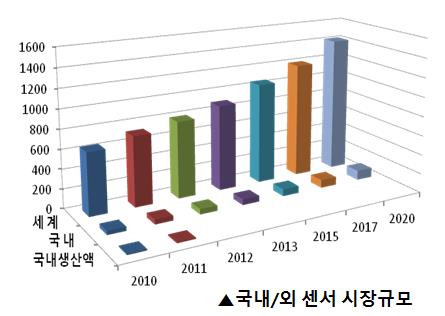
The importance of this is immediately confirmed when looking at the industrial situation. The global sensor market size grew from $72.2 billion (2011) to $79.6 billion in 2012 and is expected to reach $141.7 billion in 2020. This is an annual growth rate of 9.4%. As the outlook is good, the sensor industry has high technological entry barriers. The US, EU, and Japan occupy 70% of the global market, and advanced countries and some companies are monopolizing industrial competitiveness.
The domestic market size is also growing. It is expected to grow from $4.8 billion in 2011 to $5.4 billion in 2012 and $9.9 billion in 2020, a rapid average annual growth rate of 10.4%.
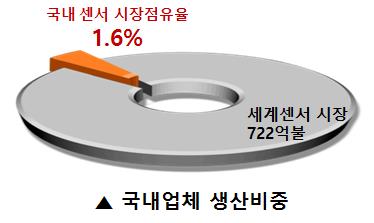
Domestic companies' production volume is $1.15 billion, accounting for 24% of the domestic market and 1.6% of the global market. Most domestic companies, which are at the modular level, are importing sensor chips due to their small size and lack of technology. 63% of sensor companies have sales of less than 5 billion won, and their R&D investment is at the level of 270 million won, which is 1.5% of the average sales (17.5 billion won) (57 research institutes, '12.6).
Among the eight key sensor products, except for image sensors for smartphones (domestic self-sufficiency rate of approximately 50%), chemical sensors for measuring gas and water quality (5-10%), and optical sensors for diagnosing building safety using optical fiber (5-10%), the remaining sensors (pressure, inertial, magnetic, imaging, radar) are entirely dependent on imports.
Government to invest a total of 150.8 billion won over the next six years starting next year
Sensors play a very important role in enhancing the competitiveness of major industries (automobiles, mobile devices, etc.) and new growth industries (robots, medical devices, etc.). Furthermore, due to the characteristics of the IoT era, the demand for sensors, especially advanced sensors, is rapidly increasing. This is because the core elements of the Internet of Things are to collect information on objects and the surrounding environment in real time and to enable communication between objects using communication functions.
Accordingly, the government plans to focus on fostering the smart sensor sector as a next-generation growth engine. The Ministry of Trade, Industry and Energy announced that it will invest a total of 150.8 billion won over the next six years starting next year through securing a budget this year to develop cutting-edge smart sensor source technologies and promising products, and to actively enhance the global competitiveness of the sensor industry through customized, field-oriented, high-level human resources training for companies.
An official from the Ministry of Trade, Industry and Energy emphasized, “This project is the first attempt at fostering advanced smart sensors at the government level, so we will actively reflect opinions from industry and academia in the future to develop it into a future food industry in preparation for the Internet of Things era.” <Reporter Shin Yun-oh>
본 기사에 대한 정정·반론·추후보도 청구는 보도 청구 안내를, 그간 게재된 보도문은 정정·반론보도 모아보기를 참고해 주세요.