This page was machine-translated and may differ from the original. View original
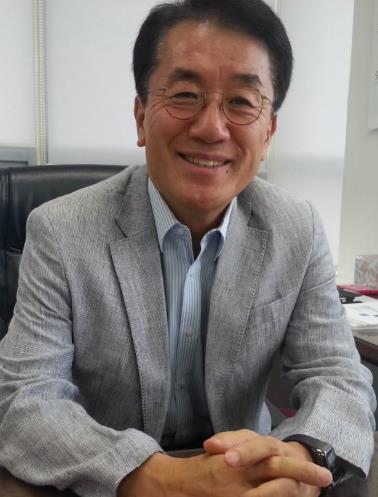
Interview / Park Ki-soon, President of Seoul Technopark (TP)
Park Ki-soon, President of Seoul Technopark (TP), began by waving his hand, denying that it was a "grand" forum. By "grand," he was referring to a gathering held at a hotel with expensive meals and ample funding. The "Sensor Convergence Forum," which President Park spearheaded earlier this year, focuses on providing a venue for dialogue that can offer practical help to one another, rather than being a gathering merely for show.
The reason he started the Sensor Convergence Forum was also initially quite modest. It began with a semiconductor fab owned by Seoul Technopark. This wafer-level back-end processing and packaging equipment is primarily used by companies requiring sensor and MEMS processes.
Sensors Meet Traditional Industries
Currently, there are four tenant companies at Seoul TP alone, and dozens of companies rent equipment. Observing the many sensor companies utilizing the fab, I pondered ways to help them. The IoT (Internet of Things), which began to take off in earnest last year, provided a starting point to resolve these concerns. This is because sensors, along with communication chips, must be at the foundation of a network where all objects can exchange data in real time.
I thought it would be good to create a venue for dialogue where people working in sensors and those in traditional businesses could meet. That is why I came up with the idea of holding a forum where these people could connect.
Director Park thought that combining sensor companies with diverse industries could create convergence synergies. “There is no place where sensors are not used. If people in traditional industries, outside of the IT sector, utilize sensors, they can generate added value. I thought it would be beneficial to create a platform for dialogue where sensor professionals and traditional business owners could meet. That is why I came up with the idea of holding a forum where these people could connect.”
With the help of many people, a preparatory committee was held last March, and the initiators' meeting and the founding general assembly were held together on May 7. On that day, over 350 people attended, demonstrating keen interest in the sensor.
Although the inaugural general meeting, held to publicly announce the founding of the forum, started off on a somewhat grand scale, the forum itself is planned to proceed by selecting application fields one by one.
The first Convergence Forum, held on the 20th at the Seoul TP conference room, clearly demonstrated the direction the forum will take in the future. Attendees showed great interest in the forum's theme, "Sensors and Furniture." Director Park thought it was a good topic to explore ways to apply sensors, as the specialized business of Gyeonggi Daejin Technopark, which helped establish the forum, was furniture.
The meeting place between sensors and diverse industries holds great significance.
“When sensor manufacturers and furniture companies meet, the sensor company will likely suggest how it would be beneficial to incorporate specific sensors into furniture, while the furniture company will discuss the sensors they actually need. I felt that a meeting like this to discuss mutual needs would be meaningful.”
For example, sensors are required to incorporate RFID or wireless chargers into furniture, and pressure sensors are key to adding back correction functions to chairs. The forum enables the application of sensors to traditional industries.
For now, we are simply facilitating meetings; there are no special benefits. One of our goals is to arrange for government support once concrete ideas emerge from repeated meetings and a new project is born.
Director Park emphasized that the great significance of the Sensor Convergence Forum lies in the fact that there has never been a meeting like this before. However, creating a venue for cross-industry collaboration was by no means as easy as it sounds. As is the case everywhere, the most difficult part is bringing together people with intertwined interests.
Director Park’s know-how and network, built through his experience as a new business manager at a large corporation, a fabless executive, a semiconductor development company, and a venture capitalist, were of great help. “I predicted the concept of IoT, where objects become connected, back in the early 1990s when I was in charge of new business at a large corporation.” Back then, the idea of home appliances being connected by microprocessors and operating systems was considered strange. I believed that we needed to prepare for the future to enable such connectivity.
The key to connectivity is sensors, and the forum focuses on application fields.
Director Park has believed for the past four or five years that sensors are the core component of IoT. This is because, ultimately, information from big data also originates from sensors. To achieve this, a system must be created that incorporates not only the inherent performance of the sensors but also microprocessors and operating systems to communicate. Among these factors, Korea has lagged significantly behind in sensor development. In other words, while the communication infrastructure is well-established, sensor technology is far behind.
While researching such sensor technology is the responsibility of companies and academic societies, the Sensor Convergence Forum plans to focus on application fields. “To reiterate, the goal of our Sensor Convergence Forum is to enable sensor companies to create differentiated products. By manufacturing sensors needed by traditional industries, they will be able to gain a competitive edge.”
Like other regional technoparks, Seoul TP aims to support companies in the Seoul area. However, since Seoul lacks specialized industries like the provinces, it has adopted a strategy to differentiate itself by focusing on the sensor industry based on semiconductor packaging facilities. It is expected that the number of companies mass-producing products using the equipment will increase, and equipment efficiency will also improve.
I hope many sensor companies participate.
However, it is not without its difficulties. There are not many sensor companies in the country, and since the majority are small businesses, they lack the resources to focus on forums. Director Park hopes that as many companies as possible will take an interest in order for the forum to become active.
As a metropolitan technopark, Seoul Technopark faces significant constraints, unlike regional technoparks established to revitalize local industries. While we are doing our utmost in our core mission of supporting businesses, we are striving to attract specialized centers to maximize this effort. The purpose of the Sensor Convergence Forum is no different from this business support. If companies succeed through the Sensor Convergence Forum, we consider that our success as well.
본 기사에 대한 정정·반론·추후보도 청구는 보도 청구 안내를, 그간 게재된 보도문은 정정·반론보도 모아보기를 참고해 주세요.