



[Reporter's Notebook] Why Did a Fabless CEO Focus on System Semiconductors?
 Published2015.10.19 19:00
Is there really no breakthrough? What was supposed to be a discussion on the current state of system semiconductors has become a repetitive cycle of repetition. The event took place on the 13th in the KINTEX conference room, during a panel discussion on establishing a system semiconductor development policy at the Semiconductor Industry Development Strategy Seminar, part of the Semiconductor Industry Expo.
In fact, the discussion that day was not a significant event representing our semiconductor industry, but it was an event hosted by the Korea Semiconductor Industry Association under the Ministry of Trade, Industry and Energy, and it was an event attended by those responsible for semiconductor policy and representatives currently leading major system semiconductor companies, so it was by no means a time to be treated lightly.
While most of the panel discussion was spent reiterating fundamental principles, it wasn't a time for reaching any conclusions. Discussing how to foster the domestic semiconductor industry isn't likely to yield quick solutions. Instead, a vicious cycle of raising issues because they exist, and then recurring when those issues aren't addressed, is occurring.
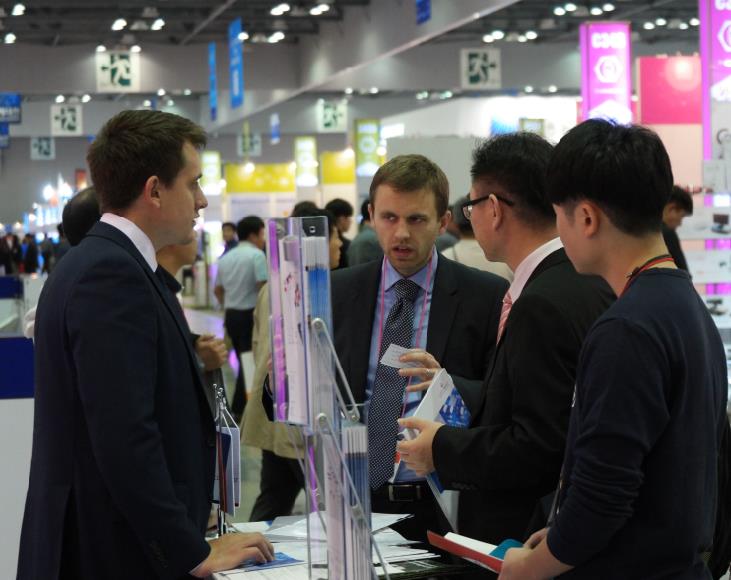
▲ Foreign buyers at the 2015 Electronics Show are consulting at the booth. Photo: Courtesy of Electronic Warfare Organizers.
Last year, the global semiconductor market grew 9.2% year-on-year to $354.5 billion. This continued growth, despite a weak global economy, is driven by new applications such as smartphones, digital appliances, and automobiles, which continue to support the market. Meanwhile, China's semiconductor industry, once considered a distant follower, has experienced remarkable growth. China's semiconductor consumption (2013) accounted for 55.6% of global production, and its IC sales in 2013 reached $40.8 billion, a 19% increase from the previous year.
The growth of China's semiconductor industry is also evident in the fabless sector. Among the world's top 50 fabless companies, the number of Chinese companies increased from one in 2009 to nine in 2014. Incidentally, the combined sales of China's top 20 fabless companies in 2013 reached $7 billion, more than four times the combined sales of South Korea's fabless sector ($1.7 billion). Building on the five-year plan for the integrated circuit industry (which aims to achieve a 30% domestic production rate), which ends this year, China has established a mid- to long-term plan to foster its semiconductor industry. The goal is to reach global standards by 2020 and become a global leader by 2030. Simply put, China aims to surpass the United States as a semiconductor powerhouse.
The domestic system semiconductor industry continues to see average operating profit and net profit decline.
In contrast, what is the reality of the domestic system semiconductor industry? The average sales of the top 35 domestic fabless companies increased only slightly from approximately 42.3 billion won in 2010 to 51.1 billion won in 2013, while the average operating profit decreased from approximately 3.5 billion won in 2010 to approximately 2 billion won in 2013, and the average net profit also decreased year by year from approximately 1.9 billion won in 2010 to -654 million won in 2013.
This panel discussion on developing a system semiconductor development policy repeatedly raised persistent issues such as labor shortages, government support, and foundry support. While the majority of domestic fabless companies feel that government support policies are inadequate, they maintain that the government has continued to support them through national projects. Despite recognizing the limitations of single-product growth, they remain reluctant or even negative about M&A, and they want domestic foundry support to address the rising cost of chip production.
Chronic problems such as lack of manpower, government support, and foundry support are recurring.
Particularly in the case of the talent shortage, the conflict between government-funded and privately funded schools is deepening. With the collapse of domestic fabless companies, graduates are increasingly focusing on large corporations, disrupting the talent supply ecosystem. Schools argue that they need to create incentives to encourage students to work for small and medium-sized enterprises (SMEs) and strengthen industry-academia collaboration programs. However, companies complain that attracting top talent is difficult, and even if they do recruit and develop them, there's no way to prevent them from moving to large corporations.
A fabless representative who took the stage for a discussion question raised his voice, saying, "Someone needs to break this (vicious) cycle" to enable companies to grow. He argued that even large, globally successful companies received significant support in their early years, and that an industry environment that expects them to grow on their own should not be left to fend for themselves. Another fabless official also pointed out the lack of an industrial ecosystem, saying, "We need a technology sharing ecosystem." Given the enormous costs and time required to develop semiconductors, he emphasized the need for a network that supports companies in meeting their needs.
CEO Lee Do-young: "Don't look inside the chip, look outside."
The panelists participating in the discussion presented the following opinions: ▲ Domestic large corporations should transfer their unused IP to small and medium-sized enterprises; ▲ There should be many successful cases of fabless companies to attract excellent talent; ▲ If we do not invest in fabless companies, Chinese companies will buy up domestic companies and this will eventually come back to haunt us. A government official admitted that it is true that the semiconductor industry is doing well because of the performance of some large corporations, as rumored, and also confirmed that there is currently no new R&D budget for next year.
The heated(?) discussion that day, which went on for 30 minutes past the scheduled time, once again reminded us of the harsh reality of fabless, but the remarks of one fabless representative who participated as a panelist were enough to provide a ray of hope. Do-young Lee, the founder of Siliconfile (currently the CEO of Optolane), which once had sales of 130 billion won, said, "Don't look inside the chip, look outside the chip." He emphasized that the most difficult part for startups is investment, and that companies should make an effort to present a vision sale along with product sales to investors. This is because there are not many investors who understand all the technologies in various fields.
CEO Lee, who recently succeeded in attracting investment for his bio-IT convergence product, also shared his survival strategy in the convergence era, saying, "You shouldn't be trapped in a paradigm." He also emphasized that companies must quickly determine whether it's better to purchase technology (products) or develop them. If business requires it, they should give up what they don't need and find another way. Was it only one reporter among the participants who felt his words— "Look outside," "Sell your vision," and "Break the paradigm" —as if they were just a tidbit to throw at someone lost? These are questions the Korean fabless industry, which has lost its way, should consider at least once.
Comments
Related news
[Reporter's Notebook] That's right! The bed was science.
The statement that "a bed is not furniture, but science" is a copy that sufficiently reflects these requirements. It is not arguing the equation 'bed ≠ furniture,' but rather emphasizing the meaning that something more than furniture is needed. Therefore, the statement 'bed = science' is not saying that a bed is science itself, but rather a figurative expression of the fact that something as sophisticated as science is required.
2015.08.24by 신윤오 기자
[Reporter's Notebook] Why Did KT Chairman Hwang Chang-kyu Take Two Devices Out of His Pocket?
Chairman Hwang revealed a plan to build an 'Intelligent GiGA Infra' based on differentiated technological capabilities to respond to revolutionary changes that will occur in industry and daily life based on ICT. The Intelligent GiGA Infra aims to provide greater value to users by combining with cutting-edge control systems, cloud, and big data, and made a surprise announcement of investing 13 trillion won by 2020 in the Intelligent GiGA Infra and future growth businesses.
2015.09.25by 신윤오 기자
[Reporter's Notebook] Our Attitude to Key Words for Next Year
What is important is not limiting oneself to a few trending topics known as the top 10 issues, but rather discovering business opportunities that exist between core issue keywords. Whether it is artificial intelligence or IoT, one must create a market that aligns with one's own business objectives. Of course, this must be premised on understanding what customers actually want. Our approach to viewing the top 10 issues of 2016 is no exception to this principle.
2015.10.12by 신윤오 기자
Intel Unveils Next-Generation 'Core Ultra Series 3' and vPro Platform for Enterprise PCs
Intel has officially unveiled the "Intel Core Ultra Series 3" for next-generation enterprise PCs and the latest vPro platform, addressing a wide range of demands from enterprise notebooks to high-performance workstations.
2026.03.26by 배종인 기자

ROHM Launches ESD Protection Diode Compatible with High-Speed Interfaces of 10Gbps or Higher
Semiconductor specialist ROHM has developed the 'RESDxVx series' of ESD (electrostatic discharge) protection diodes capable of responding to next-generation high-speed data communication environments exceeding 10Gbps, simultaneously enhancing both signal quality maintenance required in high-speed interfaces and IC protection performance.
2026.03.26by 배종인 기자











