



[Reporter's Notebook] Did you make some money with IoT?
 Published2015.10.23 18:38
The momentum of the Internet of Things shows no signs of slowing down. In the first half of the year, the government announced plans to invest 98.9 billion won over three years in five major IoT convergence sectors, including smart homes. Furthermore, the government intends to expand the domestic market size from 2.3 trillion won to 30 trillion won, aiming to become a "leading nation in the hyper-connected digital revolution" by 2020, developing and utilizing IoT services. With a connected era expected to arrive by 2020 where 26 billion devices are "connected" (according to Gartner), this is undeniably the true "creative economy."
At this point, it is worth asking yourself: Have you made any money from the Internet of Things? Are we currently doing the Internet of Things correctly? If you cannot answer immediately, perhaps the question is wrong. Then let's rephrase the question. Perhaps your understanding of the Internet of Things is incorrect. Have you been viewing IoT merely as the sale of products?
For example, let's look at IoT, which has recently started appearing frequently in advertisements. It is said that using IoT technology, you can be immediately notified whether you left the gas on or if a burglar opened a window and entered.
So what am I supposed to do about it?
Let's say you realized you left the gas on when you left the house, and let's say you realized a burglar has broken in. Now, what should you do? Should you just call and have a fire truck and a police car sent to your house? Should we consider it fortunate if the fire does not spread and the thief waits until the fire trucks and police cars arrive?
There is something we have overlooked. Gas detectors and home CCTVs are merely "connected devices," not "IoT" itself. To be precise, IoT technology must "process data collected through devices to create meaningful and tangible repercussions." What is important is that it must "provide revenue to suppliers and clear benefits to users ," rather than focusing solely on the Internet of Things devices. Professor Kim Hak-yong of Pusan National University diagnosed at a seminar that "IoT businesses have not been successful because this simple principle has not been upheld."
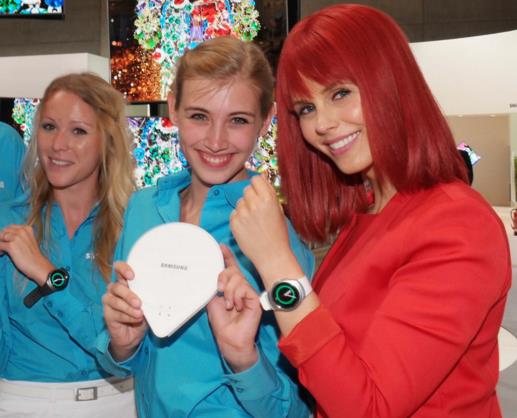
Samsung Electronics introduced strategic IoT-centric products at IFA 2015.
IoT is a business term. The technologies currently discussed as IoT are technologies that have been developed and used for a long time. IoT is not some special technology that suddenly popped up out of nowhere. Perhaps that is why we assumed that we could simply develop and supply IoT products using traditional methods. Could it be that we created products consumers didn't even want, simply because the market entry barriers were low, and then claimed that the business wasn't viable?
Professor Kim stated that the answer to this problem must be found in the 'definition' of the Internet of Things. The IoT defined by the ITU-T is to provide advanced services using connected devices that utilize information and communication technology. Here, he stated that he failed to understand the true purpose of IoT, which is 'advanced services,' and instead mistook 'connected devices' for the means of IoT. Accordingly, he introduced the so-called Provice, which provides services using devices. A Provice integrated with content services would serve as one example.
Of course, his argument is likely not the first of its kind. However, his suggestion that we reconsider the definition of IoT as we know it is very useful, especially at a time when we are swept up in the massive trend of IoT and confused about what to do and how to conduct a truly 'IoT-like' business. Fortunately, IoT businesses have recently begun to yield results in fields such as boiler meter reading, intelligent building systems, smart logistics, and smart factories.
While revenue is being generated more in the enterprise sector than in the consumer sector, government-led IoT projects aimed simply at selling communication lines, as is currently done, will not work. To catch up with overseas companies that are expanding the IoT market around platforms, a different approach is required.
In other words, the reason why people fail to make money with IoT is that they blindly rushed into it without considering what consumers truly need. It is because they failed to envision the bigger picture. This is also why we need to re-examine the definition of IoT.
As an aside, I believe that the Sensor IoT Business Commercialization Outlook Seminar, which our headquarters will host on the 25th of next month, will be an opportunity to seriously consider what kind of business can be conducted in the future using sensors and sensor-based IoT platforms.
Comments
Related news
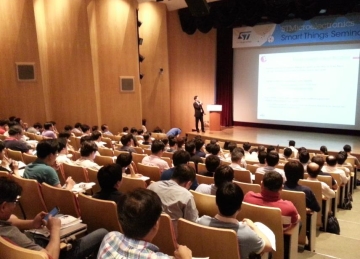
Their Smart Way of Coping with the IoT Era
In two years, the population aged 60 and above will account for 13% of the total population, and 55% of the population will live in urban areas. Additionally, energy demand is expected to increase by 6% compared to 2014, and 22 billion devices are projected to be connected. Accordingly, new business opportunities are anticipated to emerge. With 20 sensors installed per smartphone, a total demand of 4 million sensors is expected to occur, 65 million new smart meters will be installed, 24 billion microcontrollers are projected to be sold, and 56 million ultra HD TVs are expected to be sold.
2015.09.15by 명세환 기자
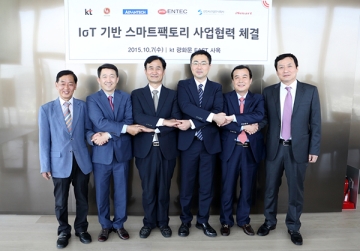
Improve factory productivity by introducing IoT-based smart factories
On the 7th, KT announced that it has signed an MOU with Gyodong Food Co., Ltd. to implement an IoT-based smart factory. A 'smart factory' refers to a factory that resolves unnecessary tasks using IoT technology and contributes to increased productivity.
2015.10.08by 명세환 기자
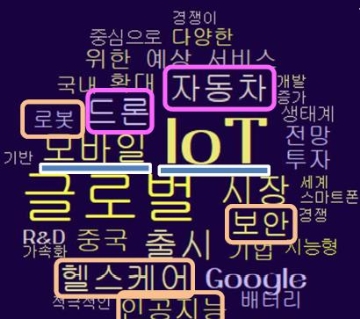
[Reporter's Notebook] Our Attitude to Key Words for Next Year
What is important is not limiting oneself to a few trending topics known as the top 10 issues, but rather discovering business opportunities that exist between core issue keywords. Whether it is artificial intelligence or IoT, one must create a market that aligns with one's own business objectives. Of course, this must be premised on understanding what customers actually want. Our approach to viewing the top 10 issues of 2016 is no exception to this principle.
2015.10.12by 신윤오 기자
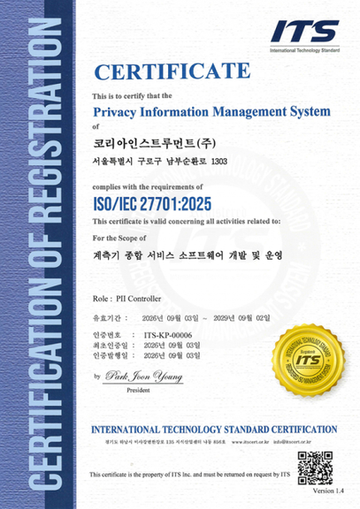
Korea Instrument, KOLAS Accredited Calibration Agency First to Simultaneously Acquire ISO/IEC 27,001·27,701
Korea Instrument has become the first among KOLAS accredited calibration agencies to simultaneously acquire ISO/IEC 27,001 and ISO/IEC 27,701 certifications. Through its proprietary platforms CWIZ Enterprise and CWIZ Partners, the company has embedded information security and personal data protection requirements across all business processes including customer information, equipment data, and calibration reports, with plans to continuously advance its management system through regular audits and security inspections.
2026.10.12by 배종인 기자

TeamViewer One, IT Incident Automation Workflow and Resolution Center Enhanced
TeamViewer has added IT incident automation capabilities and an advanced Resolution Center to its integrated digital workplace management platform 'TeamViewer ONE'. Recurrent service disruptions, configuration errors, and capacity shortages are automatically handled according to preset policies, and device status verification through script deployment can be managed in a unified interface, significantly reducing repetitive tasks for IT teams.
2026.10.12by 배종인 기자











