



Preparing for the IoT market? Thinking about how to easily develop products using MCUs.
 Published2015.10.23 20:03
Elevating display-focused MCUs to the MPU level... 'Cube MX' makes IoT productization easier for engineers
STMicroelectronics' 'SMART City Solution,' showcased at the Korea Electronics Show (KES), demonstrated the potential of various applications utilizing MCU boards. It enables real-time management of digital mesh information, ranging from smart streetlights using sensors and smart trash cans to humidity and temperature control and earthquake detection within buildings.
According to research conducted by the International Data Association, the global IoT market is projected to grow to $1.7 trillion (approximately 2,023 trillion KRW) by 2020, taking into account an annual growth rate of 16.9%. This means that the number of IoT devices will exceed the number of internet users.
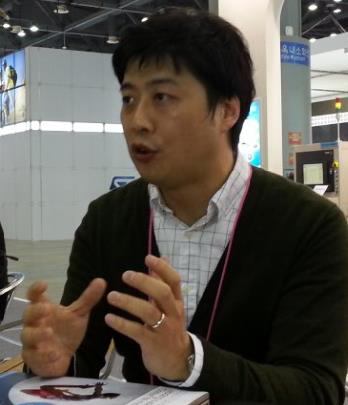
Accordingly, ST is also consistently releasing IoT-based solutions, providing engineers with opportunities to develop various applications. How exactly will ST be able to lead the IoT market, which holds infinite potential? To hear the answer, we met with Song Byeong-cheol, Manager of ST’s MCU Division, at the Korea Semiconductor Exhibition on the 16th.
 - What is ST's flagship MCU that is being重点 introduced at this electronics exhibition (KES)?
ST is introducing the newly launched 'STM32F7' and the currently most popular 'STM32 F4'. The STM32 F7 emphasizes display capabilities, elevating the MCU level to that of an MPU through ST's technology, Chrom-ART Accelerator™. A 'Nucleo car' has been prepared to easily demonstrate use cases for the STM32F4. A demo car can be built by connecting Bluetooth, the X-Nucleo board, and the motor-side X-Nucleo board.
You emphasized the F7's display; what features enable the implementation of display optimization?
By utilizing the newly introduced Cortex-M7 core, it achieved 462 DMIPS and a CoreMark 1082 performance at a maximum operating frequency of 216 MHz. This represents approximately double the performance of the Cortex-M4 core. Building on this high performance, 2D graphics hardware acceleration was implemented through ST's proprietary technology called Chrom-ART. It can be viewed as a DMA specialized for 2D graphics (also referred to as DMA2D). The advantage of Chrom-ART is that it reduces the CPU load required for graphics tasks and enables the implementation of more visually stunning GUIs by utilizing fast PFC and blending functions. Additionally, it can be easily and quickly applied to various graphics stacks.
Then, which market was this MCU developed to target?
It is precisely the highly sought-after IoT market. What ST is focusing on is how to easily develop products in this market.
What are some of ST's specific IoT solutions?
i-SEDEX is providing X-Nucleo boards free of charge. There are two types of boards: 'STM32 L0' and 'STM32 L4'. In the context of IoT, there are load and hub components. Since the load component prioritizes low power consumption, the 'STM32 L0' model features a Cortex-M0, making it effective for low-power applications. Conversely, high performance is required for the hub component, so the F4 board, equipped with a Cortex-M4, is more useful. In addition to MCUs, ST allows you to use various X-Nucleo boards, such as a 'Nucleo car,' by stacking Nucleo boards like Lego blocks.
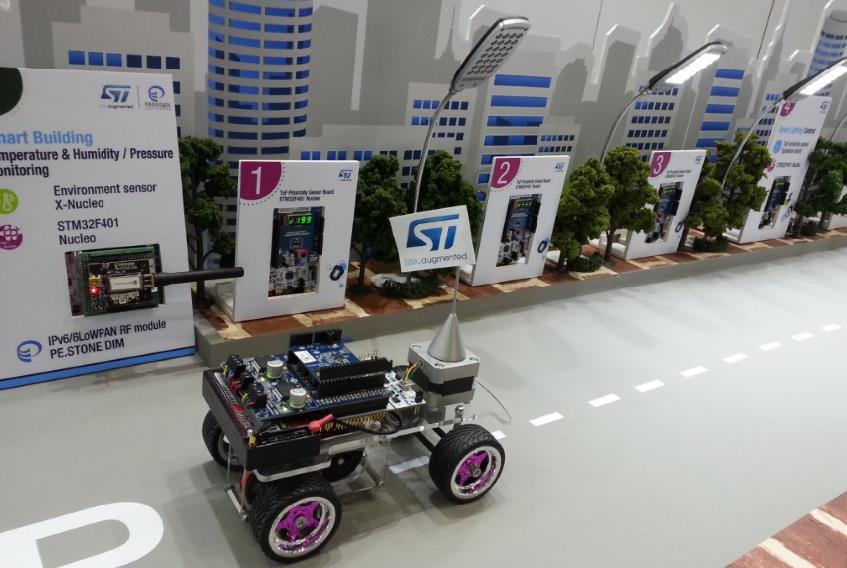
▲ 'SMART City' was realized using a 'Nucleo car' made by stacking Nucleo boards like Lego blocks .
You mentioned that Nucleo boards can be stacked like Lego. How can they be best utilized?
Developers faced significant difficulties when extending functionality beyond existing features. The Nucleo board makes development easier by connecting various X-Nucleo expansion boards to address this issue. For instance, the demo car was constructed by stacking BLE X-Nucleo and Motor X-Nucleo boards on top of a Nucleo board (MCU board). We devised a method to build products by stacking the corresponding X-Nucleo boards to achieve the desired functionality.
(Since ST is an integrated semiconductor company, there are boards with various functions, such as temperature sensor boards, MEMS sensor boards, BLE, NFC, etc.)
- What is the most convenient aspect for engineers when using an MCU?
I understand that when engineers develop an MCU, they struggle with the basic setup after selecting the MCU. Therefore, ST prepared 'Cube MX'. 'Cube MX' is a program that generates software to easily configure the hardware blocks within an MCU after it has been selected. Since it can be downloaded for free from the ST website and automatically generate software with just a click, ST has established an environment where engineers can immediately commercialize products by programming only the top layer of the application.
Lastly, regarding smart cities, what features will be added to the MCU in the future?
It is somewhat difficult to associate MCUs with smart cities based solely on their special additional features. However, I believe that as general-purpose products, MCUs can serve as a cornerstone for smart cities by offering high performance at lower power consumption. For example, considering a scenario where streetlights turn on automatically in a smart city, sensors must detect the approach of people to activate the lights and communicate this information to a central system; for the MCU to perform this role effectively, power consumption and performance will be fundamental requirements. For reference, ST plans to release MCU products with higher performance and lower power consumption in the future.
Comments
Related news
STMicroelectronics Supports All STM32 MCUs with Software Platform STMcube
2015.02.25by 명세환 기자
.png)
TI Develops 32-Bit MCU That Captures Both Low Power and High Performance
2015.05.18by 명세환 기자
Korea Instrument, KOLAS Accredited Calibration Agency First to Simultaneously Acquire ISO/IEC 27,001·27,701
Korea Instrument has become the first among KOLAS accredited calibration agencies to simultaneously acquire ISO/IEC 27,001 and ISO/IEC 27,701 certifications. Through its proprietary platforms CWIZ Enterprise and CWIZ Partners, the company has embedded information security and personal data protection requirements across all business processes including customer information, equipment data, and calibration reports, with plans to continuously advance its management system through regular audits and security inspections.
2026.10.12by 배종인 기자
TeamViewer One, IT Incident Automation Workflow and Resolution Center Enhanced
TeamViewer has added IT incident automation capabilities and an advanced Resolution Center to its integrated digital workplace management platform 'TeamViewer ONE'. Recurrent service disruptions, configuration errors, and capacity shortages are automatically handled according to preset policies, and device status verification through script deployment can be managed in a unified interface, significantly reducing repetitive tasks for IT teams.
2026.10.12by 배종인 기자











