



Will Concentrated Investment in Promising Medical Devices Make Korea One of the World's Top 7 Powerhouses by 2020?
 Published2015.11.02 17:26
Designating innovative medical device companies to provide priority R&D support, health insurance benefits, etc.
Relevant government ministries are joining forces to expand investment in research and development to secure a leading position in the promising medical device sector, where the market is just beginning to form.
The plan is to invest more than 30% of new medical device R&D projects starting in 2016, and to invest more than 50 billion won through bio-sector funds by 2020.
The reason relevant ministries, including the Ministry of Trade, Industry and Energy, the Ministry of Science, ICT and Future Planning, the Ministry of Health and Welfare, and the Ministry of Food and Drug Safety, have joined forces is that they shared the view that while they have been pursuing various measures focusing on the growth potential of the medical device industry, a significant portion of their strategic choices involved catching up with an already mature sector led by developed nations.
 Recently, due to the convergence of technologies and the growth of healthcare services, various new concept medical devices are emerging, and we agreed that it is necessary to make efforts to secure a market share for these promising medical devices in their nascent stage.
Accordingly, these four ministries announced the 'Bio Future Strategy 2 (Medical Devices),' which contains strategies for the development and commercialization of promising future medical devices.
While previous measures covered medical devices in general, this latest initiative is a strategy to secure a leading position in the market for nascent sectors where even developed nations are just beginning to accelerate development. In other words, the plan is to simultaneously pursue development by the Ministry of Trade, Industry and Energy and the Ministry of Science and ICT, linkage with clinical trials by the Ministry of Health and Welfare, and licensing by the Ministry of Food and Drug Safety.
This plan presents measures in four areas to leap forward as one of the world's top seven medical device powerhouses by market share by 2020.
First, R&D investment in promising technologies in their nascent stage, where markets are beginning to form, will be expanded. The budget for related projects is 104.3 billion won in 2015 and 116.2 billion won in 2016 (proposed).
Accordingly, government investment in promising future fields such as ICT-converged diagnostic and therapeutic devices, bio-alternative materials, and healthcare apps will be expanded. Rather than merely increasing investment, the government will prioritize commercialization and pursue development methods tailored to the specific characteristics of each sector. For instance, to develop ICT-converged medical devices, the government will encourage hospital participation and user-centric development, while supporting healthcare apps where innovative ideas are the key competitive factor.
Second, we support the early market entry of innovative products. To this end, we encourage early market entry through regulatory consulting support and the expansion of translational clinical trial support centers. We will expand the Rapid Commercialization Support Program, which began this year, and broaden the Translational Clinical Trial Support Centers to resolve difficulties in clinical licensing.
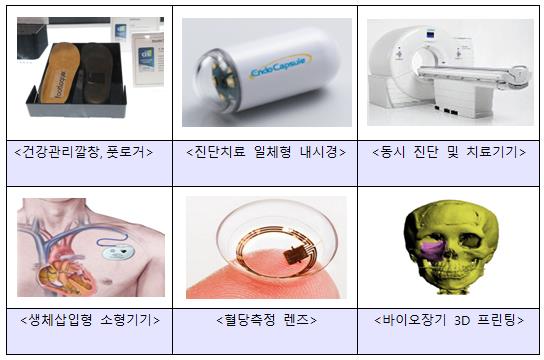
Examples of promising future medical devices
 Third, establish a foundation for growth through the development of domestic and international sales channels. By 2020, expand the market share of domestically produced medical devices to 45% and achieve 1,000 medical device exporting companies. Domestically, the plan is to expand validation tests and support for presentations at renowned academic conferences to improve the quality of domestically produced medical devices, while also analyzing the current status of their usage to improve the usage environment.
Finally, we will expand the infrastructure to foster the medical device industry. We will invest over 50 billion won in fund capital by 2020 and expand the number of specialized graduate schools to six by 2020, while providing practical support to companies through the linkage of regional corporate support infrastructure.
Meanwhile, in response to the need to foster global mid-sized enterprises in the medical device sector, measures will be established through collaboration with relevant ministries to certify innovative medical device companies and provide customized support in areas such as R&D, taxation, human resources, and marketing.
In addition, regarding the corporate support infrastructure already established in each region (Osong, Daegu, Gumi, Wonju, etc.), we will prioritize strengthening region-specific specialized functions while enhancing corporate support capabilities through mutual linkages.
To manage the implementation of this announcement, the government plans to have a working inspection team (Korea Research Foundation, Korea Institute for Industrial Technology Evaluation and Management, and Korea Health Industry Development Institute) conduct quarterly inspections, and to carry out semi-annual joint reviews of policy implementation status and necessary improvements by relevant ministries.
Comments
Related news
.jpg)
Nvidia invests $5 billion in Intel
NVIDIA and Intel, leaders in global AI computing technology, are now forging ahead in providing cutting-edge solutions through NVLink-based architecture integration. NVIDIA and Intel have officially announced a strategic partnership and stated that they will jointly develop customized data center and personal computing products to accelerate diverse applications and workloads ranging from hyperscale to enterprise and consumer markets, thereby laying the foundation for the next generation computing era.
2025.09.22by 배종인 기자
.jpg)
Applied Materials Launches Environmental Protection Campaign to Mark World Cleanup Day
Applied Materials Korea (CEO Park Kwang-seon) is carrying out environmental cleanup activities with employees and their families around the Dongtan Sinricheon area on the occasion of World Cleanup Day, evolving into a company that engages with the local community beyond technological innovation.
2025.09.22by 명세환 기자











