



A low-power, secure MCU optimized for wearable devices has been released.
 Published2015.11.10 10:50
An MCU platform has been released that makes developing IoT (Internet of Things) devices more convenient.
Maxim Integrated announced the launch of the MAX32600MBED microcontroller (MCU) that supports the ARM mbed IoT device platform.
Embed is an open platform provided by ARM that provides developers with hardware, hundreds of components, and a large ecosystem of cloud-related partners to enable rapid development of IoT products.
" Embedded systems can be developed quickly"

Maxim Integrated Products Korea (CEO Hyunsik Kim) announced that mbed engineers and Internet of Things (IoT) developers can now quickly develop embedded systems based on the MAX32600MBED.
Maxim has been providing software libraries and hardware designs for its microcontrollers being prototyped through Embed. This highlights the fact that engineers and developers can design IoT applications more easily and quickly with differentiated ICs.
Maxim's emphasis on IoT application design stems from three key technology trends required for next-generation computing SoC solutions: robust microcontroller security policies, increased memory capacity, and differentiation in power-optimized memory access methods.
First, vulnerable wearable devices must be protected from malicious attacks that can corrupt or steal data. To address these threats, SoC designers must incorporate multi-level cryptography and physical security into their MCU architectures. The MAX32621, with its integrated Trust Protection Unit (TPU), is a prime example.
Furthermore, wearable devices, with their increasing number of sensors, require significant memory capacity. To reduce communication congestion, data processing on the LAN must be minimized. The proprietary algorithms and mobile application software used to process sensor data are embedded within the wearable device, requiring even more memory capacity.
Security, increased memory, and low-power issues are key trends.
As memory increases, power consumption also increases, requiring technologies to manage it efficiently. Maxim's focus is on achieving power optimization through a dedicated Peripheral Management Unit (PMU) for Direct Memory Access (DMA). The PMU is a Programmable State Machine (PSM) that executes opcodes and operands within the main MCU memory space. This methodology offloads the main processor core from service memory and peripherals, reducing overall operating power, the company said.
These features are fully reflected in the MAX32600MBED. This platform includes ▲ MAX32600 ARM Cortex-M3-based microcontroller ▲ prototyping area with precision analog front-end (AFE) connection ▲ input/output (I/O) connection via Arduino-compatible connector ▲ additional I/O connection via 100milx100mil header ▲ removable storage (USB) interface ▲ other general-purpose I/O devices.
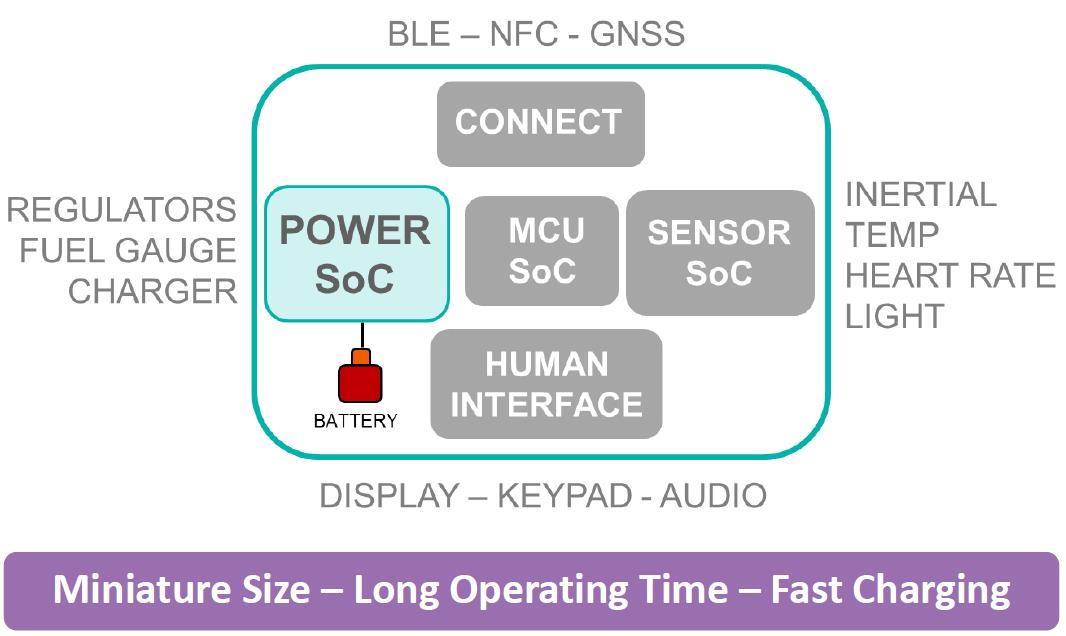
▲Wearable device block diagram.
Additionally, the MAX32600MBED supports faster time to market with convenient design through software, tools, infrastructure, and support community, and provides integrated security with an onboard Trust Protection Unit (TPU). It preserves static random access memory (SRAM) data with low power consumption of 175µA/MHz in active mode and 1.5µA in standby mode.
“Maxim is providing core solutions for wearable devices in Korea, including power SoCs, MCU SoCs, and bio sensors,” said Kim Hyun-sik, president of Maxim Integrated Korea. “We are currently working on projects in the sports and fitness fields, including smartwatches, earplugs, golf, fitness bands, and smart shirts, as well as the healthcare and beauty fields, including skincare, carbon dioxide monitors, and wearable pulse meters.”
Additionally, Damian Anzaldo, Chief Technology Officer, who visited Korea for the product announcement, said, “Wearable devices are spreading widely in health, social, mental wellness, exercise and fitness, etc. Accordingly, wearable devices require more memory, more sensors, and stronger security. Maxim will continue to build a cooperative ecosystem with SoCs that apply low-power methodologies and multi-layer security technology.”
Comments
Related news

Maxim Integrated Unveils Next-Generation Healthcare Wearable Technology
2014.12.04by 명세환 기자
.jpg)

Maxim Integrated Leads the Sports Wearable SoC Market
Maxim Integrated Products Korea (Representative Kim Hyun-sik) announced its participation in the 'International System-on-Chip Design Conference (ISOCC) 2015' to be held in Gyeongju, Gyeongbuk from November 2nd to 5th. The ISOCC 2015 event is co-sponsored by the Circuits and Systems Society (IEEE-CAS) of the Institute of Electrical and Electronics Engineers.
2015.11.02by 신윤오 기자

ESP32 Development Environment Selection and GPS Application Implementation
The ESP32 is a microcontroller that integrates Wi-Fi, Bluetooth, 12-bit ADC, capacitive touch, PWM, DAC, and UART in a single SoC. However, the abundance of features does not by itself solve the designer's problems. The real challenges lie in selecting the appropriate development environment, determining which pins can be used and which must be avoided, and converting raw data from modules into usable information. This document addresses ESP32 peripheral constraints (ADC2 and Wi-Fi coexistence limitation, UART1 occupancy, ADC non-linear regions), the trade-offs between Arduino IDE and ESP-IDF, and the process from connecting NEO-6M/NEO-M8N GPS modules to UART2, parsing NMEA sentences, and visualizing routes in Google Earth, all organized based on documented references.
2026.10.12by 편집부
MIPI CSI-2, DSI-2, C-PHY, D-PHY Test Solution Technical White Paper
The MIPI interface adopts a burst mode that transitions between low-power (LP) and high-speed (HS) states for low-power consumption, and in return, strict timing rules are imposed on state transitions. Additionally, the high-speed section operates as a packet-based protocol with headers, ECC, and CRC, so verification engineers must handle waveforms and protocols simultaneously. Traditional configurations combining general-purpose oscilloscopes and AWGs reveal limitations in setup complexity, measurement uncertainty, and lack of reproducibility when faced with these requirements. This white paper, based on webinar materials, organizes the structure of this problem and describes how the SV5C-DPTXCPTX generator for receiver testing and SV5C-DPRXCPRX analyzer for transmitter testing integrate state transition testing, stressed eye testing, and protocol analysis into a single bench, along with their application boundaries.
2026.10.12by 편집부











