


u-blox Selects ARM mbed Platform for IoT Wireless Applications
 Published2015.11.19 13:35
u-blox announced that it has selected the ARM mbed IoT device platform for customers developing Internet of Things (IoT) wireless applications.
Developers can quickly and easily develop and use wireless IoT apps by adopting the open ARM mbed environment and the u-blox ODIN-W2 module.
As initially intended for the ODIN-W2 Wi-Fi/Bluetooth module, developers have access to the ARM Cortex M4-based microcontroller housed within the module, leveraging the ARM mbed development environment, tools, and libraries. This means that the module's microprocessor can be used to implement sensor- and actuator-based IoT designs without the need for an external host CPU.
Developers can significantly reduce costs and development resources, while minimizing product board size. Furthermore, the open standards approach ensures IoT connectivity and restricts access to the communication stack, maintaining pre-certified type approval.
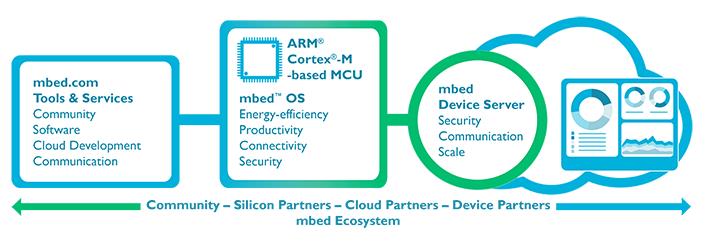
▲ARM mbed IoT Device Platform
“It’s a great idea for u-blox to provide IoT developers with access to the ARM processor that powers the ODIN-W2 multiradio module,” said Coby Sella, vice president of the IoT business unit at ARM. “Being able to design on top of pre-certified wireless modules accelerates the development process and significantly reduces costs,” he said.
The ODIN-W2 module measures 14.8 x 22.3 mm and supports dual-band Wi-Fi and dual-mode Classic and Bluetooth Low Energy (BLE) connectivity, operating simultaneously. It is equipped with core Bluetooth and Wi-Fi stacks, and the Wi-Fi function can operate in either infrastructure (STA) or access point (AP) mode. Peripheral support for connecting sensors and other devices includes SPI, I2C, UART, and CAN, along with GPIO, ADC, and DAC. In addition to supporting multiple communication standards, the mbed development environment offers security features such as secure boot, hardware-enhanced security domains, and SSL/TLS capabilities.
During ARM TechCon, u-blox will demonstrate the ODIN-W2 wireless module, connected via GPIO to an Arduino board that collects various sensor data. An ARM mbed app running on the ODIN-W2 will transmit sensor data via Wi-Fi to the IBM Bluemix cloud-based analytics platform. The data can be used for real-time verification as well as for more sophisticated analysis via a server app developed here.
“By choosing the ARM mbed platform, our customers can benefit from a development platform that provides the libraries and security features they need to build robust IoT applications,” said Mats Andersson, Head of Product Technology, Wi-Fi/Bluetooth at u-blox. “ODIN-W2 enables developers to provide wireless connectivity using Wi-Fi, Bluetooth, and Bluetooth Low Energy without having to develop or integrate the communication stack themselves.”
Comments
Related news

ARM, the winds of acceleration for IoT devices are blowing.
The product lineup unveiled at ARM TechCon 2015 held in California includes 'mbed Device Connector,' a free service that enterprises can use to securely manage and connect IoT devices. It also includes an enhanced 'mbed OS (Technology Preview version)' and a new 'mbed Reference Design.' This reduces hardware design time, allowing companies to focus their capabilities on product differentiation.
2015.11.12by
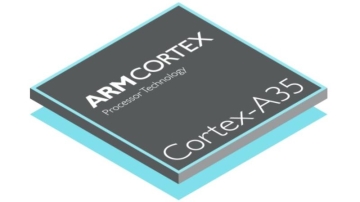
ARM Announces Processor Featuring 64-Bit Mobile Processor
ARM, a British semiconductor intellectual property (IP) design company, has announced the 'ARM® Cortex®-A35 Processor,' the first CPU in its ultra-high-efficiency processor lineup utilizing its architecture. Announced on November 17th, the company states that this product offers the highest efficiency among 64-bit processors, and silicon production of the 'Cortex-A35' is expected to begin with partner companies starting from the end of 2016.
2015.11.17by
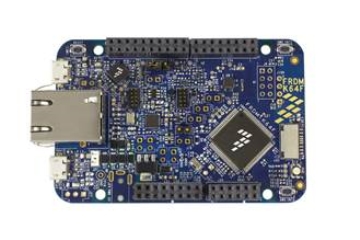
Support for device platform technologies including Freescale and ARM mbed software
The FRDM-K64F board from Freescale Semiconductor works with ARM® mbed™ and supports ARM mbed IoT (Internet of Things) device platform technology, including ARM's latest mbed OS operating system.
2015.11.18by
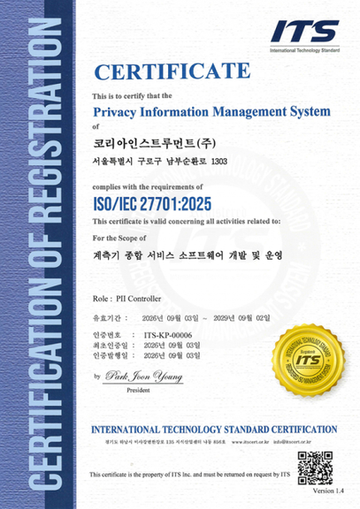
Korea Instrument, KOLAS Accredited Calibration Agency First to Simultaneously Acquire ISO/IEC 27,001·27,701
Korea Instrument has become the first among KOLAS accredited calibration agencies to simultaneously acquire ISO/IEC 27,001 and ISO/IEC 27,701 certifications. Through its proprietary platforms CWIZ Enterprise and CWIZ Partners, the company has embedded information security and personal data protection requirements across all business processes including customer information, equipment data, and calibration reports, with plans to continuously advance its management system through regular audits and security inspections.
2026.10.12by 배종인 기자

TeamViewer One, IT Incident Automation Workflow and Resolution Center Enhanced
TeamViewer has added IT incident automation capabilities and an advanced Resolution Center to its integrated digital workplace management platform 'TeamViewer ONE'. Recurrent service disruptions, configuration errors, and capacity shortages are automatically handled according to preset policies, and device status verification through script deployment can be managed in a unified interface, significantly reducing repetitive tasks for IT teams.
2026.10.12by 배종인 기자











