



[International Issue] 3D-Printed Antimicrobial Products That Block Bacterial Formation at the Source, and More
 Published2015.11.23 18:23
3D printed antimicrobial product that completely blocks bacterial film formation
ScienceDaily reported that materials scientist Andreas Hermann, dental orthodontist Yijin Ren, and their colleagues have developed a 3D printed substrate that kills bacteria upon contact .
The first application will be in the field of dental treatment, but this could also lead to applications in other implant fields. In dental treatment, it is standard practice to use materials that harden by undergoing a polymerization reaction when exposed to ultraviolet light. Andrea Herman added a substance known as a quaternary ammonium ion to a commonly used monomer. These positively charged molecules interact with the negatively charged cell membrane of bacteria and kill them by creating holes in it.
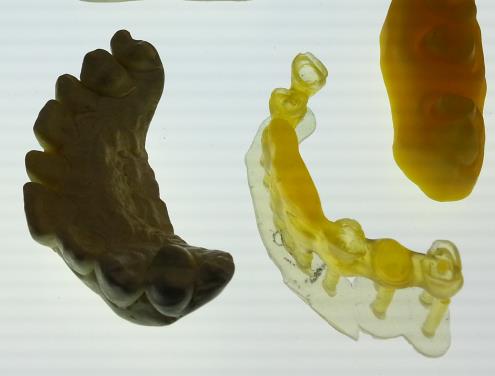
▲ Example of a 3D-printed tooth (unrelated to the article)
Using such antimicrobial products can solve major problems in the field of dentistry. “All artificial objects in the mouth can become habitats for bacteria,” explains Andrea Herman. The resulting dental costs amount to billions of dollars annually in the United States alone.
The challenge is to enable 3D printing through the right mixing ratio while minimizing antimicrobial leakage. “This is because the antimicrobial agent must not flow into the intestines through the mouth and kill the beneficial microorganisms in the digestive system,” explains Andrea Herman. Andrea Herman tested the printed objects with saliva. After about two and a half years of research, they eventually succeeded.
He says that while all the components of these 3D antimicrobial products are already used in the human body, further testing is needed before they can be released. The field of orthodontics, where 3D-printed retainers and aligners are already in use, is expected to be the first application area. A more long-term option could be 3D-printed dental crowns with antimicrobial properties.
Overseas Issue 2
Achieve perfect security features with unreplicable nano-scale 'fingerprints'
As the realization of autonomous vehicles approaches, concerns are growing regarding the devastating consequences that could result if they communicate with fake servers. One solution to this problem has recently been introduced. The BBC reported that British scientists have developed an atomic-level 'fingerprint' technology capable of enhancing the security of internet-connected devices.
The idea of ultra-small "identification tags" using such "fingerprints" stemmed from the phenomenon where inherent imperfections appear in nanoscale structures. Researchers at the universities of Lancaster and Manchester in the UK created ultra-small, layered metal structures in the laboratory, ensuring that each had a unique "design flaw." They then scaled these systems down as small as possible. These 'fingerprints' are virtually impossible to replicate unless measured at the atomic level.
The purpose of this technology is to make identity forgery of internet-connected devices impossible. Since small defects created in the components of materials are impossible to replicate, they can be used as the foundation for a robust system for hardware and software authentication.
Overseas Issue 2
Quantum dot image sensor threatening CMOS image sensors
Startup InVisage Technologies is preparing to ship its first quantum dot image sensor. The company hopes that this product will be able to replace currently widely used silicon-based CMOS sensors, CNET reported.
What differentiates this company's QuantumFilm from typical CMOS sensors is the capture process and characteristics of quantum dots. The photosensitive layer of existing silicon-based sensors consists of "pots" that hold electrons generated when photons strike the silicon layer.
In contrast, InVisage's QuantumFilm replaces these tubes with liquid nanoparticles (so-called quantum dots), which float within the substrate just as silver chloride particles in the film float within gelatin.
When a photon strikes a quantum dot, one electron and one positively charged hole are ejected. These positive and negative charges flow through the Quantum Film to the electrodes that cover it like a sandwich. Then, just as in the case of a silicon sensor, they flow to an analog-to-digital converter.
This technology brings about several significant performance improvements, one of which is the potential to eliminate rolling shutter. This is because, unlike other sensors that read image data line by line, quantum dot sensors send the entire frame of image data at once. Shaking is one of the most unsightly issues in phone videos.
InVisage's first QuantumFilm product is the Quantum 13, which features a 13-megapixel resolution. This sensor, equipped with 1.1-micron pixels, is housed in a module measuring 8.5 square millimeters in width and 4 millimeters in thickness. The Quantum 13 is expected to be available for shipment to phone manufacturers around the end of this year.
Comments
Related news
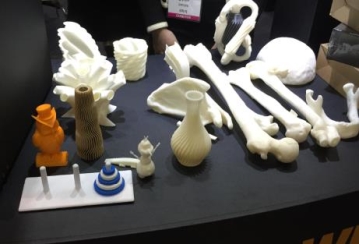
After trying to make it myself with 3D printing, now consumers are designers
The Korea Electronics Show (KES) being held at KINTEX features continuous product introductions from various IT companies and industry outlook seminars. Among these, the 3D printing sector is providing separate 3D experience exhibitions and seminar spaces, thereby enhancing visitor understanding and participation.
2015.10.15by
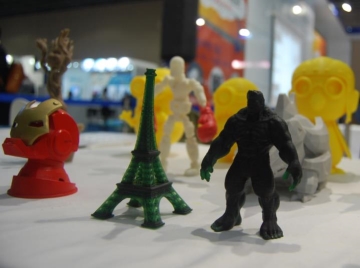
Urgent Review of 3D Printing Market: “Educational FDM Market is Saturated”
The industrial sector that actually uses 3D printing extensively is mockup work for automotive parts. However, Korea's current educational equipment market using FDM-type printers is in a saturated state.
2015.11.10by
3D Developer Participates in China 3D Printing Shenzhen 2015
3Developer, a 3D printer and material import supplier under Mirae Trading, announced that it will participate in 3D Printing Shenzhen 2015, which will be held in Shenzhen, China from November 25th (Wednesday) to 27th (Friday) for three days, and will showcase 3D printer filament Colorfabb and 3D printing samples as the Asia distributor.
2015.11.23by 신윤오 기자

ESP32 Development Environment Selection and GPS Application Implementation
The ESP32 is a microcontroller that integrates Wi-Fi, Bluetooth, 12-bit ADC, capacitive touch, PWM, DAC, and UART in a single SoC. However, the abundance of features does not by itself solve the designer's problems. The real challenges lie in selecting the appropriate development environment, determining which pins can be used and which must be avoided, and converting raw data from modules into usable information. This document addresses ESP32 peripheral constraints (ADC2 and Wi-Fi coexistence limitation, UART1 occupancy, ADC non-linear regions), the trade-offs between Arduino IDE and ESP-IDF, and the process from connecting NEO-6M/NEO-M8N GPS modules to UART2, parsing NMEA sentences, and visualizing routes in Google Earth, all organized based on documented references.
2026.10.12by 편집부

MIPI CSI-2, DSI-2, C-PHY, D-PHY Test Solution Technical White Paper
The MIPI interface adopts a burst mode that transitions between low-power (LP) and high-speed (HS) states for low-power consumption, and in return, strict timing rules are imposed on state transitions. Additionally, the high-speed section operates as a packet-based protocol with headers, ECC, and CRC, so verification engineers must handle waveforms and protocols simultaneously. Traditional configurations combining general-purpose oscilloscopes and AWGs reveal limitations in setup complexity, measurement uncertainty, and lack of reproducibility when faced with these requirements. This white paper, based on webinar materials, organizes the structure of this problem and describes how the SV5C-DPTXCPTX generator for receiver testing and SV5C-DPRXCPRX analyzer for transmitter testing integrate state transition testing, stressed eye testing, and protocol analysis into a single bench, along with their application boundaries.
2026.10.12by 편집부











