


Cisco Survey: Asia-Pacific Manufacturing Industry in a Dilemma
 Published2015.11.26 18:06
Cisco announced research results suggesting that changes in business models based on digitalization strategies are necessary for the mid-to-long-term growth of the manufacturing industry.
Through this survey, Cisco emphasized that the manufacturing industry must shift from a 'product-centric business model,' which involves simply producing good products, to a 'service-centric business model' based on digitalization strategies to respond to disruptive innovation and numerous forms of market threats. However, the study revealed that in reality, the industry faces a 'Service Dilemma,' where there is a significant gap between the scale of business opportunities that can be secured by adopting a service-centric business model and the capability to actually seize those opportunities.
In addition, Cisco projected that if manufacturing companies with an average revenue of $20 billion implement digitalization, profits will increase by 12.8% within the next three years and 19% within ten years.
40% of Leading Companies to Be Weeded Out Within 5 Years... Corporate Innovation Through Digitalization Needed
According to the 'Digital Vortex' report surveyed by the Digital Business Transformation (DBT) Center, 40% of existing leading companies in each industry will be eliminated from the industry within the next five years, emphasizing the need for corporate innovation through digitalization.
Furthermore, by industry sector, digitalization is progressing rapidly in IT, media/entertainment, telecommunications, and finance, whereas it appears to be slow in the pharmaceutical, energy, manufacturing, and public service (utility) sectors. In response, Cisco stated that while the potential value of digitalization worldwide is projected to reach $19 trillion, the value of digitalization in the manufacturing sector is expected to reach $6.3 trillion, emphasizing the urgent need for digital transformation in the manufacturing industry.
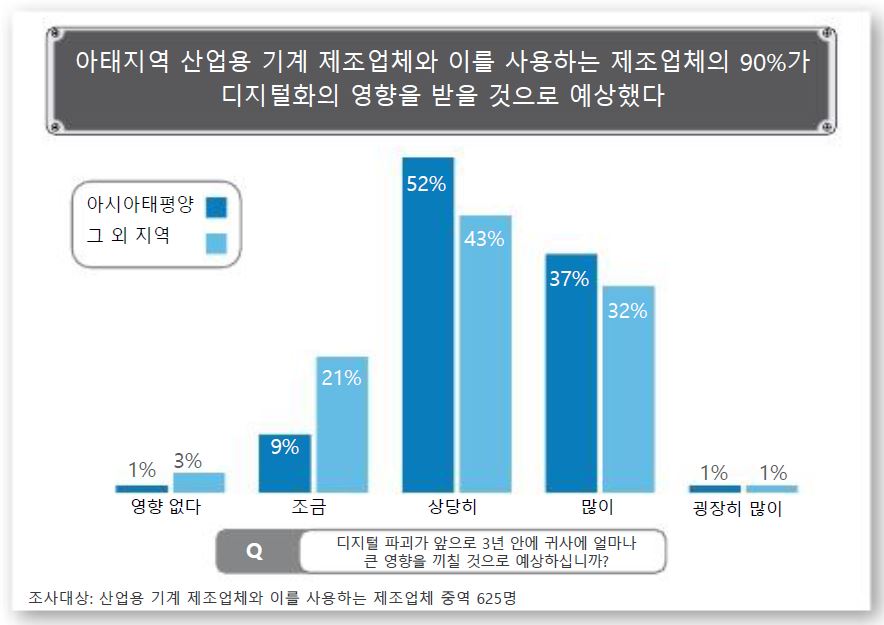
86% recognize that service-oriented business is important for growth, but a dilemma exists.
Cisco conducted a survey titled 'The Digital Manufacturer: Resolving the Service Dilemma' on the impact of digitalization on manufacturing, targeting 625 decision-makers in the manufacturing sector across 13 countries worldwide.
Analysis results showed that 86% of global respondents identified a 'service-centric business model' incorporating digitalization as a core element of their growth strategy, and 44% stated they plan to transition to this model. However, when looking at actual growth rates, only 29% of companies worldwide responded that they expect the service business sector to grow faster than the product sector, indicating that they are facing a 'Service Dilemma' where a gap exists between goals and reality. The complexity of having to manage both products and services, and a lack of digital capabilities were identified as the causes of the service dilemma.
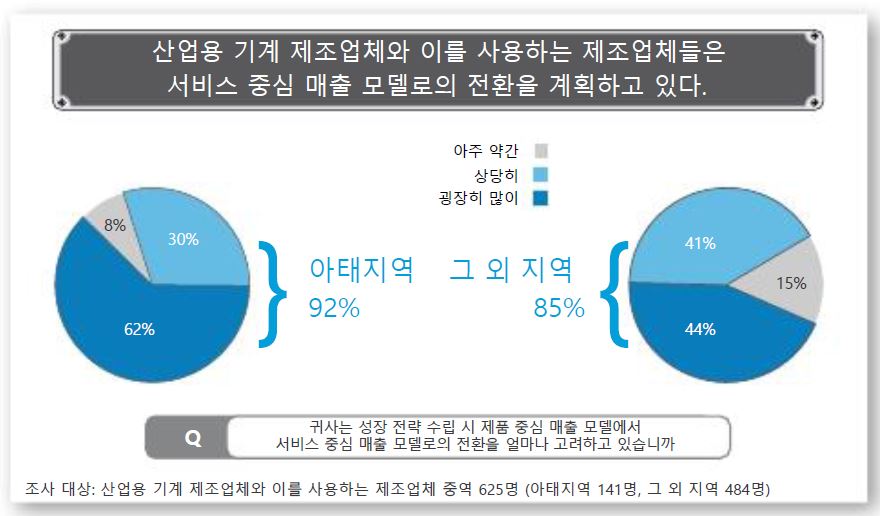
In contrast, awareness of digitalization in the Asia-Pacific region was found to be significantly higher than in other regions across all categories. More than 90% of respondents in the Asia-Pacific region recognized the need for change due to digitalization, and 62% of companies responded that they plan to transition to a 'service-oriented business model,' which was very high.
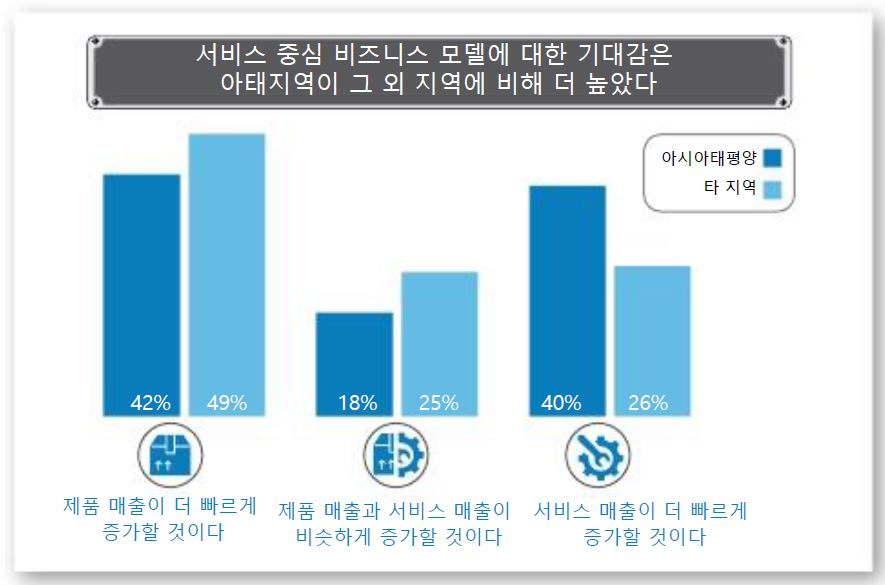
The percentage of Asia-Pacific companies that responded that a 'service-oriented business model' would help with growth compared to a 'product-oriented business model' also reached 40%, which was significantly higher than that of the Americas (28%) and Europe (20%). However, the intent behind establishing 'service-oriented business models' by Asia-Pacific manufacturers appeared to be limited to developing relationships with existing customers rather than developing and expanding new growth opportunities.
Cloud, IoT, M2M, and analytics identified as core digital technologies.
To resolve the service dilemma, a transition to digital business is necessary, and to this end, manufacturing companies must actively utilize digital technologies and transform their organizations.
Manufacturing companies around the world participating in the survey identified cloud (37%), the Internet of Things and M2M (33%), and analytics (32%) as the digital technologies that will have the greatest impact on production over the next three years, while the proportion of technologies directly connected to production, such as robotics and 3D printing, was relatively small. For companies in the Asia-Pacific region, 43%, 43%, and 37% responded in the order of analytics, IoT and M2M, and cloud, respectively, suggesting that the importance of digital technology is being emphasized more for manufacturers in the Asia-Pacific region compared to other regions.
Regarding connected machines, or Internet of Things industrial devices, 56% of companies surveyed worldwide responded that they plan to adopt connected machines, and 33% stated that they are already using connected machines for internal factory monitoring.
Only 6% of companies worldwide stated they had no plans to adopt connected machines. Additionally, among global respondents, 48% answered that they were "very interested" in Machine-as-a-service (MaaS), 36% answered that they were "considerably interested," and 4% of the surveyed companies were found to be already experimentally implementing a MaaS approach.
Ross Fowler, President of Digital Transformation & IoE Acceleration for Cisco Asia Pacific, stated, “Through digitalization, manufacturers will gain the benefits of increased agility, efficiency, and insights necessary to conceive unique new businesses, thereby creating limitless opportunities.” He added, “To seize such opportunities, it is necessary to move away from short-term planning, establish corporate strategies from a long-term perspective, and transition to a ‘service-centric business model.’”

Comments
Related news

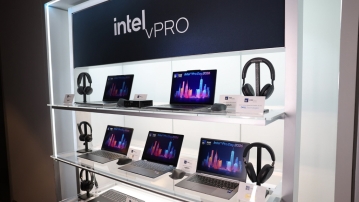
Intel Unveils Next-Generation 'Core Ultra Series 3' and vPro Platform for Enterprise PCs
Intel has officially unveiled the "Intel Core Ultra Series 3" for next-generation enterprise PCs and the latest vPro platform, addressing a wide range of demands from enterprise notebooks to high-performance workstations.
2026.03.26by 배종인 기자
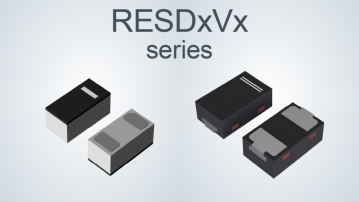
ROHM Launches ESD Protection Diode Compatible with High-Speed Interfaces of 10Gbps or Higher
Semiconductor specialist ROHM has developed the 'RESDxVx series' of ESD (electrostatic discharge) protection diodes capable of responding to next-generation high-speed data communication environments exceeding 10Gbps, simultaneously enhancing both signal quality maintenance required in high-speed interfaces and IC protection performance.
2026.03.26by 배종인 기자
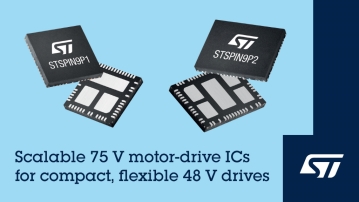
ST Launches 75V Drive IC Targeting 48V Industrial Motor Driving
ST Microelectronics has unveiled the 'STSPIN9P' series of 75V motor drive ICs tailored for 48V-class industrial drive system design. The new product family is characterized by half-bridge and full-bridge configurations that enable design scalability according to motor type and output conditions. Power supply circuits, protection functions, and current sensing circuits are integrated on-chip to simplify system configuration, and the devices are designed to support applications up to 500W maximum. The company plans to provide reference designs and demo boards to support development and evaluation in industrial automation, robotics, pumps, fans, lighting, and textile machinery.
2026.03.26by 배종인 기자

Nordic supports security updates for the entire lifecycle of IoT devices at a single fixed cost
Nordic Semiconductor, a global leader in low-power wireless connectivity solutions, has unveiled a single fixed-cost licensing model that delivers FOTA (Firmware Over-the-Air) and device management capabilities throughout the device lifecycle via nRF Cloud, and introduced a new firmware update solution to prepare for the enforcement of the European Union's Cyber Resilience Act (CRA).
2026.03.26by 배종인 기자











