



Infineon's security chip adopted in Lenovo smartphones
 Published2015.12.03 10:50
Infineon supplies embedded Secure Elements (eSE) to Lenovo's latest smartphones for secure mobile transactions using NFC technology.
Infineon's security controller is used in the Lenovo Vibe P1 and X3. This security chip serves as a protection mechanism for mobile devices, thereby ensuring the secure transmission of sensitive payment information, such as during contactless payments or mobile ticketing for public transportation.
Dr. Stefan Hofschen, President of Infineon’s Chip Card and Security division, said, “I am pleased that Lenovo, one of the world’s top five smartphone makers with a strong presence, especially in China, has adopted Infineon products.”
“Mobile payments are growing at a rapid pace, and Infineon provides trusted security solutions. By securely storing sensitive information such as users’ banking data or biometric data, we enhance the reliability of new features like fingerprint authentication and cloud services. This allows us to improve user convenience without compromising security. At the same time, we help customers minimize design-in work and shorten product launch times,” he said.
Infineon’s SLE 97 eSE, supplied by Lenovo, meets internationally recognized security standards and has obtained Common Criteria EAL5+ (high) and EMVCo (Europay International, MasterCard, VISA) certifications. The EMVCo standard enables the seamless implementation of global interoperability and secure payment transactions.
Embedded security chips are establishing themselves as a mainstream security solution for NFC (Near Field Communication) applications. According to IHS (2015 NFC Report), the number of smartphones equipped with embedded NFC security devices is projected to increase from 420 million in 2015 to 1.6 billion in 2020, with the growth drivers being primarily mobile payment, transportation, and ticketing applications.
Comments
Related news
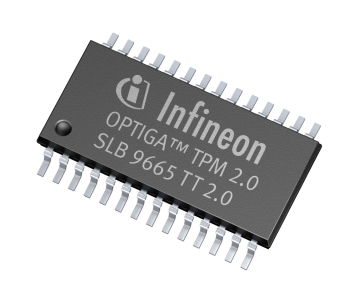
Infineon Certifies Security Solutions for the Growing IoT Market
Infineon can now protect data, devices, and networks in IoT applications through certified security solutions. This is because Infineon's OPTIGA™ TPM (Trusted Platform Module), which is based on the latest TPM 2.0 standard, has obtained recognized computer security certification.
2015.10.19by
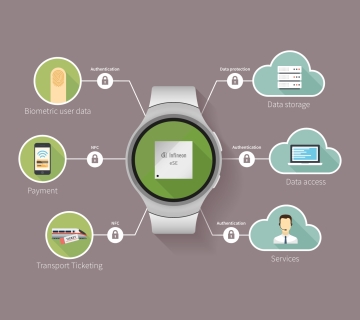
Infineon Supports Secure NFC Payments on Samsung Gear S2 Smartwatch
The new Samsung Gear S2 smartwatch enhances user convenience and mobility by enabling payment at coffee shops with a simple wrist gesture and allowing email viewing through scrolling via the rotating circular bezel.
2015.11.30by

Intel Unveils Next-Generation 'Core Ultra Series 3' and vPro Platform for Enterprise PCs
Intel has officially unveiled the "Intel Core Ultra Series 3" for next-generation enterprise PCs and the latest vPro platform, addressing a wide range of demands from enterprise notebooks to high-performance workstations.
2026.03.26by 배종인 기자

ROHM Launches ESD Protection Diode Compatible with High-Speed Interfaces of 10Gbps or Higher
Semiconductor specialist ROHM has developed the 'RESDxVx series' of ESD (electrostatic discharge) protection diodes capable of responding to next-generation high-speed data communication environments exceeding 10Gbps, simultaneously enhancing both signal quality maintenance required in high-speed interfaces and IC protection performance.
2026.03.26by 배종인 기자
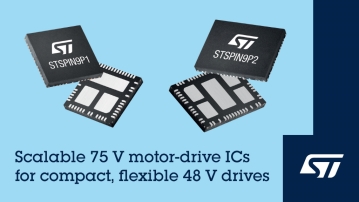
ST Launches 75V Drive IC Targeting 48V Industrial Motor Driving
ST Microelectronics has unveiled the 'STSPIN9P' series of 75V motor drive ICs tailored for 48V-class industrial drive system design. The new product family is characterized by half-bridge and full-bridge configurations that enable design scalability according to motor type and output conditions. Power supply circuits, protection functions, and current sensing circuits are integrated on-chip to simplify system configuration, and the devices are designed to support applications up to 500W maximum. The company plans to provide reference designs and demo boards to support development and evaluation in industrial automation, robotics, pumps, fans, lighting, and textile machinery.
2026.03.26by 배종인 기자











