



Development of 360-degree color hologram display, a step forward in virtual reality technology
 Published2015.12.03 18:49
3-inch hologram implementation, large-scale and real-time transmission research in 2021 through Giga Korea
A domestic research team has developed the world's first display capable of viewing 3-inch 3D color holograms from all 360 degrees.
ETRI (Electronics and Telecommunications Research Institute, President Heung-Nam Kim) announced that it has developed the first holographic stereoscopic imaging technology capable of viewing 3D full-stereoscopic holograms.
The tabletop holographic display developed by ETRI is one of the intermediate results of the technology being developed through the Giga Korea project, and is a technology that can reproduce color holographic images in all 360 degrees on a table display.
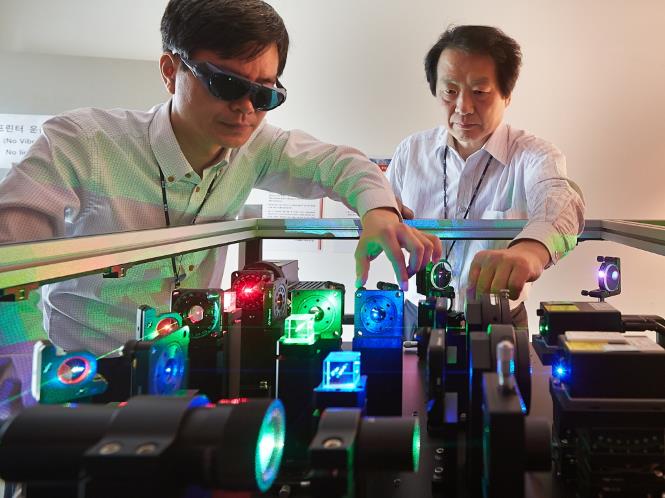 Holography is a technology that implements perfect 3D stereoscopic images. Research has been conducted worldwide to digitalize it to implement perfect 3D stereoscopic videos, but it is a technology that has not yet been commercialized due to technological limitations.
Researchers at the world's leading research groups, such as the Massachusetts Institute of Technology (MIT) in the United States and the National Institute of Information and Communications Technology (NICT) in Japan, have also succeeded in demonstrating holograms that can be observed only at a limited viewing angle of about 20 degrees.
The technology developed by ETRI this time is significant in that it is a true hologram reproduction technology that utilizes the phenomenon of light diffraction, rather than a pseudo-hologram in the form of an optical illusion used in hologram performances, etc.
A pseudo-hologram is an image projected through a screen floating in the air. It is a technology that uses 2D images to create 3D effects, but it cannot provide 3D stereoscopic images that look different depending on the angle.
On the other hand, the digital holographic display developed by ETRI reproduces a complete three-dimensional stereoscopic image that allows viewing of different aspects of the image depending on the viewing point by utilizing diffraction and interference of light.
The tabletop color holographic display implemented by the actual research team implements 3D objects with various colors from 360 degrees of different viewpoints. In particular, in the case of the digital holographic display studied previously, it was developed in a form that could be observed only from very limited angles, making it difficult to recognize 3D stereoscopic images.
However, in the case of the tabletop holographic display developed by ETRI, it is very significant that it was developed to enable viewing of object images as color holograms simultaneously from all 360 degrees.
This research was developed through the "Development of Digital Holographic Tabletop Terminal Technology" project of the Giga Korea project that began in 2013, and 16 joint research institutes including Kyungpook National University and Korea University participated in the development. The technology developed by ETRI was exhibited to the public at the 2015 Creative Economy Expo held for four days from the 26th of last month, and received a great response.
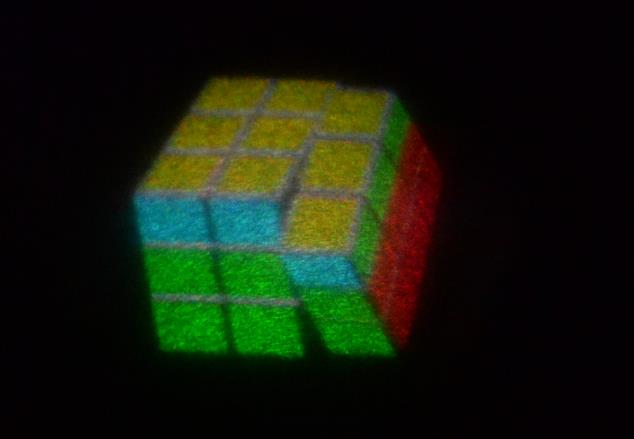
ETRI also attracted the attention of visitors by exhibiting color holographic display technology using mobile LCD panels at the exhibition. ETRI's head of the Broadcasting and Communications Media Research Institute, Kim Jin-woong, who is in charge of research and development, said, "Tabletop holographic display technology is a new attempt to overcome the technical limitations of existing methods, and its success opens up possibilities for future holographic broadcasting and virtual reality.""We have made significant technological progress," he said.
The research team plans to implement and commercialize this technology by 2021. They plan to develop technologies to improve image quality, enlarge image size, and miniaturize the system over the course of about five years, and to develop technologies to transmit and receive holograms of real-life images through a 5G network.

Comments
Related news
The future of virtual reality (VR) is quickly becoming the present.
Anderson's CTO stated, "Our focus areas include industry, education, and entertainment, and last year we particularly concentrated on the education sector," adding, "By utilizing our VR prototype solutions in actual industrial sites, we have achieved dramatic improvements in safety and accuracy, resulting in cost reduction effects, and the learning effectiveness demonstrated in educational settings shows a retention rate of over 80% compared to traditional education methods."
2015.09.09by 신윤오 기자
Samsung Electronics Launches Affordable 'Gear VR' Compatible with Latest Galaxy Phones
Samsung Electronics has launched the Gear VR, a reasonably priced virtual reality headset that is compatible with a variety of its latest Galaxy smartphones. The newly launched Gear VR is compatible with the Galaxy Note5, Galaxy S6 Edge+, Galaxy S6, and Galaxy S6 Edge.
2015.11.24by 명세환 기자

Intel Unveils Next-Generation 'Core Ultra Series 3' and vPro Platform for Enterprise PCs
Intel has officially unveiled the "Intel Core Ultra Series 3" for next-generation enterprise PCs and the latest vPro platform, addressing a wide range of demands from enterprise notebooks to high-performance workstations.
2026.03.26by 배종인 기자

ROHM Launches ESD Protection Diode Compatible with High-Speed Interfaces of 10Gbps or Higher
Semiconductor specialist ROHM has developed the 'RESDxVx series' of ESD (electrostatic discharge) protection diodes capable of responding to next-generation high-speed data communication environments exceeding 10Gbps, simultaneously enhancing both signal quality maintenance required in high-speed interfaces and IC protection performance.
2026.03.26by 배종인 기자
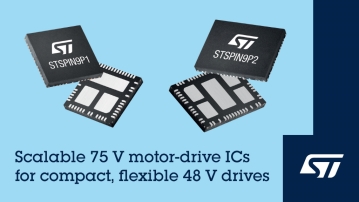
ST Launches 75V Drive IC Targeting 48V Industrial Motor Driving
ST Microelectronics has unveiled the 'STSPIN9P' series of 75V motor drive ICs tailored for 48V-class industrial drive system design. The new product family is characterized by half-bridge and full-bridge configurations that enable design scalability according to motor type and output conditions. Power supply circuits, protection functions, and current sensing circuits are integrated on-chip to simplify system configuration, and the devices are designed to support applications up to 500W maximum. The company plans to provide reference designs and demo boards to support development and evaluation in industrial automation, robotics, pumps, fans, lighting, and textile machinery.
2026.03.26by 배종인 기자











