



Intel Focuses on Building Ecosystem to Form 5G Network Foundation
 Published2015.12.03 19:49
Xeon Processor D-1500, Ethernet Multi-Host Controller FM10000 Expansion
In response to the question of what Intel is doing in the cloud field, an Intel official said, “We are working to create an environment where computing resources can be used more easily.”
This aligns with the background of Intel's recent announcement that it will lead the rapid transition to cloud-ready communications networks, while unveiling its new Xeon D processor family and collaborations with major companies.
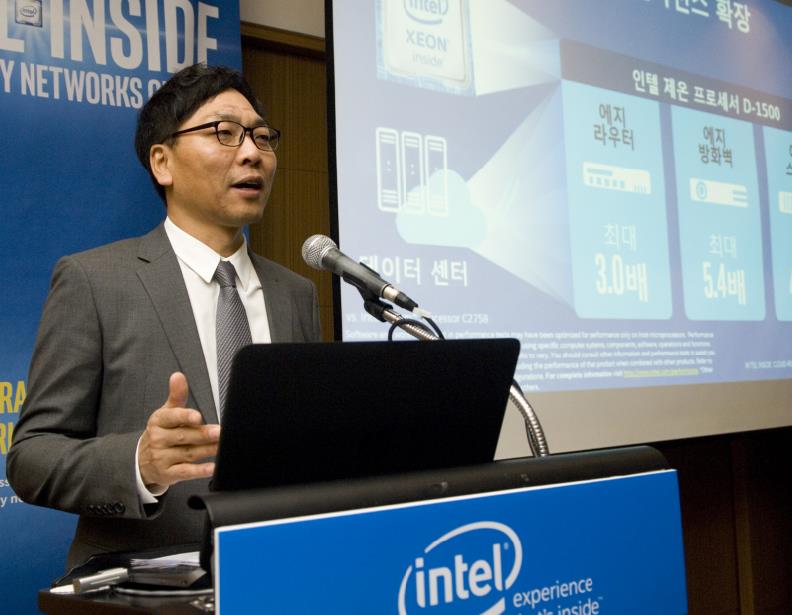 Cloud-based communication networks are expected to not only effectively handle the demands currently emerging in the telecommunications industry and the cloud and data center service sectors, but also enable future devices and services. The transition to cloud-based networks is made possible by applying server, cloud, storage, and virtualization technologies, and by building greater intelligence across the entire network.
In this regard, Intel has launched three new product families that enhance network edge performance, network intelligence, and bandwidth to build more flexible and responsive networks. Intel stated that this product family, which includes the Intel Xeon D-1500 processor, provides flexibility, agility, and scalability for a successful transition to cloud-based networks, while improving cost and operational efficiency.
Use cases for the Intel Xeon D-1500 processor family are also emerging one after another. In networking use cases, the Intel Xeon D-1500 family provides 5.4 times better performance than the Intel Atom C2000 processor for Internet Protocol Security (IPsec). This processor features performance advantages combining large memory capacity, low power consumption, and embedded hardware-assisted virtualization technology.
For storage use cases, the Intel Xeon D-1500 family of processors provides a wide range of options for data center optimization by applying the enhanced performance and intelligence of Intel Xeon processors to a high-density, low-power SoC form factor. For IoT use cases, the Intel Xeon D-1500 family of processors is optimized for industrial, military, and aerospace applications that require high-density, high-performance system designs with strong thermal tolerance.
Intel is strengthening its collaboration with the ecosystem for the transition to cloud-based networks. Intel is working closely with industry leaders such as Cisco, Ericsson, SK Telecom, and Verizon to enable more flexible and responsive networks and to lay the foundation for 5G networks. This collaboration includes providing cutting-edge technologies and standards-based solutions that enhance network performance and bandwidth.
Red Hat is the first ISV to actively participate in key sectors of the Intel Network Builder Fast Track and has been collaborating with Intel for a long time to commercialize open source technologies and provide standards-based solutions to the telecommunications industry. The two companies are further expanding their collaboration and are also working on optimizations to provide carrier-grade solutions based on Red Hat software and Intel technology.
Intel also introduced details of its collaboration with SK Telecom regarding 5G. Intel and SK Telecom signed an MoU for joint 5G research and development last July. Based on the MoU, the two companies selected frequency bands likely to be commercialized for 5G and are currently developing 5G prototype terminals and verifying their performance based on those frequencies.
In addition, they plan to jointly research and develop core 5G technologies, such as 'Anchor-Booster Cell,' a data transmission technology using next-generation wireless LAN; 'Massive MIMO,' a multi-antenna technology that significantly improves the transmission and reception capacity of base stations; and '5G Cloud Virtualization Base Station,' which can freely allocate frequencies according to traffic capacity through network virtualization.
'Anchor-Booster Cell' is one of the core technologies of 5G, a technology that enables the seamless transmission of large amounts of data by utilizing 'WiGig,' a next-generation wireless LAN, as a catalyst and auxiliary network in existing 4G networks. This enables high-quality voice calls and ultra-high-speed data transmission simultaneously.
The two companies also plan to apply Mobile Edge Computing technology to anchor-booster cells to improve Quality of Experience (QoE) and develop new business models with enterprises and the industry to advance 5G technology.
Comments
Related news
The most actively applied technology in the software field is cloud computing.
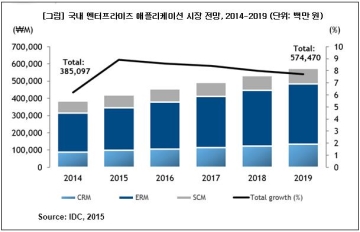
According to a recent report published by Korea IDC (CEO: Hong Yu-sook), a market analysis and consulting firm for the IT industry, titled "Korea Enterprise Application Market Forecast, 2015-2019," the domestic enterprise application market (including ERM, CRM, and SCM) grew 6.2% compared to 2013, reaching a market size of 385 billion won (based on software license standards) last year.
2015.09.30by 신윤오 기자

Has the burden of cloud adoption eased? Average annual growth of 20.8% over the next five years.
According to a recent report published by Korea IDC, an IT market analysis and consulting organization, the domestic cloud professional services market last year recorded a market size of 161.8 billion won, achieving a high growth rate of 20.3% compared to 2013, as the burden of initial cloud adoption stages has decreased.
2015.10.12by 신윤오 기자

60% of all companies are using the cloud in some form.
Citrix (www.citrix.co.kr), a specialist in virtualization and networking, jointly with Korean IDG, a market research organization, has released a report on the current state of cloud usage in Korea, implementation effects, and measures to promote smart work.
2015.12.02by 신윤오 기자
.jpg)
SalePoint Signs Multi-Year Partnership Agreement with AWS… Promoting Identity Security that Integrates Even AI Agents
Sailpoint has entered into a multi-year strategic partnership agreement with AWS and is moving forward with establishing an integrated governance system that manages both human and non-human identities together. The plan is to consistently manage access permissions in an environment where AI agents are increasing as work execution entities, while applying the principle of least privilege and automated policy enforcement. The two companies plan to jointly expand capabilities to manage the identities of various entities, including AI agents, within a single layer in the AWS environment. This collaboration is interpreted as a move to design security and governance together in corporate environments where AI adoption is expanding.
2026.03.26by 배종인 기자
.png)
Databricks Unveils Open AI Security Monitoring 'Lakewatch'
Databricks entered the security market on March 24 by unveiling LakeWatch, an open-source agentic SIEM. The core functionality of this product is to integrate and analyze security, IT, and business data in a single environment to support AI-based threat detection and investigation. The company explained that it reduces the limitations of existing security operations centers, which have had to forgo some data due to high cost structures, and enables large-scale data analysis and automation based on open formats and ecosystems. LakeWatch is currently offered as a private preview, with Adobe and Dropbox mentioned as early customers. Databricks also announced an expanded partnership with Anthropic as well as the acquisition of Antimatter and SiftD.ai.
2026.03.26by 배종인 기자











