



Expansion of educational tablet market, domestic tablet market projected to reach 2 million units this year
 Published2015.12.08 11:11
According to recent research by IDC Korea (CEO Hong Yoo-sook), shipments in the domestic tablet market in 2015 are projected to reach 2,004,000 units, a 35.8% increase compared to 1,476,000 units in the previous year. This represents an increase of approximately 9.2% compared to the forecast at the beginning of the year, and attention is focused on the key factors behind the expansion of the domestic tablet market.
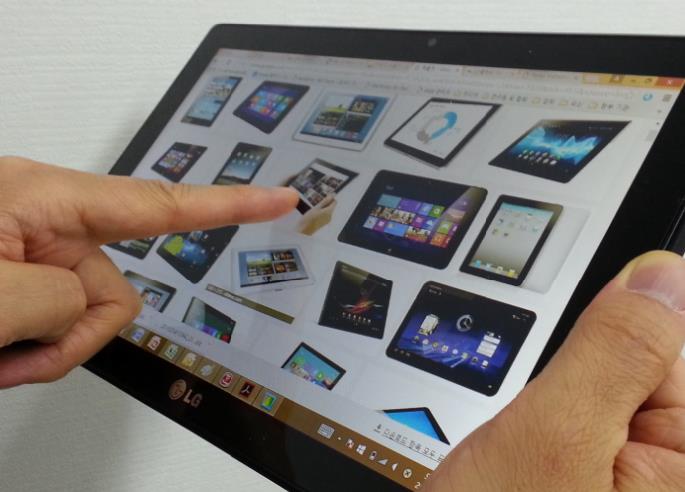
The domestic tablet market, which once experienced negative growth due to a lack of distinct identity between large-screen smartphones and laptops, successfully reversed its trend last year by reviving interest in tablets through a diverse product lineup. This year, the realization of the value that tablets can provide based on use cases specialized for education is identified as the main driver of market growth.
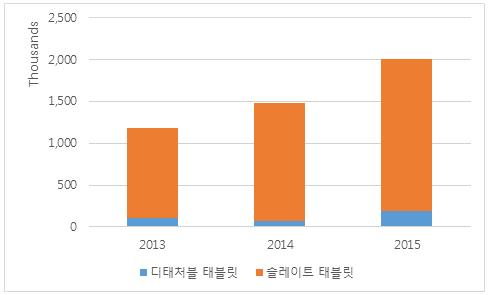
▲ Domestic Slate and Detachable Tablet Shipments, 2015 Forecast (Thousands of Units)
While the global tablet market is expected to decrease by 8.1% this year to 211.3 million units compared to the previous year, the domestic tablet market has seen expanded consumption as the needs of the industry and consumers in the specialized private education market aligned, allowing for a direct experience of utility.
Almost all publishers and educational companies are developing demand for reading content rental programs and efficient online lectures through business models linked with tablets. It appears that the expansion of the market was driven by the discovery of new demand sources for tablets as they replaced paper in reading content—that is, by the resolution of doubts regarding the effectiveness of tablets as learning support devices.
Meanwhile, the overall stagnant consumer market shows no particular need for replacement, and both the global and domestic markets appear to be in a transitional phase. In response to these challenges, the industry is focusing on detachable tablets as a future growth engine for the market. Detachable tablets recently introduced by vendors demonstrate distinct evolution in OS and hardware compared to early models; they are assessed to have reached a stage capable of accommodating both productivity-oriented consumer and business users, and are expected to play a significant role in the future growth of the tablet market.
[Table] Domestic Tablet Shipments, 2013-2015 (thousands)

IDC Korea forecasts that domestic detachable tablets will reach 9.2% of the total market in 2015 and expects this figure to increase further thereafter. Consequently, competition among major platform vendors such as Apple, Google, and Microsoft is expected to be more interesting.
"It is particularly encouraging that the demand for education in the domestic tablet market is driven by the private sector rather than government initiatives like those seen overseas," said Kim Ae-ri, a senior researcher at IDC Korea. "The commercial market is emerging as an alternative to drive the tablet market, which is stagnating due to relatively long replacement cycles and overlap in usability with phablets. It is expected that the potential for commercial use will continue to be explored by discovering use cases in various industries, such as finance, healthcare, logistics, and retail, in addition to the education market."
Comments
Related news
44% of tablet users are considering using other devices
Gartner, Inc., a leading global IT advisory firm, projected that worldwide device shipments (PCs, tablets, ultraportables, and mobile phones) would reach 2.4 billion units in 2015. Contrary to expectations in the previous quarter that shipments would increase by 1.5% compared to the prior year, they actually declined by 1%.
2015.10.01by 신윤오 기자

Lenovo's PC and Windows tablet sales fell 17% year-over-year.
Lenovo announced its Q2 results. Excluding currency fluctuations, it achieved $12.2 billion with 23% growth. However, under Hong Kong Financial Reporting Standards (HKFRS), it recorded a pre-tax loss of $842 million and a net loss of $714 million.
2015.11.13by
Will competition between ultra-slim laptops and tablets with detachable keyboards intensify?
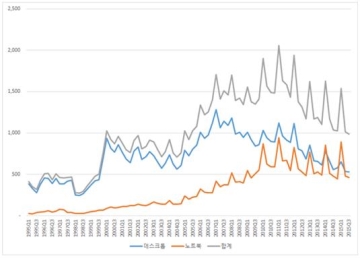
According to a recent domestic PC market survey by Korea IDC, domestic PC shipments in the third quarter of 2015 reached 990,000 units, marking the first time in nearly 10 years since the second quarter of 2005 when 920,000 units were recorded that quarterly shipments fell below 1 million units. Desktop shipments totaled 530,000 units and notebook shipments reached 460,000 units, representing year-over-year declines of 5.4% and 3.7% respectively, while overall PC shipments decreased by 4.6%.
2015.11.18by

ESP32 Development Environment Selection and GPS Application Implementation
The ESP32 is a microcontroller that integrates Wi-Fi, Bluetooth, 12-bit ADC, capacitive touch, PWM, DAC, and UART in a single SoC. However, the abundance of features does not by itself solve the designer's problems. The real challenges lie in selecting the appropriate development environment, determining which pins can be used and which must be avoided, and converting raw data from modules into usable information. This document addresses ESP32 peripheral constraints (ADC2 and Wi-Fi coexistence limitation, UART1 occupancy, ADC non-linear regions), the trade-offs between Arduino IDE and ESP-IDF, and the process from connecting NEO-6M/NEO-M8N GPS modules to UART2, parsing NMEA sentences, and visualizing routes in Google Earth, all organized based on documented references.
2026.10.12by 편집부

MIPI CSI-2, DSI-2, C-PHY, D-PHY Test Solution Technical White Paper
The MIPI interface adopts a burst mode that transitions between low-power (LP) and high-speed (HS) states for low-power consumption, and in return, strict timing rules are imposed on state transitions. Additionally, the high-speed section operates as a packet-based protocol with headers, ECC, and CRC, so verification engineers must handle waveforms and protocols simultaneously. Traditional configurations combining general-purpose oscilloscopes and AWGs reveal limitations in setup complexity, measurement uncertainty, and lack of reproducibility when faced with these requirements. This white paper, based on webinar materials, organizes the structure of this problem and describes how the SV5C-DPTXCPTX generator for receiver testing and SV5C-DPRXCPRX analyzer for transmitter testing integrate state transition testing, stressed eye testing, and protocol analysis into a single bench, along with their application boundaries.
2026.10.12by 편집부











