


The Present and Future of the Wearable Business: Case Studies from Two Companies
 Published2015.12.21 18:17
Urgent need to build wearable device manufacturing infrastructure
Interest in wearable devices, hailed as the next generation of the post-smartphone era, is growing rapidly. The wearable device market, commonly referred to as smart devices worn or attached to the body to input, output, and process information, is projected to grow by an average of 21.5% annually, reaching a market size of $70 billion by 2024.
Smartwatches, which initially felt unfamiliar when they first came out, are now experiencing a shift in perception, from "Why should I buy this? Why do I need this?" to "Having one wouldn't hurt." With growing interest in health, it's not hard to find people purchasing or gifting smartbands.
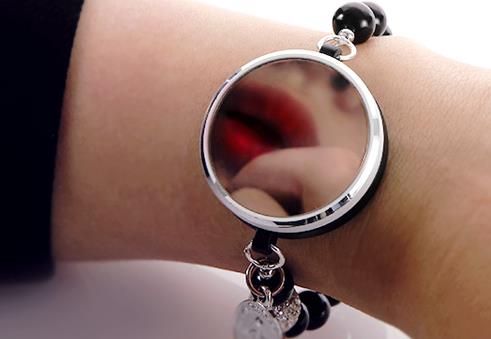 Smartwatches: A Changing Perception of Fashion
Despite this shift in perception, numerous obstacles still exist in the purchase of wearable devices. Consumers are hesitant to purchase due to issues with product design and functionality. This is why many argue that smartwatches need to be positioned clearly as just another smartphone or as a fashion accessory.
Another challenge is improving the industrial structure necessary for the commercialization of wearable devices. For wearable devices, which are created through the convergence of multiple industries, organic cooperation among each industry is essential. When necessary, understanding across completely different industries is necessary, and it is also a question of whether companies in those fields are sufficiently prepared.
Here, we examine the present and future of the wearable device business through the examples of smartwatches and smartwear development companies, which can be said to be representative applications of wearable devices.
Now: Focusing on the Value of Fashion, Jewelry Smartwatches
First, DNX (CEO Eun-kyung Kwon) targeted the current state of the wearables industry with the jewelry smartwatch "RANG." Founded in January by Professor Eun-kyung Kwon of the Department of Visual Design at Kyewon University of Arts and her students, DNX launched the smartwatch in October. The company, which prioritizes "fashionable design" that allows for portability in various forms, recognized that the current problem with smartwatches lies not in technology alone, but in "ideas and design."
“Current technology-centric smartwatches are strongly centered around the concept of a smartphone on the wrist, a smaller version of a smartphone,” said Eun-kyung Kwon, CEO of DNX. “Therefore, from the perspective of jewelry smartwatches, the current design is not keeping up with fashion.” A survey of consumers supports this, showing that the most common problem with smartwatches is design, followed by battery life and price.
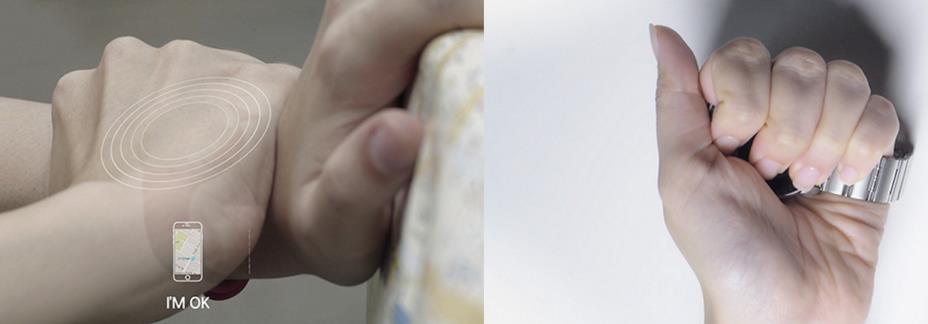
▲ The 'RANG' smartwatch is equipped with a safety feature that allows it to transmit location information just by holding it in your hand.
Accordingly, DNX incorporated the safety of a simple UI that can be operated simply by holding it in your hand, practical functions such as a selfie function and phone finder, and fun features such as simple games, all combined with the fashion element of being able to change accessories at will. Furthermore, the price was differentiated, with the finished watch-shaped product priced at $50-100, and the semi-finished keychain-shaped product priced at $30-40, reducing the burden on the user.
CEO Kwon stated, “RANG is already selling online in several countries around the world, including the US, China, the UK, and Peru. Following IFA 2015, we plan to participate in next year’s MWC exhibition and apply for an award.” He added, “We will now develop our next product to incorporate features for the visually impaired and augmented reality.” The company plans to expand sales by listing its products on Amazon starting in January.
The Future: Will Smartwear and Conductive Fabrics Help Expand Their Use?
In contrast, outdoor company Blackyak recently introduced smartwear, cautiously exploring the future of wearables.
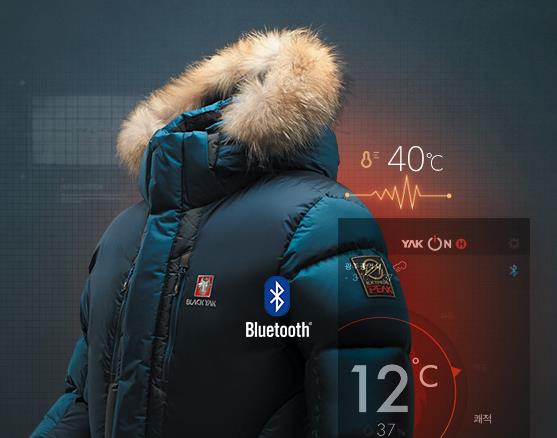
Black Yak announced the launch of the world's first smartwear, the "Yak On H" heated jacket, which can automatically regulate temperature and humidity. This smartwear is an upgrade from the "Yak On P," released in May, which allows users to check various information, such as heart rate, exercise type, goal setting, and exercise distance measurement, all via a smartphone.
 In the clothing and IT industries, you need to understand different unit price concepts.
The YakOnH heated jacket consists of three core systems: a heating fabric, a temperature control device, and a connector connecting the heating element and the device. The company's heating fabric is embedded inside the back panel, and the connector and temperature control device are located inside the garment. A portable, detachable device that controls temperature and humidity connects to a smartphone and automatically charges when attached to the cage.
By connecting YakOn H to a portable device via Bluetooth, you can select desired control functions such as temperature and humidity directly from the smartphone screen. Users can select smart control modes such as energy saving, comfortable, warm, and power according to their preference, and set the desired temperature and humidity values using the jog shuttle on the screen.
This smartwear is able to generate heat (30-40℃) thanks to its fiber-based heat-generating fabric. Black Yak stated that the heat-generating fabric is made of a washable fiber-based material and has an internal graphene coating that blocks electromagnetic waves.
Smart clothing has evolved from a simple attachment in the early 2000s to the embedding of chips and wires within fabrics, and is now being developed into conductive fibers. The types of so-called e-textiles are diverse, with developments underway including stainless steel twisted and spun yarns, copper composite twisted yarns, copper-plated yarns, and silver twisted yarns. These e-textiles are being applied to embroidery, knitting, woven fabrics, conductive bands, and conductive Velcro. In particular, the development of optical fibers capable of communication is actively underway.
However, developing wearable products has faced many challenges to date. In fact, Black Yak's successful launch of smartwear was possible because the project was funded by a government grant. In other words, this isn't something a clothing company can accomplish alone.
“As a clothing company that produces a wide variety of products in small quantities, it is burdensome to include the price of wearable devices in the price of clothing,” said Jo Ha-kyung, a senior manager at Black Yak’s product planning department. “Because the unit prices of clothing and IT companies are different, clothing and devices have to be sold separately, so for now, we are focusing on expanding the base of smartwear.”
Comments
Related news
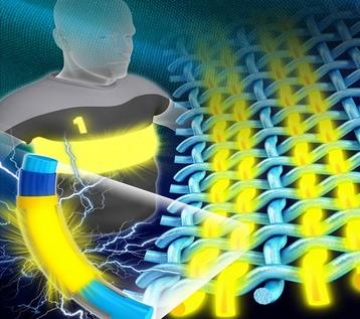
Discovered wearable display technology worn like clothes
This technology is a foundational technology that enables fabrication of organic light-emitting displays directly on fibers themselves. The achievement was recognized and published in the online edition dated July 14 of 'Advanced Electronic Materials,' an international academic journal in the field of nanoelectronics. Conventional wearable displays have been attached on top of clothing to realize aesthetic design, but this approach has limitations in that they are rigid and inflexible, making real-world application difficult, and it is challenging to maintain the inherent characteristics of textiles.
2015.08.05by 명세환 기자
Low-Power, Security-Enhanced MCU Optimized for Wearable Devices Now Available
Maxim Integrated has announced the launch of the MAX32600MBED microcontroller (MCU), which supports the ARM mbed IoT device platform.
2015.11.13by 신윤오 기자
Full-scale fostering of the wearable industry, 127 billion won invested by 2020
The Ministry of Trade, Industry and Energy (Minister Yoon Sang-jik) and the Ministry of Future Creation and Science (Minister Choi Yang-hee) jointly will actively promote the 'Wearable Smart Device Business', a flagship sector of the future growth engine and industrial engine project.
2015.11.27by 신윤오 기자

ESP32 Development Environment Selection and GPS Application Implementation
The ESP32 is a microcontroller that integrates Wi-Fi, Bluetooth, 12-bit ADC, capacitive touch, PWM, DAC, and UART in a single SoC. However, the abundance of features does not by itself solve the designer's problems. The real challenges lie in selecting the appropriate development environment, determining which pins can be used and which must be avoided, and converting raw data from modules into usable information. This document addresses ESP32 peripheral constraints (ADC2 and Wi-Fi coexistence limitation, UART1 occupancy, ADC non-linear regions), the trade-offs between Arduino IDE and ESP-IDF, and the process from connecting NEO-6M/NEO-M8N GPS modules to UART2, parsing NMEA sentences, and visualizing routes in Google Earth, all organized based on documented references.
2026.10.12by 편집부

MIPI CSI-2, DSI-2, C-PHY, D-PHY Test Solution Technical White Paper
The MIPI interface adopts a burst mode that transitions between low-power (LP) and high-speed (HS) states for low-power consumption, and in return, strict timing rules are imposed on state transitions. Additionally, the high-speed section operates as a packet-based protocol with headers, ECC, and CRC, so verification engineers must handle waveforms and protocols simultaneously. Traditional configurations combining general-purpose oscilloscopes and AWGs reveal limitations in setup complexity, measurement uncertainty, and lack of reproducibility when faced with these requirements. This white paper, based on webinar materials, organizes the structure of this problem and describes how the SV5C-DPTXCPTX generator for receiver testing and SV5C-DPRXCPRX analyzer for transmitter testing integrate state transition testing, stressed eye testing, and protocol analysis into a single bench, along with their application boundaries.
2026.10.12by 편집부











