



2016 will be the year IoT becomes visible in actual applications.
 Published2015.12.28 10:18
Business innovation through accelerated adoption of containers, agile security, analytics, IoT, and blockchain
CA Technologies Korea (www.ca.com/kr) announced the top five IT technologies that will drive business innovation in 2016.
CA predicted that the application economy would accelerate in business and IT operations, app development, and data management methods in 2016, and selected five major IT technologies: ▲acceleration of flexible and scalable development through containers ▲full-scale implementation of Agile security ▲emergence of analytics customer experience ▲visualization of the Internet of Things (IoT) into actual applications ▲and the resurgence of blockchain technology.
In today's business environment, where software is at the center, companies can exceed customer expectations through the adoption of agile practices and digital transformation. Whether utilizing containers, agile security, analytics, the Internet of Things, blockchain, or any other technology, it is crucial to find a partner with diverse business experience.
Michael Choi, President of CA Technologies Korea, said, “To stay ahead in today’s fierce competition in the application economy era, companies must drive digital transformation and adopt agile practices to adapt to the changing market.”

1. Accelerating flexible and scalable development through containers
Enterprises can easily simplify current complex software architectures and development processes by utilizing containers and microservices. Container technology shapes the future of software development standards and enables developers to move applications from one system to another more easily and efficiently.
Microservices enable the independent operation of small-scale services and help continuously release new features without having to wait for a new version of the entire application. This technology completely transforms the way applications are developed, built, and upgraded. It is also useful for companies that need to keep pace with the changing market by focusing on agility.
2. Agile Security Takes Off
Security is essential in all aspects of application design, development, and implementation. As development cycles accelerate, security must be considered from the very beginning of the project and development process. Today, the need for security has increased even further amidst numerous security incidents, their economic impact, and growing social concern.
In 2016, all roads will lead to a new idea called 'Agile Security.' In large-scale software development that proceeds at a rapid pace, security must be considered alongside DevOps and Agile practices.
Application Programming Interfaces (APIs), combined with appropriate tools, address security challenges, enhance the impact of agile processes, and further cultivate the trust and confidence that are central to the customer experience. Modern security technologies and development methodologies accelerate the development of innovative applications while maximizing the utilization of sensitive data and assets and protecting them securely.
3. Analytics Emerges as the New Standard for Customer Experience
Over the past few years, analytics has evolved from business intelligence to transactional data and big data. Real-time analytics, which enhances the customer experience by linking predictive insights with prescriptive behavior, will become the new standard. With the rise of the "single-person household," companies must provide a wider variety of services, pricing, sales, and products in a personalized manner. This demands analytical tools and techniques capable of deriving meaningful insights.
Analytics enhances the customer experience based on security that protects customers. New analytics techniques utilize user patterns and machine learning to distinguish between legitimate customers and illegal traders, providing seamless service and a customer experience.
4. Internet of Things (IoT) visualized as actual applications
The Internet of Things (IoT), a component of digital transformation, holds significant potential but remains in its early stages. Analytics and security maximize the value of IoT. The inherent multilayered and hand-off capabilities of IoT create more vulnerabilities and attack points than ever before, increasing the risk of collisions. While IoT is a definite next-generation trend, there is a great deal of complexity behind it.
With the full-scale launch of the Internet of Things in 2016, 'Identity of Things' is expected to become a key topic. Just like user accounts, device accounts and the data within those devices must be authenticated and trusted. Tools such as Identity and Access Management (IAM) and IoT interaction tables that support the Internet of Things are necessary for users to communicate with the correct 'things' and prevent conflicts, denials, and duplication between devices.
5. The Revival of Blockchain Technology
Blockchain technology is making a comeback and will be utilized beyond the realm of Bitcoin transactions. Blockchain, which was a keyword for many startups two years ago, is spreading against the backdrop of the proliferation of the Internet of Things (IoT), the security of inter-device connections, and the need to record communication between devices. Technologies like blockchain, which rely on computer networks and prioritize privacy, enhance agility and customer responsiveness and play a crucial role in the execution of IoT and corporate digital transformation.
Comments
Related news

The Future Can Be Seen by Looking at the Top 10 Issues in the ICT Industry of 2016
According to a report released by the Information and Communications Technology Promotion Center (IITP), the top 10 ICT industry issues in 2016 were identified as IoT (Internet of Things), automobiles, mobile, drones, artificial intelligence, robotics, China, batteries, and healthcare.
2015.10.06by 신윤오 기자

Polycom Announces "Five Major Trends in Video Collaboration for 2016"
Polycom has identified the following trends to focus on in the video collaboration market next year: ▲widespread adoption of high-function collaboration solutions that enhance focus on presenters and increase the efficiency of meetings and collaboration ▲expansion of cloud-based collaboration solutions ▲securing business insights by analyzing big data containing information about collaboration solution usage patterns ▲normalization of simple and easy-to-use collaboration solutions that require no separate user training ▲popularization of content sharing and utilization for business progress using cloud.
2015.12.21by 명세환 기자

Z-Wave Goes All-In on IoT Security and Consumer Education in 2016
The Z-Wave Alliance (http://z-wavealliance.org) announced that it has achieved sustained growth throughout the year, formed new partnerships, announced online consumer education programs, and enhanced security for Z-Wave IoT devices. The organization reported that approximately 100 new member companies have joined the Z-Wave ecosystem to date this year, 250 devices have been certified, and 15 million smart home devices have been launched in the market.
2015.12.23by 신윤오 기자
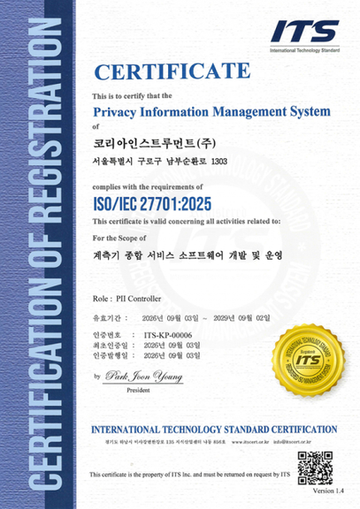
Korea Instrument, KOLAS Accredited Calibration Agency First to Simultaneously Acquire ISO/IEC 27,001·27,701
Korea Instrument has become the first among KOLAS accredited calibration agencies to simultaneously acquire ISO/IEC 27,001 and ISO/IEC 27,701 certifications. Through its proprietary platforms CWIZ Enterprise and CWIZ Partners, the company has embedded information security and personal data protection requirements across all business processes including customer information, equipment data, and calibration reports, with plans to continuously advance its management system through regular audits and security inspections.
2026.10.12by 배종인 기자
TeamViewer One, IT Incident Automation Workflow and Resolution Center Enhanced
TeamViewer has added IT incident automation capabilities and an advanced Resolution Center to its integrated digital workplace management platform 'TeamViewer ONE'. Recurrent service disruptions, configuration errors, and capacity shortages are automatically handled according to preset policies, and device status verification through script deployment can be managed in a unified interface, significantly reducing repetitive tasks for IT teams.
2026.10.12by 배종인 기자











