



Development of ID-based next-generation networking technology suitable for 5G and IoT
 Published2016.01.04 11:29
Next-generation networking technology based on IDs (identifiers) has been developed instead of the Internet Protocol (IP) commonly used in wired and wireless communication networks.
ETRI (Electronics and Telecommunications Research Institute) announced that it has succeeded in developing core technologies for ID-based next-generation networking, an alternative to IP-based networks that have reached their limits, and has completed verification.
IP, which communicates based on addresses, becomes highly inefficient when the recipient moves or when duplicate incoming data exists on the network. For example, in the current IP technology environment, the address (IP) configured for a company computer cannot be used when traveling on business or at home.
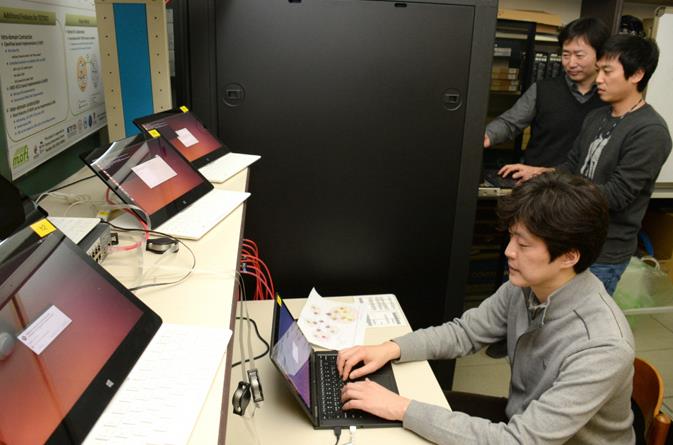
In contrast, communication using IDs—identifiers like names—is independent of addresses, so it can fundamentally resolve the problems associated with IP. ETRI stated that this technology is designed to enable the assignment of identifiers to various communication objects, such as terminals, people, data, and services.
ETRI explained that this technology is suitable for the upcoming 5th generation (5G) mobile communication era and the Internet of Things (IoT) era. With the advent of 5G and IoT, it is expected that tens of billions of diverse devices will be connected to the internet, requiring high mobility and security.
In such cases, it is true that current IP-based network methods have structural limitations in addressing these requirements for large scale, mobility, and security.
Therefore, there is a global consensus that next-generation network technology is evolving based on ID. Consequently, leading research groups are competitively engaging in the development of solutions to address technical challenges.
Furthermore, as IP-based technology originated primarily in the United States, foreign products are dominating not only the internet equipment market but also the service market. In the case of equipment, major developed countries such as the United States hold more than 80% of the market share.
Replacing foreign products and laying the foundation to lead the next-generation network market
Therefore, ETRI's development of core technologies for next-generation networks has significant implications. In other words, it amounts to securing a "second internet-based technology."
ETRI explained that the core technologies developed this time include: a routing protocol that quickly finds information transmission paths even in large-scale networks; a mapping system that finds the location of large-scale communication objects in real time and provides structural mobility; and a trusted communication protocol that uses an identifier containing authentication information to prevent tampering or forgery of the sender on the network itself and efficiently respond to DDoS attacks.
Meanwhile, ETRI stated that based on this technology, it received a great response from attendees through demonstrations of the developed technology at the ACM ICN conference held in San Francisco, USA last September and the ICT 2015 exhibition held in Lisbon, Spain last October.
Jeong Hee-young, Head of the ID Communication Research Lab at ETRI, stated, "Moving beyond the current level of merely adopting technologies developed in advanced nations, such as the Internet, securing homegrown source technologies that enable us to compete on equal footing with advanced countries in the next-generation network market holds great significance."
In addition, ETRI announced that it has secured intellectual property rights for the developed technology by publishing approximately 20 papers in SCI journals and filing around 30 domestic and international patent applications. Based on the secured source technology, ETRI is currently developing various scenarios for applying this technology.
First, we plan to develop IoT technology based on identifier-based networking technology for application in the Internet of Things. Kim Young-jin, Head of the Wired and Wireless Communication Infrastructure Research Division at ETRI, stated, "This effectively lays the foundation to lead technology in the next-generation network market, which is expected to fully materialize within the next 5 to 10 years." "We expect this to be of great help in strengthening the technological competitiveness of domestic companies," he explained.
This technology was developed as part of the Ministry of Science, ICT and Future Planning's "Research on Identifier-based Networking Technology for High-Quality Future Internet" project.
Comments
Related news
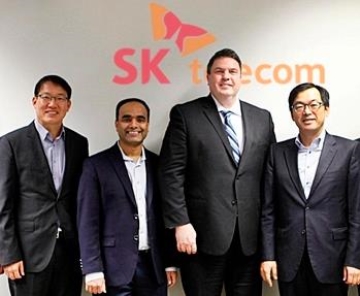
SK Telecom Embarks on Comprehensive Cooperation with Qualcomm in Preparation for 5G Era
SK Telecom (CEO and President Jang Dong-hyun, www.sktelecom.com) is advancing comprehensive 5G technology research and development cooperation with Qualcomm (CEO Steve Mollenkopf, www.qualcomm.com), the world's largest telecommunications semiconductor manufacturer, including the development of 5G terminal prototypes.
2015.12.21by 명세환 기자
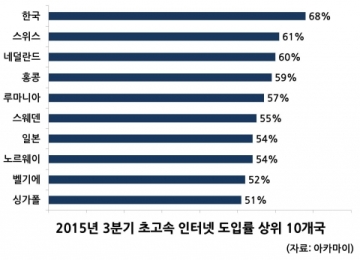
Korea's Internet speed is the fastest in the world, but mobile web page loading time is below the global average
Our country has recorded the world's top position for seven consecutive quarters in average internet speed and adoption rate of ultra-high-speed internet (speeds of 10Mbps or higher). The adoption rate of ultra-high-speed internet at 15Mbps and 25Mbps or above, which enables ultra-high-definition (UHD) video transmission, also ranked first, solidifying our position as an internet powerhouse.
2015.12.29by 신윤오 기자

Ministry of Science, ICT and Future Planning Announces Results of '2015 Internet Usage Survey'
The Ministry of Science, ICT and Future Planning announced the results of the '2015 Internet Usage Survey' conducted jointly with the Korea Internet & Security Agency (KISA). According to this year's survey results, internet service usage patterns are showing a clear trend of shifting from PCs to smartphones. In particular, the survey found that differences in usage rates by gender and age have decreased, and the internet usage rate among older age groups has increased significantly, including a rise in instant messenger usage among those in their 60s.
2015.12.30by
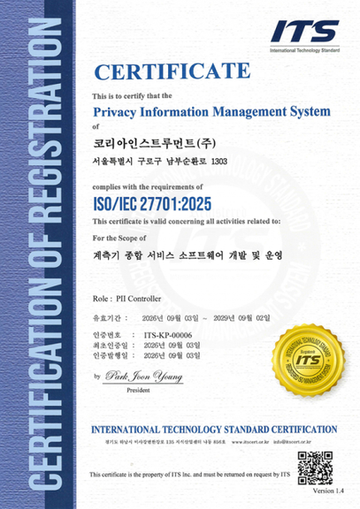
Korea Instrument, KOLAS Accredited Calibration Agency First to Simultaneously Acquire ISO/IEC 27,001·27,701
Korea Instrument has become the first among KOLAS accredited calibration agencies to simultaneously acquire ISO/IEC 27,001 and ISO/IEC 27,701 certifications. Through its proprietary platforms CWIZ Enterprise and CWIZ Partners, the company has embedded information security and personal data protection requirements across all business processes including customer information, equipment data, and calibration reports, with plans to continuously advance its management system through regular audits and security inspections.
2026.10.12by 배종인 기자
TeamViewer One, IT Incident Automation Workflow and Resolution Center Enhanced
TeamViewer has added IT incident automation capabilities and an advanced Resolution Center to its integrated digital workplace management platform 'TeamViewer ONE'. Recurrent service disruptions, configuration errors, and capacity shortages are automatically handled according to preset policies, and device status verification through script deployment can be managed in a unified interface, significantly reducing repetitive tasks for IT teams.
2026.10.12by 배종인 기자











