



Development of ITO alternative materials for smartphone touch panels is gaining momentum.
 Published2016.01.11 17:33
Patent applications for 'transparent electrode films' using ITO alternative materials are actively being filed.
Find a replacement for the aging ITO primary material.
The development of transparent electrode films using alternative materials that can replace ITO (indium tin oxide), which is used in touch panels such as smartphones, is gaining momentum.
The Korean Intellectual Property Office (KIPO) (Commissioner Choi Dong-gyu) announced that patent applications related to technologies using ITO alternative materials as transparent electrode film materials have shown a high annual average growth rate of 26.4% over the past five years, from 37 in 2010 to 92 in 2014.
ITO, currently the primary material for transparent electrode films for touch panels, is expensive due to limited reserves of its primary ingredient, indium, and is limited in flexibility. Consequently, interest in manufacturing transparent electrode films using alternative materials like metal nanowires, graphene, and carbon nanotubes, which can overcome ITO's shortcomings, is growing, leading to an increase in related patent applications.
In terms of the status by applicant, it appears that domestic large corporations (27.3%), small and medium-sized enterprises (24.0%), and industry-academia cooperation groups such as universities (24.0%) are leading the patent applications, indicating that domestic companies are actively seeking to secure technologies to utilize alternative materials as materials for transparent electrode films.
Looking at the patent application proportion by material, metal nanowires accounted for 41.6%, conductive polymers accounted for 16.1%, graphene accounted for 15.2%, and carbon nanotubes accounted for 14.4%, while hybrid electrodes manufactured by mixing two or more alternative materials accounted for 12.6%.
Metal nanowires can be manufactured at low cost and can relatively easily achieve a certain level of light transmittance or conductivity required for transparent electrode films for touch panels, so they have shown a high application rate compared to other materials.
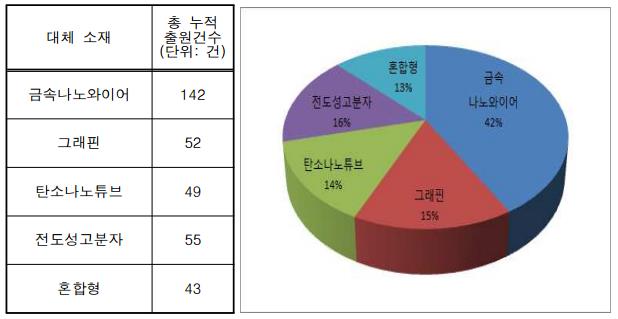
▲Number of patent applications by alternative material
On the other hand, graphene and carbon nanotubes are somewhat difficult to process, and conductive polymers have relatively weak conductivity and light transmittance, which are considered drawbacks, leading to a relatively low number of applications. Meanwhile, hybrid materials show a similar number of applications to other materials, excluding metal nanowires, indicating that they are gaining attention as a way to complement the shortcomings of alternative materials.
Going forward, the market size of touch panels for smartphones is expected to continue to expand, considering the market size of emerging countries such as China and India. Meanwhile, over 70% of indium reserves, the primary material for ITO, are concentrated in China, and with these reserves limited, there are even predictions that they will be depleted within a few years. Consequently, the burden of securing a stable supply and price for ITO film is increasing, and technological development for transparent electrode films utilizing alternative materials is expected to intensify in the future.
A patent office official said, “In a situation where the commercialization of new materials to replace ITO used in transparent electrodes is urgent, it is necessary to develop various techniques that can complement the vulnerabilities of alternative materials, and it is necessary to secure sufficient patents related to transparent electrodes using alternative materials.”
Comments
Related news

TI Launches MCU with Multitouch Technology
TI has announced the launch of the MSP430™ FRAM microcontroller (MCU), the lowest power capacitive touch MCU featuring CapTIvate™ technology.
2015.11.17by
Images Supplies Touch Controller ICs to China's Xiaomi, 'Full-scale Entry into China'
Mobile solutions specialist Imagis announced that it has shipped initial production volumes of Touch Controller IC to Xiaomi. Imagis, which has been consistently working to penetrate the Chinese market, launched its full-scale entry into the Chinese market by beginning shipment of initial Touch Controller IC volumes to Xiaomi on the 23rd.
2015.11.23by 신윤오 기자
ESP32 Development Environment Selection and GPS Application Implementation
The ESP32 is a microcontroller that integrates Wi-Fi, Bluetooth, 12-bit ADC, capacitive touch, PWM, DAC, and UART in a single SoC. However, the abundance of features does not by itself solve the designer's problems. The real challenges lie in selecting the appropriate development environment, determining which pins can be used and which must be avoided, and converting raw data from modules into usable information. This document addresses ESP32 peripheral constraints (ADC2 and Wi-Fi coexistence limitation, UART1 occupancy, ADC non-linear regions), the trade-offs between Arduino IDE and ESP-IDF, and the process from connecting NEO-6M/NEO-M8N GPS modules to UART2, parsing NMEA sentences, and visualizing routes in Google Earth, all organized based on documented references.
2026.10.12by 편집부
MIPI CSI-2, DSI-2, C-PHY, D-PHY Test Solution Technical White Paper
The MIPI interface adopts a burst mode that transitions between low-power (LP) and high-speed (HS) states for low-power consumption, and in return, strict timing rules are imposed on state transitions. Additionally, the high-speed section operates as a packet-based protocol with headers, ECC, and CRC, so verification engineers must handle waveforms and protocols simultaneously. Traditional configurations combining general-purpose oscilloscopes and AWGs reveal limitations in setup complexity, measurement uncertainty, and lack of reproducibility when faced with these requirements. This white paper, based on webinar materials, organizes the structure of this problem and describes how the SV5C-DPTXCPTX generator for receiver testing and SV5C-DPRXCPRX analyzer for transmitter testing integrate state transition testing, stressed eye testing, and protocol analysis into a single bench, along with their application boundaries.
2026.10.12by 편집부











