


Miniaturization and low power consumption are key elements of wearable and IoT devices, and while everyone knows this, Maxim is undoubtedly the leader in implementing them!
 Published2016.01.20 14:53
While specialized healthcare wearables like Fitbit and Xiaomi Bands already exist, the market is expected to accelerate as watches now feature built-in fitness features. Samsung's Gear S2 watch saw a slight increase in sales in the domestic wearable/IoT market last year, and the anticipated release of the second-generation Apple Watch in March of this year suggests the wearable/IoT market will experience further volatility.
The biggest challenge for wearable devices is their ability to operate and monitor frequently, making low-power battery life a crucial priority. Furthermore, the importance of portability, including battery life, is driving the miniaturization and lightweighting of hardware. Furthermore, as they are gaining popularity as accessories, design considerations are also becoming increasingly important.
Accordingly, the two key factors engineers developing wearable and IoT devices must focus on are size and battery life. Minimizing size and extending battery life with low power consumption are key priorities. Maxim is making headlines with its products that meet both of these requirements. We met with Seongho Son, General Manager of Maxim Integrated Field Applications, to discuss the products and the core principles of wearable and IoT device development.
- I heard that the product being introduced this time is a PMIC product specialized for wearable/IoT devices. It's very interesting, could you give us a brief introduction to the product?
The product we're introducing today is the MAX14720 PMIC, which is suitable for wearable and IoT devices that use coin cells or regular batteries and need to operate for a long time on a single charge.
What challenges must a product suitable for wearables and IoT devices satisfy?
Wearable and IoT devices must be small, as they are meant to be carried on the body at all times. Furthermore, because they must detect body conditions and continuous signals, they must be able to operate for long periods of time on a single charge. However, as wearable and IoT devices become smaller and more functional, the number of discrete semiconductors used increases, inevitably taking up more PCB space. This raises issues regarding solution size and efficiency.
To summarize, low power and miniaturization are key for wearable and IoT devices. First, how can PMICs achieve low power?
The MAX14720 provides power regulators such as Buck-Boost, Buck, and Low-dropout regulator (LDO), all of which can operate with low quiescent current and have a battery seal mode to extend battery life.
- If you explain in detail the role of the power regulator and the battery's real mode
The aforementioned regulators offer 10x lower standby current than competitors, extending battery life in devices with multiple sleep/standby modes. Battery-seal mode completely disconnects the power rail using a power switch, reducing power consumption and extending battery life even when the device is not in use or stored for extended periods.
- Why is standby current important for wearables and IoT products?
Engineers may think that sleep mode has nothing to do with battery life because it is already low-power, but in fact, as you can see from the graph, sleep mode is the key to extending battery life by reducing the sleep mode current of wearable/IoT products. If we can save even a few nanoamperes of current in sleep mode, the overall battery life will increase significantly.
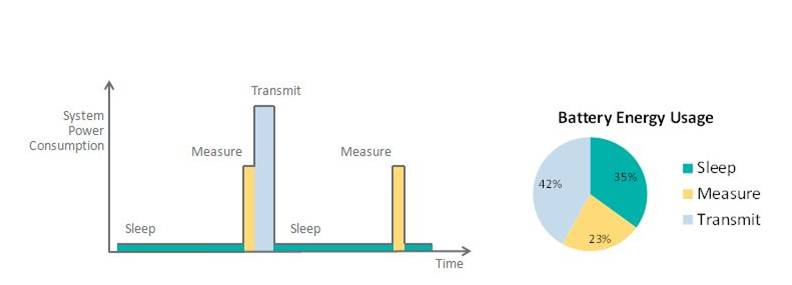
▲Power consumption rate by mode
- Besides low power consumption, what are MAXIM's unique strengths compared to other companies?
In particular, the MAX14720 features a built-in 1.2V buck that delivers 90% efficiency, reducing power consumption compared to applications using general LDOs. It also includes features such as pushbutton input monitoring, power-up sequencing, and voltage rail monitoring, providing flexibility in power control. For example, developers can implement a sequence interface that specifies how to handle the power key when it is pressed, or which power source should be turned on and off first, allowing for easier power control. Despite including all these features, its small size of 2.26 x 2.14 mm2 makes it suitable for wearable and IoT products with space constraints.
- Why was it possible to reduce the size despite all these features?
Maxim has specialized technology in integrated circuits, so it was able to create small-sized products that included multiple DC/DC and control blocks.
- Lastly, if you were to emphasize why engineers should choose this product,
As mentioned earlier, the MAX14720 PMIC integrates multiple components into a single, integrated chip, eliminating space constraints and enabling low-power control, making it ideal for wearables and the Internet of Things (IoT). Furthermore, by providing a direct IC, it offers a robust development environment that can significantly reduce development time and costs.

Comments
Related news
ESP32 Development Environment Selection and GPS Application Implementation
The ESP32 is a microcontroller that integrates Wi-Fi, Bluetooth, 12-bit ADC, capacitive touch, PWM, DAC, and UART in a single SoC. However, the abundance of features does not by itself solve the designer's problems. The real challenges lie in selecting the appropriate development environment, determining which pins can be used and which must be avoided, and converting raw data from modules into usable information. This document addresses ESP32 peripheral constraints (ADC2 and Wi-Fi coexistence limitation, UART1 occupancy, ADC non-linear regions), the trade-offs between Arduino IDE and ESP-IDF, and the process from connecting NEO-6M/NEO-M8N GPS modules to UART2, parsing NMEA sentences, and visualizing routes in Google Earth, all organized based on documented references.
2026.10.12by 편집부
MIPI CSI-2, DSI-2, C-PHY, D-PHY Test Solution Technical White Paper
The MIPI interface adopts a burst mode that transitions between low-power (LP) and high-speed (HS) states for low-power consumption, and in return, strict timing rules are imposed on state transitions. Additionally, the high-speed section operates as a packet-based protocol with headers, ECC, and CRC, so verification engineers must handle waveforms and protocols simultaneously. Traditional configurations combining general-purpose oscilloscopes and AWGs reveal limitations in setup complexity, measurement uncertainty, and lack of reproducibility when faced with these requirements. This white paper, based on webinar materials, organizes the structure of this problem and describes how the SV5C-DPTXCPTX generator for receiver testing and SV5C-DPRXCPRX analyzer for transmitter testing integrate state transition testing, stressed eye testing, and protocol analysis into a single bench, along with their application boundaries.
2026.10.12by 편집부

NVIDIA to Invest $1 Billion in U.S. Science Over Next Five Years
NVIDIA has announced plans to invest $1 billion over the next five years to strengthen U.S. scientific and technological competitiveness. The company will enhance cutting-edge artificial intelligence research and development capabilities in key areas including quantum computing, healthcare, and energy security, while expanding support for higher education research institutions and cloud service providers. NVIDIA is participating as a major industry partner in the White House Office of Science and Technology Policy's Genesis Mission, and is promoting supercomputer construction in collaboration with national laboratories including Argonne and Los Alamos.
2026.10.12by 배종인 기자
Advanced Capacitive Sensing Technology for Moisture-Resistant Touch and Digital Level Sensing
Capacitive sensing is replacing mechanical buttons and contact-type water level sensors by virtue of its non-contact and movable-part-free characteristics. However, water and frequently changing ground conditions directly disturb its measurement principle. Based on Microchip webinar materials, this white paper describes the principles, configuration, and performance basis of Digital Level Sensing (DLS), which reports water level regardless of ground conditions, and Impulse Touch Sensing (ITS), which eliminates the effect of water at the moment of signal acquisition. Furthermore, it specifies application boundaries that designers should be aware of, including recommended mechanical stack-up below 5mm, inapplicability to metal containers, and the necessity of validation for media other than water.
2026.10.12by 편집부
ElevenLabs Achieves $22 Billion Valuation...Completes $300 Million Employee Tender Offer
ElevenLabs completed a $300 million employee tender offer based on a $22 billion corporate valuation, driven by expanding demand for enterprise conversational AI agents.
2026.10.12by 배종인 기자











