



[CASE STUDY] Robots are the central axis of the 'Smart Factory,' innovation in the manufacturing field.
 Published2016.01.28 17:08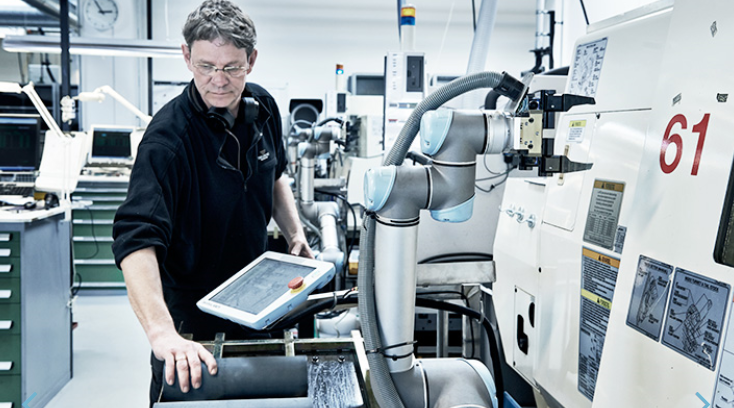
[Caption: UR5 collaborating with people at the production site of TSS, Denmark]
A 'smart factory' is a facility that produces products by integrating the entire manufacturing process—from planning and design to production, distribution, and sales—using ICT (Information and Communications Technologies). By autonomously controlling production and processes and managing workplace safety through systems and sensors installed on machinery, a 'smart factory' is truly a 'smart factory' in the truest sense of the word.
In the past, skilled workers had to monitor the workplace in real time and inspect the condition of workpieces to directly resolve issues in order to detect problems occurring within the factory. However, as the number of skilled workers decreases due to an aging population and the era of multi-product, small-batch production arrives to meet the proposals and needs of various customers, flexible production systems are now required. Accordingly, the 'smart factory,' which enables flexible production by optimizing the entire production process, is currently emerging as a key keyword for innovation in the manufacturing industry.
Robots are at the heart of the 'smart factory,' where smart machines communicate with one another. Industrial robots, the core of production automation, are working more actively than ever in factories, increasing production efficiency. According to the International Federation of Robotics (IFR), global sales of industrial robots last year totaled 250,000 units, a 27% increase from the previous year. It was also reported that industrial robot sales accounted for $10.7 billion, or 68%, of the total global robot sales of $15.7 billion last year. As more and more manufacturers are adopting next-generation robots that boast rapid and sophisticated technology, the importance of industrial robots is expected to continue to grow in the future.
The benefits that industrial collaborative robots provide to manufacturers are substantial. First, manufacturers can significantly improve productivity by deploying industrial collaborative robots on factory production lines to work alongside humans. For instance, collaboration is possible where a worker assembles a part halfway and hands it over, while the robot completes the remaining half of the intricate and complex work.
Next-generation industrial collaborative robots, which are smaller and lighter than conventional industrial robots, can easily move to different locations and work as needed. Therefore, manufacturers can rapidly respond to changing demands by flexibly applying next-generation industrial collaborative robots to various work environments.
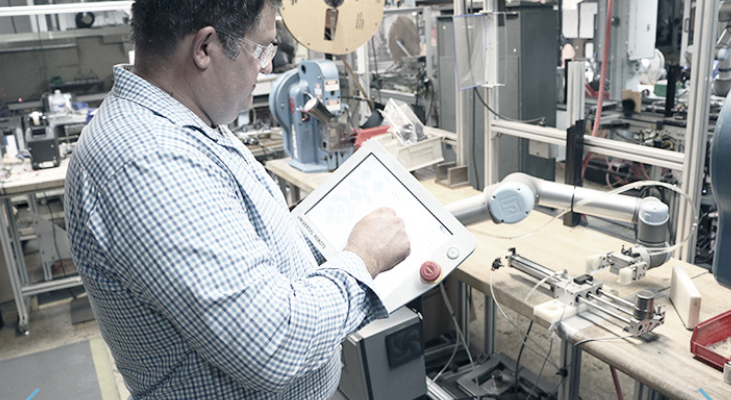
[Photo Caption: UR5 collaborating with people at SFEG's production site in the US]
Universal Robots’ collaborative robots, performing tasks alongside humans on the production floor of the Scott Fetzer Electrical Group (SFEG), an electronics manufacturer in Tennessee, USA, are an excellent example of industrial collaborative robots that optimize production processes and enhance corporate competitiveness.
From cutting blanks to forming, folding, and the final assembly of electronic components
SFEG, a manufacturer of multi-product, small-batch goods, was able to improve productivity and increase operational efficiency by deploying Universal Robots’ collaborative robots into its production line. These robots are small, lightweight, easy to move, and can be flexibly adapted to any manufacturing environment. Furthermore, by reassigning employees who previously performed monotonous tasks on the production line to more specialized and rewarding work, the company was able to utilize its workforce more efficiently and significantly enhance its competitiveness.
SFEG produces products by deploying Universal Robots’ collaborative robots UR5 and UR10 in all processes, from cutting blanks to forming, folding, and the final assembly of electronic components. Universal Robots’ collaborative robots, which are much smaller and lighter than conventional industrial robots, collaborate with humans even in confined spaces to achieve optimal productivity. Universal Robots’ safety control system automatically stops the robot's operation if a force exceeding the user-set limit is applied.
This 'stopping power' feature, certified by TÜV (German Technical Supervisory Association), is a key characteristic that allows Universal Robots to be classified as a 'collaborative robot' among industrial robots. Furthermore, Universal Robots' modular design enables the rapid replacement of affected parts in the event of a breakdown or malfunction, minimizing losses during production stoppages.
Next-generation industrial and collaborative robots, which are core technologies of 'smart factories,' are becoming smarter and more advanced, expanding their scope in the workplace. Moving forward, they will continue to lead the realization of the 'smart factory,' a future-oriented manufacturing site, by maximizing synergy through convergence with various software and security technologies.

Comments
Related news

Focusing investment on the robot industry: 'Safety Robots, Care Robots, and IoRT'
At the RoboWorld seminar held at KINTEX on the 28th, Park Hyun-seop, PD at KEIT, stated, "Based on the 2013 data from the IFR, there are approximately 400 types of developed and commercialized robots, with the global robot market size reaching a total of 14.8 million dollars." He added, "Of this, manufacturing robots account for 9.7 million dollars, comprising approximately 64 percent, followed by professional services at 24 percent, and personal service robots at 12 percent."
2015.11.03by
Robots Will Play a Significant Role in Industry 4.0
KUKA Robotics Korea announced on the 19th that it will exhibit its intelligent industrial robot 'LBR iiwa' developed with Industry 4.0 in mind at the '2015 Creative Economy Exhibition' starting on the 26th at COEX in Samseong-dong, Seoul.
2015.11.19by 명세환 기자
Universal Robots Partners with Korean Distributors to Target the Market
Universal Robots announced that it has selected ㈜TES (True Engineering Solutions Co., Ltd.), Korea's first vacuum robot developer for the semiconductor and display industries, and ㈜A&G Technology (A&G Technology Co., Ltd.), which manufactures quality testing equipment for completed vehicle, engine, and transmission production lines in the automotive industry, as additional official distributors for Universal Robots in Korea. With this appointment, Universal Robots is now partnering with a total of three domestic distributors, including existing distributor Vision Semiconductor Co., Ltd., to pursue the Korean market.
2015.11.26by 명세환 기자
What will the factories of the future be like, working alongside robots?
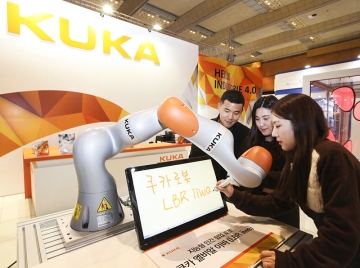
KUKA Robotics Korea Co., Ltd. will participate in the '2015 Creative Economy Expo' running for four days starting today, showcasing the intelligent collaborative robot 'LBR iiwa' as a solution for realizing the creative economy.
2015.11.26by 명세환 기자











