


[Interview] Outstanding Domestic AI Technology Needs Regulations Lifted and Ecosystem Established to Develop
 Published2016.02.01 15:45
Interview / Kim Jin-hyung, Director of the Software Policy Research Institute
After IBM's 'Deep Blue' defeated a human in a chess match in 1997, there were predictions that Go would still be difficult. This was because the number of possible moves is far more numerous and complex than in chess. However, the words of Kim Jin-hyung (pictured), Director of the Soft Policy Research Institute, whom I met at 'e4ds' on January 19, were different. "Artificial intelligence will soon beat Go as well. If they set their minds to it and invest heavily, they will win," he said. Beginning with his words, "Do not get excited, nor be cynical," we were able to hear candidly about the reality and future of artificial intelligence in Korea.
The hot topic in IT in 2016 is undoubtedly artificial intelligence. Artificial intelligence technology has always been a topic that captures the interest of the general public through movies and comics, but what is the reason for its particular prominence?
The reason humans created computers was for 'automation,' and the starting point of artificial intelligence is the creation of 'automating thinking.' It has been over 70 years since artificial intelligence emerged, and most of its achievements have come from academic fields. However, with the emergence of groundbreaking results today, it has become possible to apply it to everyday life.
However, this is not the first time there has been an artificial intelligence boom. When I first came to Korea in 1985, expectations for AI were also high. Currently, I hope that people do not view this atmosphere with excessive excitement, nor with cynicism.
Has this been an issue due to technological advancements?
That is correct. A boom occurred with the development of expert systems in 1970. However, as it failed to produce remarkable results thereafter, research and investment went into decline. It was after the 1990s that artificial intelligence truly took flight. This was due to the rapid improvement in computing power. Had computing power comparable to today existed since the 1970s, the technologies we see today could have been realized.
It is not that technology has not advanced, but the core technology has been known for a long time. However, computer performance could not keep up. In the past, it took several days to recognize a single piece.
Next is the power of data. The volume of data has increased tremendously. When developing speech recognition, voice data must be analyzed to identify specific patterns. For example, when pronouncing the word "Korea," the system can be trained using data from countless pronunciations to recognize the sound even if the pronunciation is clumsy or unclear. This is called 'universality'. Finally, there is the infinite storage space known as the 'Cloud'. Since storage is possible even in places without computers, it has become possible to store massive amounts of data and utilize computing power.
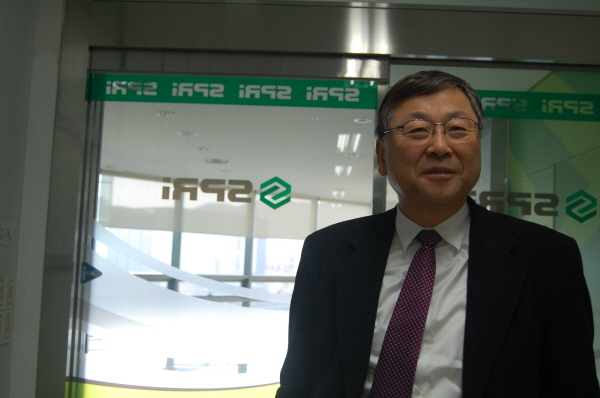
The Software Policy Research Institute (SPRI) office located in Pangyo
The trifecta development of computer power, cloud, and big data
Rekindle the AI boom
I heard that artificial intelligence is broadly divided into knowledge processing and signal processing.
Signal processing recognizes data coming from sensors—such as camera feeds, voice, and smell—to perceive the situation and converts it into symbols through signal processing. The upper level then combines these symbols to perform knowledge processing. The ultimate goal of artificial intelligence is for these two stages to be seamlessly connected.
But it is difficult. The reason is that the purpose is different.
Signal processing is the process of recognizing speech as "something was said." However, this is because the subsequent conversion into symbols to the knowledge processing stage requires interpreting the meaning of the sentence and determining a response, and this process is a separate matter.
Although both methods are artificial intelligence, it is difficult to connect them naturally because their approaches differ. However, ordinary people process these two methods simultaneously. They recognize and acquire information and decide on actions. Currently, the iPhone's Siri incorporates mostly signal processing with a small amount of knowledge processing added. But as you know, the level is low.
Didn't you say that technology has advanced enough to be used in daily life?
Translation systems are very well developed. Currently, 91 languages are supported. While a Korean speaker can translate into English to speak, it is rare to find someone who can translate from Hindi into Mongolian. In fact, it is practically non-existent. However, computers can do it. Of course, it is not perfect, but it has reached a level where it can grasp the meaning to some extent. Preparations are underway to implement such translation services at the PyeongChang Olympics. The service is expected to be implemented in a simple manner.
It is also possible to discover knowledge, principles, and rules. In addition, there are many AI technologies used in daily life, such as question-answering systems and recommendation systems. The most dramatic event was Watson winning a quiz competition against humans at the 2011 IBM Challenge. Also, the Japanese robot 'Pepper' read emotions and responded. Furthermore, G-BOT helps with food preparation. The future has already arrived, and ordinary people have started using it.
Translation, Q&A, and recommendation systems used in daily life are knowledge processing
iPhone's 'Siri' combines signal processing and knowledge processing, but it is still insufficient.
- What is the current state of artificial intelligence technology? Also, what are its limitations?
For example, even if speech recognition technology has been developed, if it can recognize the speech of a specific person but fails to recognize the speech of others, it cannot be said that the technology is 100% feasible. Just as ordinary people can understand and speak, 'universality' is crucial for artificial intelligence. If we were to judge whether it can recognize the speech of people passing by on the street, the current success rate would likely be less than 50%.
Are you saying that it will still be difficult to catch up to human capabilities?
Humans possess the ability known as the cocktail party effect, which allows them to clearly hear only the sounds they need. Since this remarkable human ability is distinct from rational intelligence, it would not be easy to realize "human-like intelligence."
Is the area where AI currently shows strength related to knowledge processing?
Watson also went as far as finding the answer and providing a response. In this regard, when it comes to knowledge processing, it excels at judging and analyzing an infinite amount of knowledge. However, if someone were to ask me about a specific part that goes into a large ship, I naturally would not be able to answer. Such knowledge is called domain knowledge, which refers to specialized knowledge about a given problem domain.
The ultimate goal is to have 'universality', but it is an unknown.
Warnings about 'artificial intelligence' are often issued by non-experts in the field.
Bill Gates and Elon Musk are warning about the technological advancement of artificial intelligence.
First of all, Bill Gates is not an artificial intelligence scholar. Current AI technology is one of the technologies with many weaknesses. As I have repeatedly emphasized, this is because it is difficult to achieve 'universality'.
Even Watson, which won the quiz competition, found it difficult to recognize the host's words in a noisy broadcasting environment, so it was put into a computer file so that knowledge processing could be performed immediately.
For engineers, versatility and technological depth are their primary concerns. People outside the field often look at just one example and imagine that artificial intelligence poses a threat. However, not only is it extremely difficult to mimic humans, but to threaten them, 'self-awareness' is required. To survive, one must find new goals and methodologies on one's own, and the question is whether there is any reason for a machine to do so. It would be difficult for self-awareness to exist in anything other than a living organism. If it were possible, it might be faster to develop it in the field of biology than in engineering.
According to one report, Korea is ranked among the top countries likely to adopt AI-based industrial automation the fastest, whereas there is a report predicting that developed countries will adopt it more slowly in comparison. I am curious to know what you think about this.
No, our country is incredibly slow. A university student created a used car app and earned over 30 billion won in revenue. However, due to interference from existing used car dealers, a law was passed requiring a physical storefront to operate. Unable to secure a business location immediately, the student eventually had to shut down the business. Currently, our country has severe regulations designed to protect vested interests. We are failing to foster technological and market competitiveness because of this infighting over our own interests. It is truly ridiculous.
There are truly many other cases as well. The accredited certificate that was abolished last year was also the subject of a battle that lasted for six to seven years. Then, last year, the President finally stepped in, and the issue was resolved all at once.
'Red flag' laws for vested interests are still rampant in our country.
neutralize the capabilities of the software
Just as horse-drawn carriages have lost their function as a means of transportation, many current jobs will disappear. According to research findings from our institute, about 63% will vanish. Journalists are among the jobs that will disappear. An article about the LA earthquake this past March was written in just eight minutes. It was written using artificial intelligence. As such, simple reporting, such as sports results, can be written using AI.
In fact, it is very simple. Humans create article templates and simply input fact-based data. Trained journalists produce templates, and artificial intelligence inputs the constantly changing data. The same applies to corporate earnings reports. These repetitive tasks can be automated. This very kind of society can be called a software-centric society.
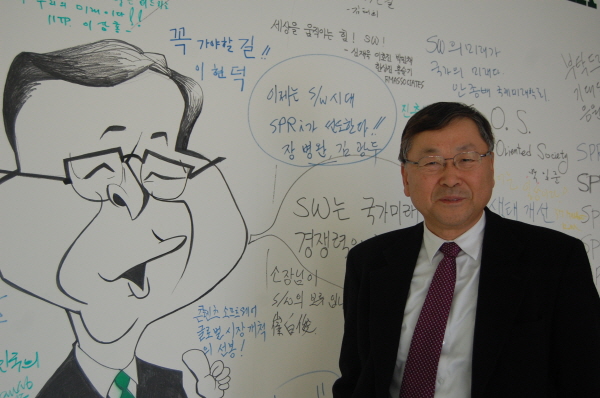
When the automobile was first invented in England, horse-drawn carriage operators felt a sense of crisis and enacted a traffic law, which was the 'Red Flag Act'.
The rule was that when cars were passing, one person had to hold a red flag and shout, "Car, car!" to allow people to pass.
Because of this law, cars could not go ahead of a person holding a red flag. That law completely neutralizes the capabilities of automobiles. Just like this, red flag laws are rampant in our country as well.
In that case, is it to prevent the Software Policy Research Institute from enacting 'Red Flag Laws' and the like?
That is correct. They continuously publish software-related reports and act as an advisor to help the government formulate sound software industry policies.
I saw in another interview that you strongly advocate for private sector participation in particular.
The current government creates and owns software. Therefore, it is the government's responsibility to manufacture, use, maintain, and repair it properly. However, public officials are too ignorant about this field.
Even when tasked with creating a program, they speak without fully understanding the process. Furthermore, once the work is completed, they say, "This isn't right," and fail to treat engineers properly. As a result, talented individuals are reluctant to work for the government.
The United States needs 1.4 million engineers by 2020, but it can only supply 400,000. The remaining 1 million are recruited from India, China, and South Korea. Therefore, the argument is that the government should not own these resources without proper knowledge, but rather utilize them through private sector participation by making reasonable payments.
The Ministry of Land, Infrastructure and Transport created a map service called 'V-World.' It received awards and positive reviews. However, I said, "It won't work." The government should only provide data. In the case of Japan, knowledge industries developed because private individuals provided services with data such as "the day cherry blossoms bloom most beautifully."
The same applies to patents. Data is submitted to the government to obtain patent approval. It would be fine if they simply stored the data, but the government is using taxpayer money to provide services for private businesses.
Then, what is the situation regarding artificial intelligence in Korea?
The same applies to artificial intelligence. Since it was developed in the U.S., the prevailing sentiment is that "our country can develop it too." Consequently, ETRI is also pursuing this initiative. The problem is that even if it is completed, a user group must be formed. This is because establishing an ecosystem is crucial. However, ETRI lacks the capability to gather the necessary personnel. IBM, recognizing this early on, unveiled Watson. The purpose is to establish an ecosystem.
In that case, we can use it too. We just need to develop services that artificial intelligence can handle. Following in others' footsteps offers no competitive edge.
It is true that the number of people studying artificial intelligence in our country has increased. Furthermore, since algorithms are made public, the field is competitive enough to be easily understood just by looking into it. The problem is that while persistent effort is required to overcome the challenges encountered through research, investment is not being made effectively.
- As part of talent development, wasn't coding education for elementary school students made mandatory in early 2017?
That is correct. It is also being implemented at universities. The government provides financial support to universities that select software-focused institutions and provide coding education. Currently, this is being implemented at several locations, including Sungkyunkwan University.
With the widespread adoption of computer technology, startups are now fully capable of developing technologies through artificial intelligence. Previously, giant IT corporations led the way but lacked the capacity to develop innovative technologies. This is because large conglomerates are accustomed to an industrial society. They must secure massive profits through mass production driven by capital investment.
However, the software industry can no longer be explained by conventional economics. The accommodation sharing site Airbnb has a market capitalization of $25 billion. The global real estate-based Hyatt hotels are worth $8.3 billion. Airbnb hasn't even gone public.
Mandatory coding in elementary schools and support through the selection of software-focused universities
However, the startup support policy is a sham.
I understand that the government is currently supporting policies to foster startups.
That is true. However, current startup support policies need to change. This is because they are enticing young people who lack the necessary skills to start businesses. As a result, there is a frenzy these days about students who haven't graduated or lack the ability to start businesses. Although Bill Gates started his company after dropping out of college, he already possessed college-level knowledge and skills while in high school.
- Finally, what needs to be done for South Korea to enhance its competitiveness in artificial intelligence?
Software capabilities depend on computer hardware power, the cloud, and data. Therefore, the first priority is to provide an environment where researchers and small and medium-sized enterprises can freely use computing power to develop artificial intelligence.
Second, it is necessary to collect massive amounts of data. The performance of artificial intelligence improves as the amount of data increases. This requires joint support at the national level to facilitate development through the utilization of data power. Finally, setting precise goals is essential.
Even if data is collected, a large amount of data becomes useless if the purpose of collection is unclear. An in-depth approach is needed regarding 'what specific problem' is being solved through artificial intelligence. If we gather data and utilize computing power to create algorithms based on this approach, Korea will be able to gain sufficient competitiveness.

Comments
Related news

Artificial intelligence, virtual reality, sensing homes… consumers consider them the near future
According to this report, consumers expect to be able to interact with objects without looking at smartphone screens in the not-too-distant future through the use of artificial intelligence (AI). Approximately half of smartphone users anticipate that smartphones will become outdated devices within the next five years.
2015.12.22by 신윤오 기자

[it-Movie] The present and future of artificial intelligence as seen through movies. Is 'Jarvis' from 'Iron Man' our friend?
At CES 2016, IBM Chairman Virginia Rometty forecast that artificial intelligence (A.I.)—technology that thinks and makes judgments like humans—will lead the future of the IT industry. In her keynote address, she explained that "digital alone cannot create differentiated value in the massive Internet of Things market," and emphasized that "artificial intelligence technology capable of understanding and reasoning about data is necessary for data analysis that brings business insights." Artificial intelligence has always been a topic of interest, as seen in many films up to now. But why is it being discussed in this way this year?
2016.01.25by
[e4ds Tech Day 2026 ⑨] Sim Sang-gyu, Autocrypt CTO: "In the Physical AI Era, Automotive Security Must Extend Beyond the Vehicle"
At e4ds Tech Day 2026, Sim Sang-gyu, CTO of Autocrypt, explained automotive cybersecurity strategies in the era of Physical AI and SDV (Software-Defined Vehicle). Automobiles are evolving as part of an ecosystem connected to AI, cloud, chargers, IoT, and robots, and he emphasized that the scope of security must expand beyond the vehicle interior to the entire connected environment. In particular, AI model tampering, adversarial attacks, OTA updates, and EV charger hacking were identified as major threats. He explained that response measures require zero trust, AI model integrity protection, intrusion detection, Security by Design and Default, and full lifecycle security management, and that proactive security system establishment beyond regulatory compliance is critical for securing future mobility competitiveness.
2026.10.12by 배종인 기자
NVIDIA to Invest $1 Billion in U.S. Science Over Next Five Years
NVIDIA has announced plans to invest $1 billion over the next five years to strengthen U.S. scientific and technological competitiveness. The company will enhance cutting-edge artificial intelligence research and development capabilities in key areas including quantum computing, healthcare, and energy security, while expanding support for higher education research institutions and cloud service providers. NVIDIA is participating as a major industry partner in the White House Office of Science and Technology Policy's Genesis Mission, and is promoting supercomputer construction in collaboration with national laboratories including Argonne and Los Alamos.
2026.10.12by 배종인 기자
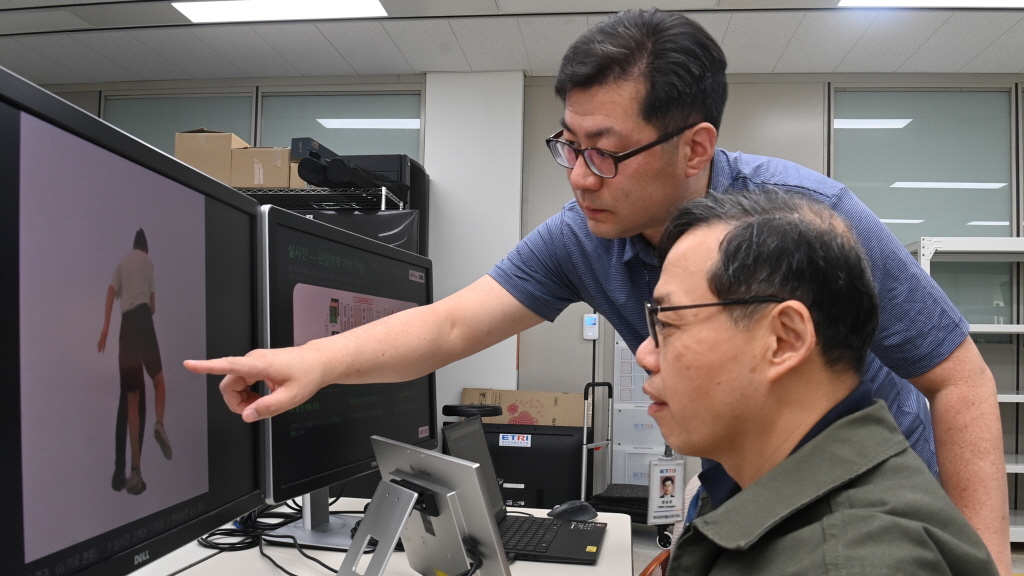
ETRI Unveils 3 Next-Generation Media Technologies Including AI-Dedicated Video Compression
ETRI has unveiled three next-generation media technologies optimized for AI. These include AI-based video encoding (VCM), 3D human generation based on sparse cameras, and generative AI-based pre-visualization technology. In environments where AI directly processes video such as autonomous vehicles, robots, and drones, these technologies enable efficient compression and transmission of large-scale data, and can be applied across various industrial sectors including smart cities, video security, and sports broadcasting.
2026.10.12by 배종인 기자











