


SK Telecom Provides IoT Product Development Environment for University Students via 'IoT Platform'
 Published2016.03.18 17:09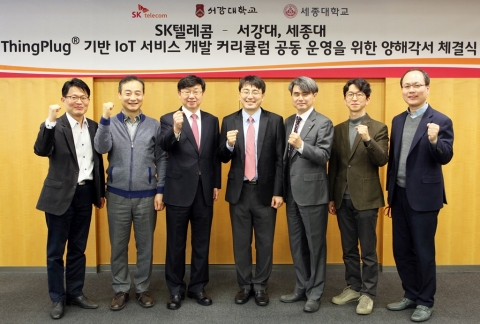
SK Telecom announced on the 18th that it has introduced 'ThingPlug,' an IoT platform that supports anyone in easily developing IoT (Internet of Things) services and applying them to real life, into the regular curriculum of universities.
On this day, SK Telecom and Sogang University and Sejong University signed an agreement at the SK Telecom headquarters in Euljiro for the "joint operation of a ThingPlug-based IoT service development curriculum." Starting this first semester, SK Telecom plans to provide education on 'ThingPlug' to undergraduate computer engineering students at Sogang University and Sejong University, which are designated as software-focused universities, and to offer opportunities for understanding and practical training on the overall IoT platform.
'ThingPlug' is an IoT platform based on the international standard 'oneM2M', and is an open platform capable of interoperability with standard-compliant devices and applications. SK Telecom pursued the development of an IoT platform based on international standards and unveiled 'ThingPlug' last June.
'ThingPlug' is characterized by providing a 'service platform' function that allows developers to easily utilize IoT services, as well as a 'DIY development environment' that enables them to create their own desired IoT services.
“We expect that by directly designing IoT services through the newly established curriculum, students will be able to enhance their expertise not only in understanding IoT theory but also through actual development experience,” the company stated. “SK Telecom will continue to drive the creation of the IoT market and the development of the ecosystem based on the 'ThingPlug' platform in preparation for the IoT era.”
IoT devices can be manufactured by combining motherboards, sensors, etc.
Students can build their own IoT devices by combining motherboards, sensors, and other components based on Software Development Kits (SDKs), and can also develop the services they need themselves. Once developed, the devices and services can be used immediately after registering them on the web portal.
Through the curriculum, students can gain experience in developing IoT devices and services and acquire technical skills applicable to actual industrial settings. SK Telecom plans to cultivate skilled professionals who can be immediately deployed to the software development field in the industry, and will provide benefits such as awards for the implementation of creative ideas and bonus points for the IoT competition 'Hackathon' upon completion of the program.
"We expect that university students will be able to enhance their expertise through actual development experience and gain a better understanding of IoT theory by directly designing IoT services through this newly established curriculum," said Cha In-hyeok, Head of the Platform Technology Institute at SK Telecom. "SK Telecom will continue to drive the creation of the IoT market and the development of the ecosystem based on the 'ThingPlug' platform in preparation for the IoT era."
Meanwhile, SK Telecom, which serves as the president of the Korea Internet of Things Association, announced on the 16th the 'IoT Total Care' program, which includes building a nationwide IoT network, establishing an integrated IoT control center, and developing dedicated IoT modules.

Comments
Related news
SK Telecom and Dongbu Daewoo Electronics Sign Agreement to Develop Smart Home Connected Devices
SK Telecom concluded a business partnership agreement with Daewoo Electronics, one of Korea's top three global home appliance manufacturers, on the 15th for the launch of smart home service-linked products. Daewoo Electronics is a global home appliance company with four production bases domestically and internationally, and approximately 40 sales outlets overseas. The company is recording continuous growth not only in the domestic market but also in emerging markets such as Eastern Europe, Central and South America, and Southeast Asia, and is particularly recognized for its competitiveness in small home appliance products.
2015.12.29by
SK Telecom and Ericsson to Establish 5G Trial Network
Test network development work to verify the performance of 5G technologies and services is ramping up. SK Telecom announced on the 11th that it has signed an MoU (Memorandum of Understanding) with Ericsson (CEO Hans Vestberg), a global telecommunications technology company, for 5G trial network development.
2016.02.11by 명세환 기자

SK Telecom Launches App Development Verification Service for Startups and Individuals
As smartphones have become mainstream, more startups and individuals are getting involved in app development. However, testing across a wide variety of devices and operating systems (OS) is nearly impossible. A breakthrough solution has emerged to address this problem.
2016.02.19by 명세환 기자
Korea Instrument, KOLAS Accredited Calibration Agency First to Simultaneously Acquire ISO/IEC 27,001·27,701
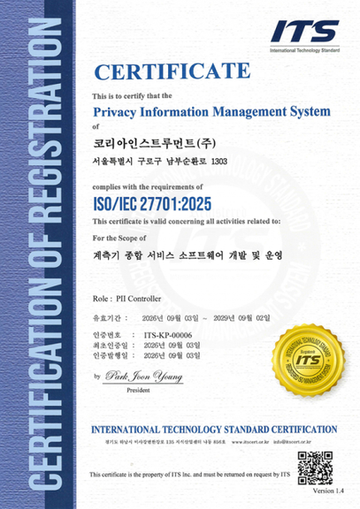
Korea Instrument has become the first among KOLAS accredited calibration agencies to simultaneously acquire ISO/IEC 27,001 and ISO/IEC 27,701 certifications. Through its proprietary platforms CWIZ Enterprise and CWIZ Partners, the company has embedded information security and personal data protection requirements across all business processes including customer information, equipment data, and calibration reports, with plans to continuously advance its management system through regular audits and security inspections.
2026.10.12by 배종인 기자

TeamViewer One, IT Incident Automation Workflow and Resolution Center Enhanced
TeamViewer has added IT incident automation capabilities and an advanced Resolution Center to its integrated digital workplace management platform 'TeamViewer ONE'. Recurrent service disruptions, configuration errors, and capacity shortages are automatically handled according to preset policies, and device status verification through script deployment can be managed in a unified interface, significantly reducing repetitive tasks for IT teams.
2026.10.12by 배종인 기자











