


Environmental sensors that meet IoT are expanding in all directions, including “indoor car environments, mobile, and smart homes”
 Published2016.03.21 16:56
Increase in complex advanced sensors using semiconductor and MEMS technologies
As Internet of Things (IoT) technology spreads, the demand for environmental sensors such as temperature/humidity sensors, gas, and pressure sensors is also rapidly increasing.
This is because the demand for sensors that meet requirements such as ultra-small size and low power consumption to collect object information in various IoT applications is rapidly increasing. In particular, smart environmental sensors are high-function, high-precision, high-convenience, and high-value-added sensors that combine sensing elements and intelligent signal processing to perform data processing, automatic correction, self-diagnosis, and decision-making functions.
Environmental sensors include temperature/humidity sensors, gas/pressure sensors, dust, ultraviolet sensors, water quality sensors, etc., and these sensors support real-time environmental monitoring of environmental media such as water quality and air, humans, and the impact of environmental pollutants on the ecosystem.
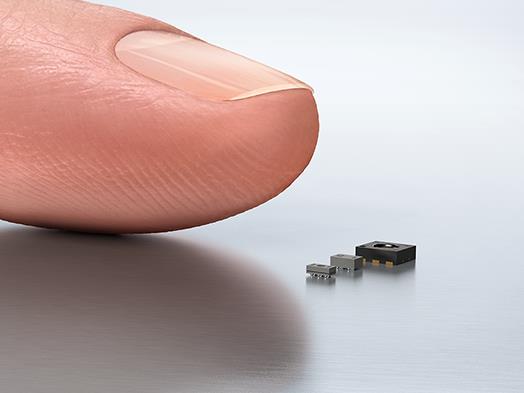
▲ Last year, Sensirion introduced an ultra-small sensor that integrated gas and pressure sensors.
First, temperature sensors are divided into contact and non-contact types depending on how they are used. Contact temperature sensors are those in which the temperature of the measured point is transferred to the sensor through heat conduction when the sensor is directly brought into contact with the object to be measured (solid, liquid, gas). Examples of these sensors include RTD, thermistor (NTC, PTC), and IC temperature sensors.
A non-contact temperature sensor is a method in which a remote sensor detects heat (infrared rays) radiated from the target object to measure temperature. Examples include thermopiles and pyroelectric temperature sensors.
Increasing number of complex sensors such as temperature and humidity sensors
In particular, IC temperature sensors are sensors that can be used even with little knowledge of thermal design, and they have many features built in to give developers the flexibility to add more functionality to their end applications.It is relatively inexpensive, the overall solution size is very small, power consumption is low, and there are sensors with various output types.
Representative companies include Sensiron from Switzerland, TI (TMP112-Q1), STMicroelectronics (STTS751), and Silicon Labs (Si7053). These companies are leading the market based on high temperature accuracy, temperature range, response time, and interface.
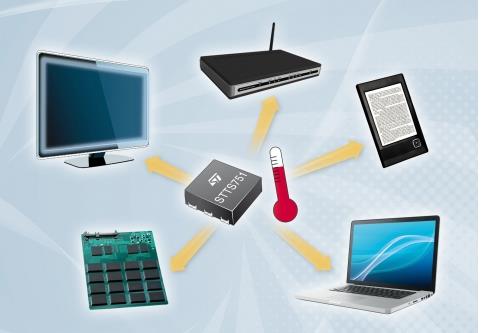
▲ STMicroelectronics' digital temperature sensor (STTS751)
Humidity sensors are also divided into resistance-type humidity sensors that detect changes in impedance that occur when the ionic activity of a hygroscopic substance changes depending on the surrounding environment and the amount of moisture adsorbed, and capacitance-type humidity sensors that detect changes in capacitance value depending on changes in the permittivity of a hygroscopic substance and the permittivity of moisture.
Temperature and humidity sensors capable of measuring temperature and humidity are also a mainstream part of the market. Temperature and humidity sensor modules are being released in the form of ultra-small/high-performance/low-power digital output, and representative products are being made by IST AG (P14 2FW Thermo) of Switzerland, Samyoung S&C (HumiChip), Sensorion (SHT1x), and ST Micro (HTS221).
Pressure sensors, which accept the size of the force applied to the sensor as a physical quantity and convert it into an electrical signal and output it, are also expanding. In particular, in the field of MEMS pressure sensors, most of the technology is held by Europe, Japan, and the United States, and research is actively being conducted on miniaturization, high functionality, and new process technologies.
Depending on the pressure detection method, they are divided into piezoresistive and capacitive types. Piezoresistive pressure sensors form a thin film through a semiconductor process, form a silicon piezoresistive body at the boundary between the film and the substrate, and measure pressure by detecting the change in the resistance of the piezoresistive body when the film is deformed by pressure. Capacitive pressure sensors measure pressure by detecting the change in the capacitance between the electrodes when the gap between the electrode plates facing each other is changed by external stress.
Representative companies active in the pressure sensor field include Omron, ST Micro (LPS22HB), and Bosch Sensortec (BMP280), and in particular, Bosch has implemented an advanced composite sensor by miniaturizing, lowering power, and improving performance of temperature/humidity/pressure composite sensors.
Developing a gas sensor with excellent selectivity
A gas sensor is a device that detects specific chemical substances contained in a gas and converts the concentration into an electrical signal to output. A representative example is a semiconductor gas sensor. A semiconductor gas sensor that uses the change in electrical conductivity that occurs when gas comes into contact with a ceramic semiconductor surface detects most toxic gases and combustible gases, and the sensor is easy to manufacture and the detection circuit configuration is simple. However, there are few gas sensors with excellent selectivity that can detect only the gases that are intended to be detected, and they are still in the research and development phase.
Gas sensors are also being released as composite sensors that detect temperature, humidity, pressure, etc., mainly from CO2Meter (USA) and Bosch Sensortec (Germany).
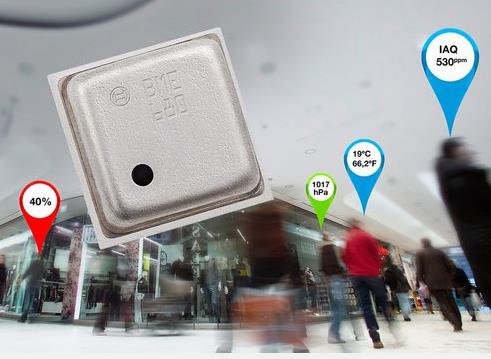
▲ Bosch Sensortec has launched a combo MEMS solution that integrates pressure, temperature and humidity, and gas sensors.
The Dust Sensor is a sensor that is included as a sensor module in air conditioners, such as air conditioners or air purifiers, and measures the dust concentration in the gas passing through the sensor by detecting light scattering, and the UltraViolet Sensor is a sensor that detects invisible ultraviolet rays with a shorter wavelength than visible light. There are silicon-based ultraviolet sensors and GaN-based ultraviolet sensors. Silicon-based ultraviolet sensors are being released by ST Micro (UVIS25), Silicon Labs (Si1132), etc., and the representative GaN-based ultraviolet sensor is Korea's GenUV.
In this way, environmental sensors are mainly comprised of sensors using semiconductor technology and MEMS technology. Sensor materials and sensor process technologies, as well as ultra-small, low-power, and high-performance sensors, are being developed. In particular, sensor signal processing and control chip development is in full swing due to the development of complex advanced sensors. The purpose is to develop a signal processing ROIC for a complex environmental sensor, compensate for sensor characteristics according to temperature, and support various output formats.
In other words, we are miniaturizing the sensor through MEMS process and multi-chip package technology, aiming for lower prices by increasing mass production and production yield, and focusing on improving the performance of smart sensors through system-on-chip.
“Future environmental sensors such as car interior environmental monitoring for maintaining temperature and humidity or measuring dust, and mobile/wearable devices equipped with various environmental sensors are expected to receive more attention,” said Kim Young-min, director of Qbit, who attended the Korea Industrial Technology Association (KITA)’s future smart sensor seminar. “In order to implement a well-being life, environmental sensors and signal processing modules capable of analyzing the living environment, and cloud-linked service platform technologies for environmental monitoring and control services will be actively developed.”
Comments
Related news
[Reporter's Notebook] Ambitious Sensor Development Industry: Do You See the Future of the Sensor Industry?
A major initiative has begun to elevate the domestic sensor industry to one of the four leading nations by 2025. The Ministry of Industry, Trade and Energy has launched the "Advanced Sensor 2025 Forum," bringing together approximately 60 participants from industry, academia, research institutes, and government to nurture the sensor industry as a future flagship sector.
2015.11.09by 신윤오 기자
How far has the development of core sensor elements come? ① “We will compete with overseas companies by developing the smallest 9-axis sensor”
The government has adopted a policy to intensively foster image sensors, magnetic sensors, inertial sensors, pressure sensors, radar sensors, environmental sensors, optical sensors, infrared sensors, acoustic sensors, and bio-medical sensors by providing a total of 150.8 billion won (national budget of 114.8 billion won) from this year through 2020.
2015.11.16by 신윤오 기자

Where Are We in Core Sensor Element Development? ② “Development of 79GHz Automotive Radar Sensor to Preempt the Autonomous Vehicle Market”
Following last week's updates on smart motion sensors, metabolic rate measurement sensors, harmful gas sensors, and optical sensors, we introduce the following technologies: ▲automotive shunt resistance current sensors ▲lidar sensors for autonomous vehicles ▲automotive 79GHz radar sensor technology.
2015.11.23by 신윤오 기자
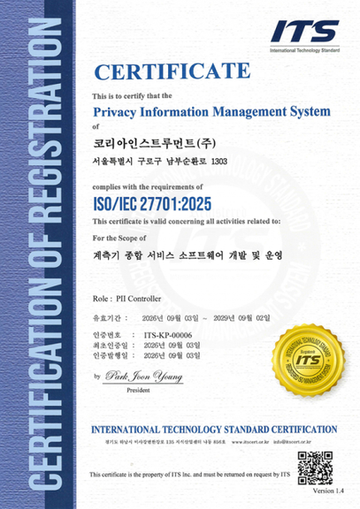
Korea Instrument, KOLAS Accredited Calibration Agency First to Simultaneously Acquire ISO/IEC 27,001·27,701
Korea Instrument has become the first among KOLAS accredited calibration agencies to simultaneously acquire ISO/IEC 27,001 and ISO/IEC 27,701 certifications. Through its proprietary platforms CWIZ Enterprise and CWIZ Partners, the company has embedded information security and personal data protection requirements across all business processes including customer information, equipment data, and calibration reports, with plans to continuously advance its management system through regular audits and security inspections.
2026.10.12by 배종인 기자

TeamViewer One, IT Incident Automation Workflow and Resolution Center Enhanced
TeamViewer has added IT incident automation capabilities and an advanced Resolution Center to its integrated digital workplace management platform 'TeamViewer ONE'. Recurrent service disruptions, configuration errors, and capacity shortages are automatically handled according to preset policies, and device status verification through script deployment can be managed in a unified interface, significantly reducing repetitive tasks for IT teams.
2026.10.12by 배종인 기자











