



ROHM 'Solves' Secondary Lithium-Ion Battery Protection with a Single LSI Realizing 14 Series Cells
 Published2016.03.23 15:52
ROHM Group's Lapis Semiconductor (www.lapis-semi.com/kr) announced that it has developed the industry's largest 14-series cell and lithium-ion battery secondary protection LSI (ML5232) capable of supporting up to 80V, which enables functional safety in lithium-ion battery systems such as electric bicycles, energy storage systems, and UPS.
Recently, with the rapid increase in applications using high-energy-density lithium-ion batteries, higher reliability is required in accordance with functional safety standards that protect human health and property.
In addition, as the applications of lithium-ion batteries expand, securing even higher reliability is becoming increasingly important, which is essential for countermeasures against overcharging and over-discharging. Accordingly, the use of secondary protection LSIs is increasing.
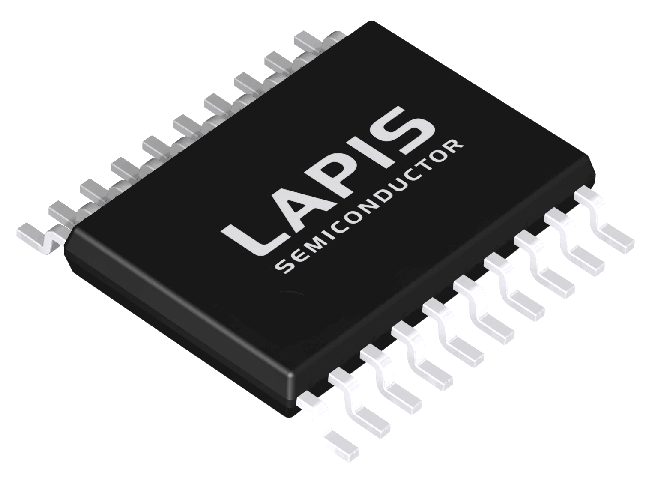
Lapis Semiconductor has focused on the development of battery monitoring LSIs and has equipped a lineup of secondary protection LSIs in response to these social demands. The secondary protection LSI prevents accidents involving lithium-ion batteries in the event of a problem with the battery monitoring LSI system installed in the lithium-ion battery monitoring system.
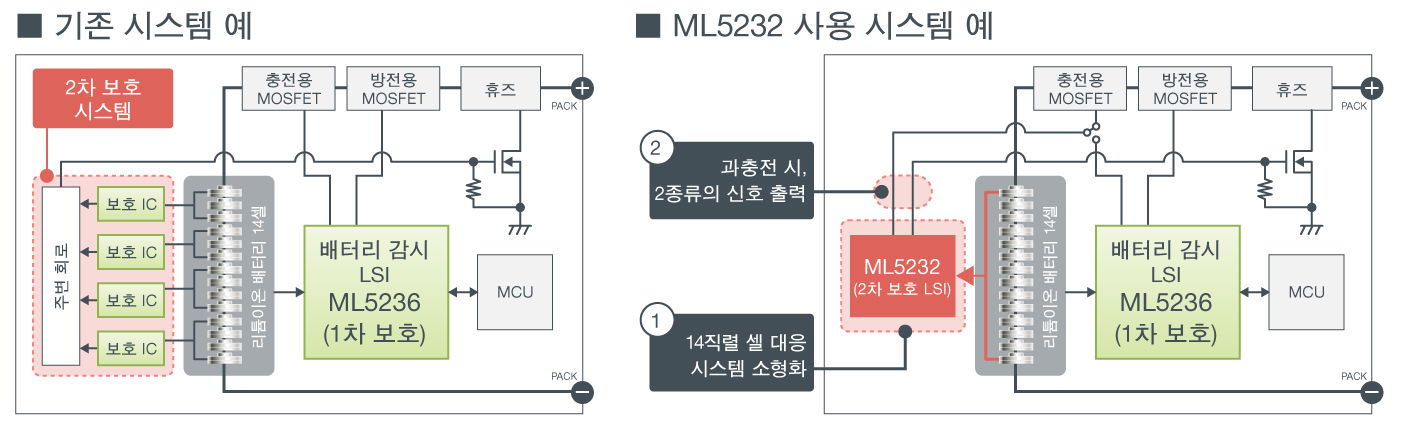
▲ Existing System Example vs. System Using ML5232 Example
The LSI developed this time is capable of detecting up to 14 series cells, which allows for a significant reduction in the number of components compared to existing 4-series secondary protection LSIs, thereby simplifying the circuit configuration.
Previously, multiple secondary protection LSIs and their surrounding circuits were required to realize secondary protection for lithium-ion batteries , but now they can be replaced with a single ML5232. In addition, high reliability of the system is realized by incorporating two types of protection signals that can cut the fuse and simultaneously turn off the charge control MOSFET upon detection of overcharging.
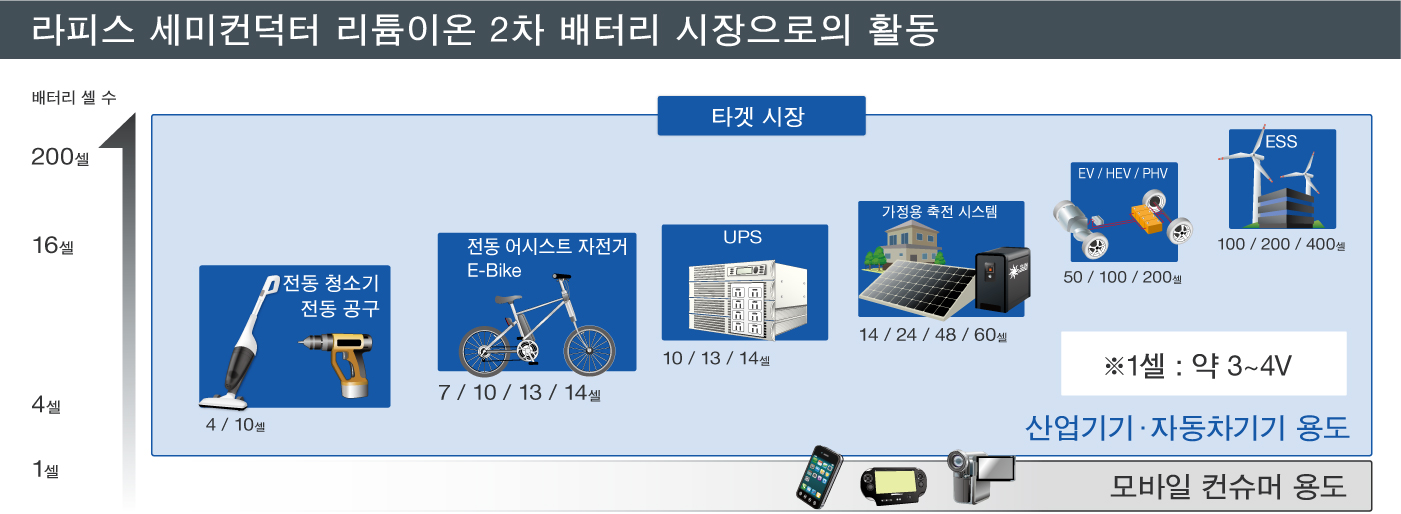
▲ Lapis Semiconductor's Entry into the Lithium-ion Rechargeable Battery Market
Samples are currently being shipped, and mass production shipments are scheduled to begin in September 2016 at Lapis Semiconductor Miyazaki. In addition, various support systems have been established, allowing users to access various manuals and tools by registering as a user on the website.
Lapis Semiconductor plans to meet the demands of the industrial equipment market for high-voltage battery monitoring systems with lithium-ion battery monitoring LSIs featuring multi-series cell configurations.

Comments
Related news
ROHM Develops System Power IC for High-Efficiency Car Audio
ROHM Co., Ltd. announced that it has developed a system power IC (BD49101AEFS-M) that realizes the industry's minimum operating power for increasingly multifunctional car audio power supplies.
2015.11.27by 명세환 기자
[2016 Automation Exhibition] ROHM Displays Eco-friendly High-efficiency Silicon Carbide
Rohm is a company that manufactures semiconductors and electronic components, and is participating in 'Automation World 2016' to exhibit cutting-edge devices used in large-scale industrial equipment and automobiles. Among these, SiC devices using silicon carbide are devices that replace conventionally used silicon devices and realize high efficiency and high withstand voltage, currently receiving significant attention. These include SiC Schottky barrier diodes and MOSFETs as individual semiconductor components, as well as SiC modules incorporating both of these products.
2016.03.10by 명세환 기자
If there is a boost DC/DC converter that satisfies mobile miniaturization and battery life
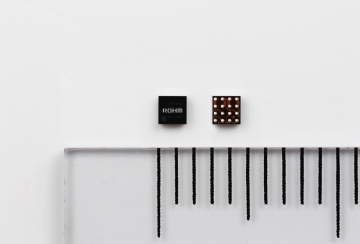
ROHM Co., Ltd. announced the development of BD1865GWL, a compact, highly efficient, high-power step-up DC/DC converter that operates from a single-cell lithium-ion battery for smartphones and tablets. The BD1865GWL, suitable for mobile devices equipped with USB and HDMI terminals, applies analog design technology to enable ultra-low voltage operation down to a minimum of 2.5V during battery discharge in mobile devices requiring miniaturization and extended battery life. As a result, the company explained that battery operating time is extended compared to conventional 2.7V products.
2016.03.16by 명세환 기자

Intel Unveils Next-Generation 'Core Ultra Series 3' and vPro Platform for Enterprise PCs
Intel has officially unveiled the "Intel Core Ultra Series 3" for next-generation enterprise PCs and the latest vPro platform, addressing a wide range of demands from enterprise notebooks to high-performance workstations.
2026.03.26by 배종인 기자
ROHM Launches ESD Protection Diode Compatible with High-Speed Interfaces of 10Gbps or Higher
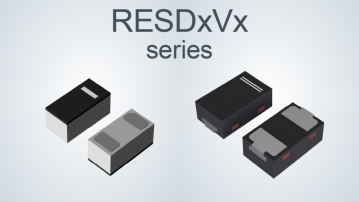
Semiconductor specialist ROHM has developed the 'RESDxVx series' of ESD (electrostatic discharge) protection diodes capable of responding to next-generation high-speed data communication environments exceeding 10Gbps, simultaneously enhancing both signal quality maintenance required in high-speed interfaces and IC protection performance.
2026.03.26by 배종인 기자











