



Schneider Electric Provides Insights into IoT Demand
 Published2016.04.05 15:55
Ultra-small wireless meters, PowerTags, data center solutions for edge computing, etc.
Schneider Electric announced that it held the '2016 Life Is On Innovation Summit' at the Paris, Porte de Versailles exhibition center in Paris, France on the 1st.
This event, attended by approximately 1,000 people including global clients, was a venue to share new insights and innovative achievements regarding the future of energy efficiency and industrial automation brought about by the Internet of Things.
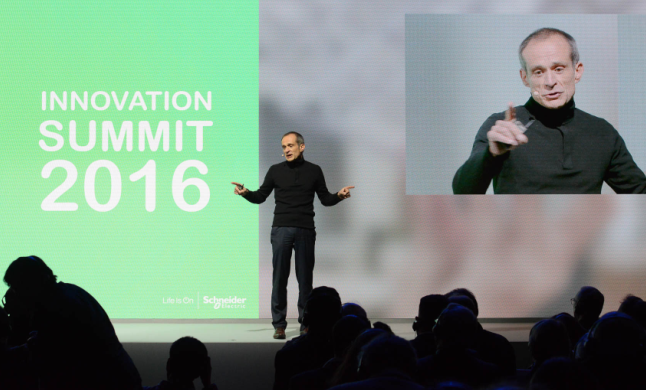
In his keynote address, Jean-Pascal Tricoire, Chairman of Schneider Electric, stated, “The world ahead will be very different from what it has been so far. The importance of electricity will grow, and along with it, the importance of digitalization, decentralization, and decarbonization will increase.” He added, “At this summit, we aim to present solutions to transform the future of industry and resolve the energy crisis through the Internet of Things (IoT) and smart city technologies.”
At this summit, Schneider Electric released the 'IoT 2020 Business Report' and presented insights into the Internet of Things. In this survey of over 3,000 business leaders across 12 countries, more than 75% of respondents answered that the Internet of Things will create new business opportunities this year, reflecting the surging demand for the Internet of Things.
63% of respondents indicated that they would utilize the Internet of Things (IoT) within 2016 to analyze customer behavior, solve problems faster, and improve customer satisfaction, suggesting that the customer experience is expected to advance significantly. Building and industrial automation were found to be the sectors with the greatest potential for cost savings from the application of IoT technology (63% and 62% of respondents, respectively, anticipating cost reductions). Nearly half of them stated that they plan to introduce IoT-based building automation systems within two years.
Furthermore, 67% of respondents stated that they plan to implement the Internet of Things (IoT) through mobile devices or apps, with the primary reason being the potential for cost savings of up to 59%. Notably, one-third of the total respondents indicated they would adopt it within six months, suggesting that mobile devices are expected to significantly enhance the value of IoT. In addition, 81% of respondents reported that information and data knowledge collected through IoT are being effectively shared within the organization. Meanwhile, cybersecurity issues were identified as the biggest challenge related to IoT.
At this summit, Schneider Electric unveiled next-generation IoT solutions for various fields, including building management, smart grids, industrial automation, data centers and edge computing, and smart power distribution. In the building management sector, it introduced the PowerTag®, an ultra-compact wireless power meter, for the first time in the industry. PowerTag is a product that easily connects existing power circuit breakers to a Building Management System (BMS).
By wirelessly providing building facility managers with real-time data on energy consumption, voltage, current, and power factor, it helps improve building energy efficiency and the condition of power facilities. A key advantage is that it eliminates the need for complex major renovations to enhance the energy efficiency of existing buildings, and it is applicable not only to Schneider Electric products but also to most circuit breakers on the market. By adding smart intelligence to existing products without the need to replace circuit breakers with new ones, it is expected to be an innovative solution that will lead the power distribution sector into the era of the Internet of Things.
In the data center sector, strategies for edge computing—which decentralizes network services to the user level in response to the increase in the Internet of Things (IoT), cloud computing, and mobile devices—and various physical infrastructure solutions were introduced. Driven by the IoT trend and the ever-increasing data traffic, centralization toward the cloud and decentralization to the local user level are occurring simultaneously.
This is because without edge computing operating close to local users, user satisfaction drops significantly in terms of performance, such as speed. Schneider Electric unveiled an edge computing portfolio optimized for diverse environments, ranging from large data centers to industrial sites, including 'InfraStucxure™' for rapid installation and modular expansion, 'SmartBunker™' and 'NetShelter™ SX' rack solutions for reliable remote control, the modular 'Micro Data Center', and 'StruxtureWare™' data center management software.
Meanwhile, with the advent of the artificial intelligence (AI) era, power supply is emerging as a prerequisite for the expansion of AI, which consumes massive amounts of electricity; in this context, Schneider Electric is taking the lead in technological innovations such as renewable energy, efficient and smart power generation and supply, and power grid management.
Recently, the company developed an ultra-compact 2kW inverter about 20 times smaller than conventional inverters and the size of a compact camera. It won second place in the 'Little Box Challenge,' an inverter competition organized by Google and the Institute of Electrical and Electronics Engineers (IEEE), and was recognized for advancing the transition to renewable energy to the next level. In addition, it demonstrated its competitiveness in power distribution, system control, and smart grid technology by being named a Gartner Magic Quadrant Leader in the Intelligent Distributed Management System (ADMS) sector for three consecutive years.

Comments
Related news
Schneider Electric Targets SDDC Market Through Joint Development
Schneider Electric Korea announced its collaboration with Naim Networks, a Software Defined Networking (SDN) specialist, to capture the SDDC (Software Defined Data Center) market.
2016.03.07by
[2016 Automation Exhibition] Schneider Electric Introducing Smart Panels
A conference was held where visitors could directly see and experience the automation industry of the future. 'Automation World 2016' is an exhibition where key automation components such as PLCs, industrial computers, drives, and sensors can be viewed, and will be held from March 9 to 11 at Halls A and B of COEX (Samseong-dong). Schneider Electric Korea, an energy management and automation specialist, is also participating and plans to showcase various products equipped with web interface functionality based on Ethernet/IP communication protocol.
2016.03.10by 명세환 기자

Schneider Electric Selected as 'World's Most Ethical Company' for 6 Consecutive Years
Schneider Electric announced that it has been selected for the sixth consecutive year as a 'World's Most Ethical Company (WME 2016)' by the Ethisphere Institute, a leading U.S.-based corporate ethics research organization.
2016.03.16by 명세환 기자
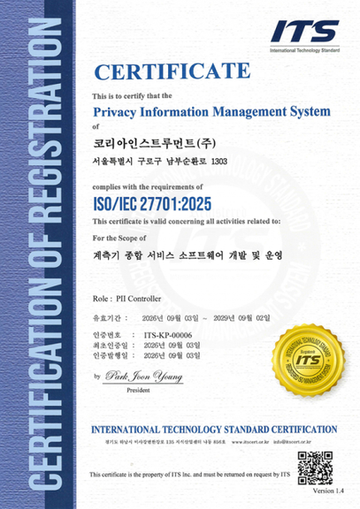
Korea Instrument, KOLAS Accredited Calibration Agency First to Simultaneously Acquire ISO/IEC 27,001·27,701
Korea Instrument has become the first among KOLAS accredited calibration agencies to simultaneously acquire ISO/IEC 27,001 and ISO/IEC 27,701 certifications. Through its proprietary platforms CWIZ Enterprise and CWIZ Partners, the company has embedded information security and personal data protection requirements across all business processes including customer information, equipment data, and calibration reports, with plans to continuously advance its management system through regular audits and security inspections.
2026.10.12by 배종인 기자
TeamViewer One, IT Incident Automation Workflow and Resolution Center Enhanced
TeamViewer has added IT incident automation capabilities and an advanced Resolution Center to its integrated digital workplace management platform 'TeamViewer ONE'. Recurrent service disruptions, configuration errors, and capacity shortages are automatically handled according to preset policies, and device status verification through script deployment can be managed in a unified interface, significantly reducing repetitive tasks for IT teams.
2026.10.12by 배종인 기자











