


NXP Semiconductors Successfully Demonstrates Autonomous Truck Driving Technology Using V2X Communications
 Published2016.04.07 14:41
Maximizing fuel efficiency, carbon emissions, safety, traffic flow, and vehicle operational efficiency in Europe
NXP Semiconductors and DAF Trucks have successfully demonstrated autonomous driving technology for automated trucks.
This demonstration is part of the "European Truck Platooning Challenge," hosted by the Dutch Ministry of Infrastructure and the Environment, an event that involves multiple trucks driving in a line from several European cities to the Netherlands. Platooning is the practice of multiple vehicles driving in a line on a road.
This event is designed to advance the economic, traffic management, and safety benefits of autonomous platooning. This event responds to the growing demand for legislation and standards for Intelligent Transportation Systems (ITS) across Europe, where current rules and regulations regarding speed and spacing vary across countries.
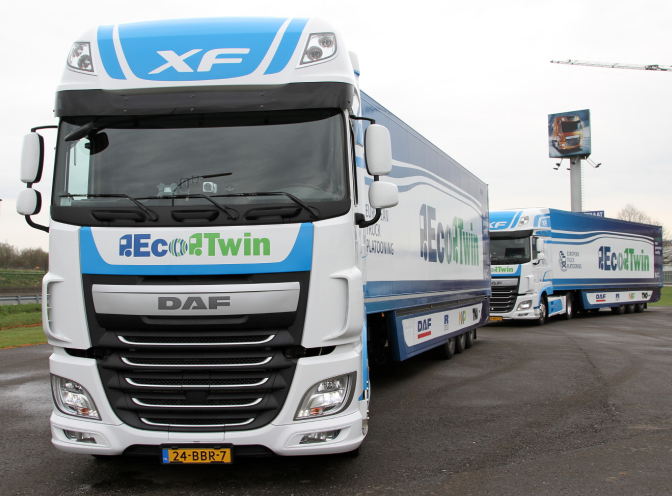
▲ The core of the 'EcoTwin' technology applied in this demonstration is RoadLINK, an advanced vehicle-to-vehicle (V2V) communication solution developed by NXP.
For this demonstration, NXP, DAF, TNO, and Ricardo formed the "EcoTwin" consortium. At the heart of EcoTwin is RoadLINK, NXP's advanced vehicle-to-vehicle (V2V) communication solution. Combining the IEEE 802.11p wireless standard with NXP radar technology, this technology allows platoon vehicles to securely exchange information in real time, automatically slowing down and accelerating in response to the lead vehicle's movements.
NXP RoadLINK's fast communication and response speed can significantly reduce the gap between platooning vehicles, enabling truly synchronized driving in DAF truck platooning. To showcase automatic braking and acceleration capabilities, the event plans to keep the gap between vehicles to 0.5 seconds. At 80 km/h, this represents a mere 10 meters. The reaction speed of the vehicle following the platoon during an emergency is expected to be 25 times faster than the average human reaction time of one second.
RoadLINK communication technology, designed by NXP, is installed in the mirrors of DAF trucks participating in the platoon. The NXP V2V system is also designed to utilize four secure redundant channels, ensuring extremely high communication reliability. This system not only issues the commands necessary for the platooning, but also enables real-time video and two-way voice communication between the two vehicles.
Voice support allows drivers to communicate with each other without using other communication channels, such as mobile phones. Furthermore, a V2V camera installed on the lead truck transmits the lead truck's "view" to the drivers of the following vehicles, allowing them to easily monitor the road ahead.
“We are honored to participate in the European Truck Platooning Challenge as a key partner and supplier of secure V2V radar technology for DAF trucks,” said Torsten Lehmann, Senior Vice President, Car Infotainment and Driver Assistance at NXP. “DAF and other transport companies will be able to operate safely and efficiently by using NXP’s technology,” he said. “As a leader in vehicle-to-everything (V2X) technology, NXP is contributing to reducing vehicle accidents and fatalities in Europe while improving fuel efficiency, carbon emissions, safety and traffic flow.”
“There is no question that platooning still needs to be developed further before it can be brought to market as a new technology,” said Ron Borsboom, member of the DAF Trucks Management Board and responsible for product development. “We will have to wait until at least 2020 to complete all of this. There are still many legal, liability and licensing issues to be sorted out. DAF Trucks, together with NXP, TNO and Ricardo, will demonstrate through the European Truck Platooning Challenge that autonomous truck platooning is a viable technology. This event will allow truck manufacturers to carry out further testing on public roads, gaining more experience than they have today.”
NXP's RoadLINK will be integrated into Delphi's V2X platform and applied to commercial vehicles starting this year.
Some of the trucks that took part in the event held in the Netherlands on April 6th used NXP's radar solutions and RoadLINK technology. NXP's vehicle-to-vehicle (V2V) and vehicle-to-infrastructure (V2I) technologies are essential to the continued development and advancement of autonomous vehicles and large-scale transportation network operation technologies.
This allows vehicles to share information about their speed, location, and direction with other vehicles in their vicinity, and allows vehicles and infrastructure to communicate with each other to relay traffic management data, hazard information such as local speed limits, traffic signal information, construction warnings, and the presence of hazardous areas.
This could significantly improve traffic flow, reduce accidents, reduce fuel consumption, and lower carbon emissions. NXP is collaborating with major industry players and vehicle OEMs, including Siemens, Harman, Delphi, and Cohda Wireless, on V2X technology. NXP's RoadLINK will be integrated into Delphi's V2X platform and implemented in commercial vehicles starting this year. NXP is also a leader in radar technology for advanced driver assistance systems, with over 15 million units shipped to date.
Comments
Related news
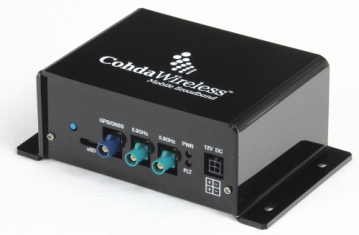
NXP and Corda Unveil New V2X Products for Connected Vehicles
2013.07.16by 명세환 기자
Can self-driving cars operate without precise maps, V2X, or road infrastructure?
As autonomous vehicle development accelerates both domestically and internationally, interest in vehicle-to-infrastructure wireless communication linking roads and vehicles—that is, V2X (vehicle-to-x)—and high-precision maps for autonomous driving is rising. Autonomous vehicles, as commonly understood, refer to human-friendly automobiles capable of safe autonomous operation by minimizing driver intervention through self-recognition of surrounding environments, risk assessment, and route planning. Accordingly, when autonomous vehicles are classified in stages, they are divided from Level 0 (driver perceives, controls, and is responsible) to Level 4 (vehicle perceives and controls, driver availability not required). True autonomous vehicles are those of Level 2 (driver perceives, vehicle controls) or higher.
2016.03.28by 신윤오 기자

[Reporter's Notebook] The Autonomous Vehicle Industry: How to Avoid Going Backwards
For autonomous vehicles to be realized, core enabling technologies must be supported. Advanced technologies are required, including LIDAR systems, GPS technology, IMU (inertial measurement unit technology for measuring speed and direction), HVI (optimal UI for drivers), smart actuator technology, V2X communication technology, and LDM (digital map technology). In other words, all technologies must be mobilized—from core components to road infrastructure and mapping technologies.
2016.04.04by 신윤오 기자
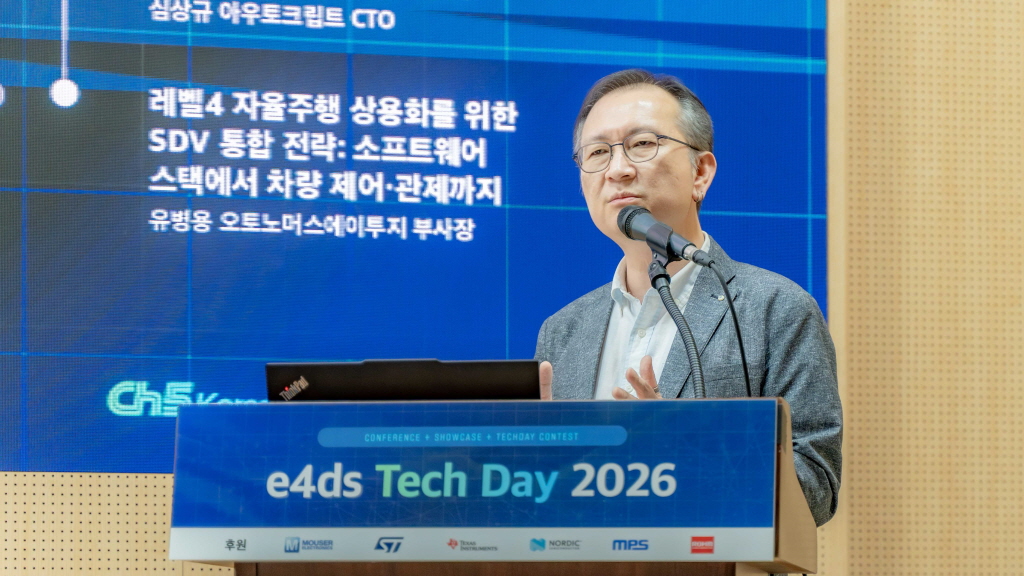
[e4ds Tech Day 2026 ⑨] Sim Sang-gyu, Autocrypt CTO: "In the Physical AI Era, Automotive Security Must Extend Beyond the Vehicle"
At e4ds Tech Day 2026, Sim Sang-gyu, CTO of Autocrypt, explained automotive cybersecurity strategies in the era of Physical AI and SDV (Software-Defined Vehicle). Automobiles are evolving as part of an ecosystem connected to AI, cloud, chargers, IoT, and robots, and he emphasized that the scope of security must expand beyond the vehicle interior to the entire connected environment. In particular, AI model tampering, adversarial attacks, OTA updates, and EV charger hacking were identified as major threats. He explained that response measures require zero trust, AI model integrity protection, intrusion detection, Security by Design and Default, and full lifecycle security management, and that proactive security system establishment beyond regulatory compliance is critical for securing future mobility competitiveness.
2026.10.12by 배종인 기자

Practical HIL Construction Strategy for Automotive and Off-Highway Controller Validation
As vehicle E/E architecture transitions to zonal structures and shifts to software-defined vehicles (SDV), the number of controllers (ECUs) requiring validation and software complexity are surging dramatically. Meanwhile, real vehicle testing cannot provide repeated verification under identical conditions and entails lead time and safety concerns. This white paper explains the principles of HIL (Hardware-in-the-Loop) validation and the structure of the NI platform composed of PXI, SLSC, and VeriStand, and through two actual implementation cases—Camera Record & Replay HIL for In-Cabin Monitoring Controller (ICMU) and Forklift Controller (VCU) HILS—describes how controller-level regression testing becomes possible. Additionally, it explicitly states application boundaries and limitations, such as lack of A2B support.
2026.10.12by 편집부











