


[Reporter's Notebook] 3D Printing: Has the Bubble Bursted?
 Published2016.04.18 19:54
To conclude, the "wind" of 3D printing is only just beginning. This isn't just a reporter's "hope." Industry insiders unanimously agree that the problem lies not in 3D printing itself, but in our premature illusions and expectations about it.
Yes, it was. It was a bit noisy at one point. At events related to 3D printing, it was packed. To put it a bit hyperbolicly, it felt like if we just adopted 3D printing right away, we could achieve truly "innovative" manufacturing. Weren't we a bit of a hasty people? Our haste led to rapid economic development, but didn't it also lead to bubbles everywhere?
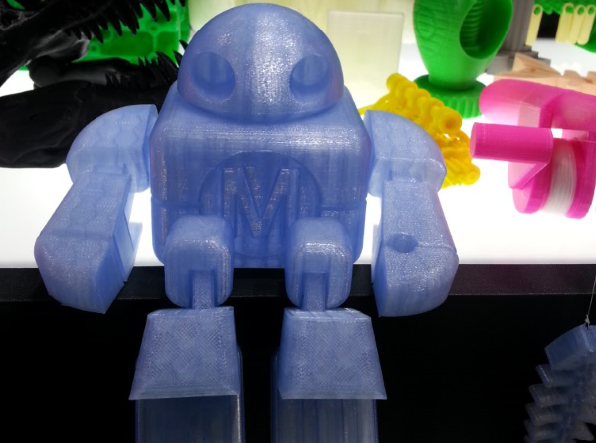
▲3D printing printer work.
"I think there was a bubble. Just like other industries, bubbles come and go. I think 3D printing is also experiencing a bubble burst right now," said an official from MakerBot, a subsidiary of global 3D printing company Stratasys.
An official from Mirae Trading, which imports and sells 3D Veloper products, also agrees. “I remember being surprised by the high price of the printers, which were more expensive than I expected, as people were very interested in 3D printing and were asking questions,” he recalled.
The story goes that people who flocked to the famous party saw the product's performance and price and turned away exclaiming, "Ah!!" Despite this, the 3D printing market is steadily expanding. According to one market research firm, the global 3D printer market size is expected to grow vertically from $3.7 billion in 2015 to $4.9 billion in 2017, $6.5 billion in 2019, and $10.8 billion in 2021. The same is true in Korea. It was reported that the market was worth around 30 billion won in 2012 and 50 billion won in 2014.
A recent report by Seo Jin-won, a researcher at the LG Economic Research Institute, titled "The 3D Printing Era: It's Just Beginning" identified the following as prerequisites for the widespread adoption of 3D printing: securing 3D printing performance and material diversity and competitiveness, reducing quality control costs, and enhancing customer value through optimal design. These challenges were evident in the early days of the 3D printing industry and remain, and will continue to be, top priorities.
However, technological advancements are solving these problems one by one, and it seems likely that widespread adoption will soon follow. A representative from Mirae Trading stated, "The current 3D printing market is clearly divided into low-priced and high-priced products. While low-priced products are sold to schools for educational use or for individual purchase, high-priced products are sold for industrial use."
MakerBot's popular 3D printers incorporate numerous convenience features. The display window, which shows the printing progress, has been enlarged and made easier to operate, providing the necessary information. By installing a camera inside the printer, you can monitor the printing status with your mobile phone even when you leave work.
Seo Jin-won, a researcher at the LG Economic Research Institute, said, "The dawn of the 3D printing era has begun. As 3D printing's limitations are overcome, the product areas where 3D printing is advantageous will gradually expand. Companies will need to understand whether the products they are manufacturing are likely to fall into areas where 3D printing is advantageous."
Those in the 3D printing industry say it's only a matter of time before the product becomes widespread. However, they emphasize that if used for specific purposes, small-batch, customized products or complex designs can provide a competitive edge.
They say that in the next five years, 3D printing's output speed will be ten times faster than it is now, its precision will be five times higher, and its price will be cut in half. So, rather than having hasty expectations, I think what we need is the 'imagination' to utilize 3D printing as a new manufacturing method.
Comments
Related news

Autodesk Strengthens IoT Services and 3D Printing Technology
Strengthening enterprise Internet of Things (IoT) cloud services through acquisition of 'C-Control', and enhancing 3D printing technology through acquisition of 'NetFabb'
2015.10.12by
3D Developer Participates in China 3D Printing Shenzhen 2015
3Developer, a 3D printer and material import supplier under Mirae Trading, announced that it will participate in 3D Printing Shenzhen 2015, which will be held in Shenzhen, China from November 25th (Wednesday) to 27th (Friday) for three days, and will showcase 3D printer filament Colorfabb and 3D printing samples as the Asia distributor.
2015.11.23by 신윤오 기자
What are the 3 challenges 3D printing must overcome to become a high-value-added industry, not an illusion?
Opinions remain divided on which sectors 3D printing technology can be applied to, and there are still unresolved questions about what obstacles must be overcome for 3D printing to lead to the third industrial revolution. In response, LG Economic Research Institute has released a report on prerequisite tasks for the expansion of 3D printing.
2016.01.12by

ESP32 Development Environment Selection and GPS Application Implementation
The ESP32 is a microcontroller that integrates Wi-Fi, Bluetooth, 12-bit ADC, capacitive touch, PWM, DAC, and UART in a single SoC. However, the abundance of features does not by itself solve the designer's problems. The real challenges lie in selecting the appropriate development environment, determining which pins can be used and which must be avoided, and converting raw data from modules into usable information. This document addresses ESP32 peripheral constraints (ADC2 and Wi-Fi coexistence limitation, UART1 occupancy, ADC non-linear regions), the trade-offs between Arduino IDE and ESP-IDF, and the process from connecting NEO-6M/NEO-M8N GPS modules to UART2, parsing NMEA sentences, and visualizing routes in Google Earth, all organized based on documented references.
2026.10.12by 편집부

MIPI CSI-2, DSI-2, C-PHY, D-PHY Test Solution Technical White Paper
The MIPI interface adopts a burst mode that transitions between low-power (LP) and high-speed (HS) states for low-power consumption, and in return, strict timing rules are imposed on state transitions. Additionally, the high-speed section operates as a packet-based protocol with headers, ECC, and CRC, so verification engineers must handle waveforms and protocols simultaneously. Traditional configurations combining general-purpose oscilloscopes and AWGs reveal limitations in setup complexity, measurement uncertainty, and lack of reproducibility when faced with these requirements. This white paper, based on webinar materials, organizes the structure of this problem and describes how the SV5C-DPTXCPTX generator for receiver testing and SV5C-DPRXCPRX analyzer for transmitter testing integrate state transition testing, stressed eye testing, and protocol analysis into a single bench, along with their application boundaries.
2026.10.12by 편집부











