


Virtual Reality and Augmented Reality Technologies: Where Have They Come and Where Are They Being Applied?
 Published2016.04.20 06:41
To be held at the Association Conference Center on April 29… Business information by industry, content, etc.
#Scene 1. Middle school student A is touring Bulguksa Temple in Gyeongju during history class. He looks at Seokgatap Pagoda and examines Dabotap Pagoda. The historical information he hears from the friendly guide's voice sinks right into his mind. However, for some reason, A can clearly see the internal structure of the pagodas. He could see the materials and structures of the pagodas at a glance. In fact, A did not actually visit Bulguksa Temple. A VR device worn like glasses guided him as if he had actually been there. A had a vivid experience, seeing and touching the historical knowledge he had learned only from textbooks, just as if he had visited the temple in real life.
#Scene 2. Mr. B was walking down the street when he came across a brightly blooming azalea. As he composed the shot with his finger, a photo was taken and uploaded to his wearable device. Checking the photo is also not difficult. He simply needs to project the device's display screen onto the floor of a coffee shop table. Editing the photo is as simple as moving his fingers in mid-air. Now, he no longer envies Tom Cruise from the movie *Minority Report*.
The examples above are not of the distant future. They are things that can be realized right now using Virtual Reality (VR) and Augmented Reality (AR). VR can be applied to all fields requiring immersion, such as realistic games, movies, and military training experiences, while AR can be applied to real life, such as education, travel, and shopping, by using smartphones or AR glasses.
VR refers to a virtual space created by a computer that allows users to experience a real-life situation through a VR device, whereas AR overlays virtual reality onto the real world; it is a concept where reality and the virtual are fused, rather than a completely virtual world like VR. You can understand VR as entering a graphic world, whereas AR is the concept of overlaying graphics onto the real world.
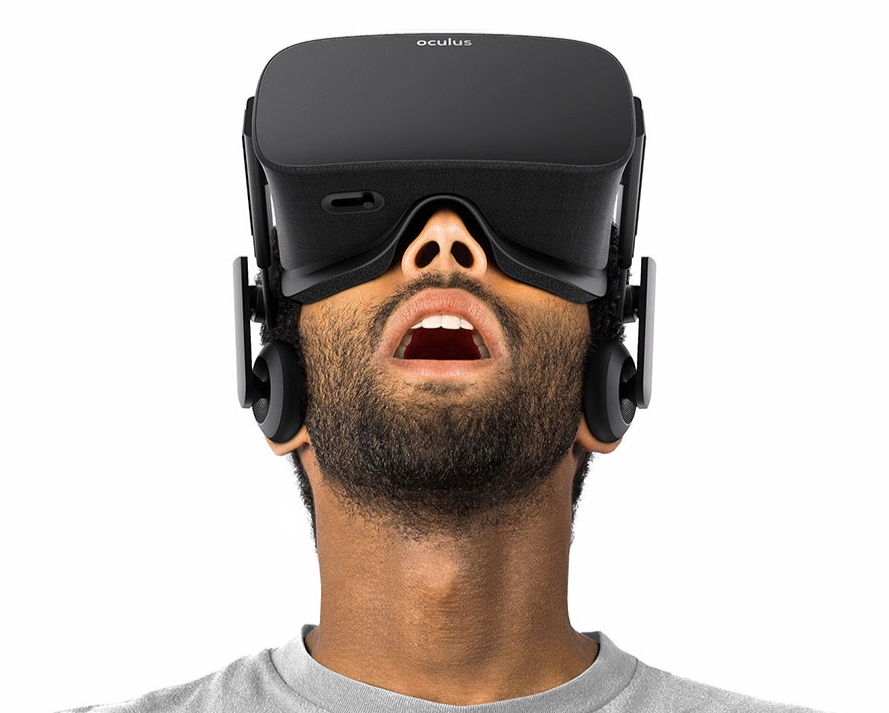
▲ Oculus Rift introduction scene.
According to market research firms, the VR/AR market is worth approximately $150 billion and is expected to grow at an average annual rate of 100% over the next five years. With the VR market size predicted to grow to a total of $6.7 billion in 2016, approximately 70 million VR headsets are projected to be sold by 2017.
Accordingly, the Korea Institute of Industrial Technology (www.kitanet.or.kr) is organizing a seminar on the upcoming 29th titled '2016 Technology Development Trends and Application Cases by Sector in Virtual Reality (VR) and Augmented Reality (AR)' to examine the present and future of the VR/AR industry.
Researcher Jae-in Hwang from the Korea Institute of Science and Technology will introduce VR/AR technology development trends, core technologies, application fields, and future strategies through his presentation on 'VR/AR Technology Development Trends and Application Cases,' while Professor Hyung-seok Kim from Konkuk University will present on 'VR/AR Interaction Technology Development Trends and Application Cases,' covering concepts of VR interaction for experience sharing and the application of technologies for multi-modal VR interaction.
Professor Ryu Je-ha of the Gwangju Institute of Science and Technology will introduce haptic technology trends and application examples in virtual and augmented reality during his presentation on "Technology Development Trends and Application Cases by Field for Virtual Training Systems Using Haptic Technology." CEO Jeong Deok-young of ClickT Co., Ltd. will present on virtual reality content.
In his presentation on "Successful Virtual Reality (VR) Game Technology Development Trends and Application Cases," Choi Jeong-hwan, Vice President of Skonec Entertainment, discusses the reasons for developing VR games now, recent development trends, and methods for successful VR game development. Lee Dong-gil, Center Director at the Korea Institute of Photonics Technology, introduces various wearable smart devices through his presentation on "Technology Development Trends and Application Cases of Wearable Smart Glasses for Virtual Reality (VR) Implementation."
In addition, Professor Jae-Hyung Park of Inha University, who will be presenting on 3D displays for Virtual Reality (VR) and Augmented Reality (AR), will introduce the general requirements for VR/AR displays, fatigue caused by the mismatch between convergence and accommodation, and solutions to resolve this mismatch using 3D display technology. The medical field is also an area that cannot be overlooked.
In the session <Virtual Reality (VR) Technology Development Trends and Application Cases in the Medical Field> presented by Professor Moon Young-rae of Chosun University, current 3D virtual reality technology and standardization trends in the medical sector will be discussed.
Seminar registration is being accepted at the Korea Institute of Industrial Technology (http://www.kitanet.or.kr).

Comments
Related news
To Avoid Repeating the Failure of 3D TV in the Virtual Reality (VR) Industry...
Virtual reality (VR) technology, which creates a realistic experience through real-time interaction with humans in a three-dimensional virtual space built using computers, is gaining significant attention. As VR becomes more mainstream, there is growing recognition that lessons from the problems encountered with 3D TV should be heeded. VR is a user interface technology that uses specialized glasses and gloves to enable humans to experience simulated scenarios realistically through their senses such as vision and hearing, based on what is possible within computer software programs. It allows users to view and manipulate environments as if they have entered spaces that are difficult to experience in everyday life. Consequently, VR is being utilized across diverse fields including military, entertainment, medical, education, film, and tourism.
2016.02.22by 신윤오 기자
China's VR Market Is Growing Fast, VR Devices Expected to Grow 476% This Year
According to IDC (www.idc.com), a market analysis and consulting firm specializing in the IT sector, China's VR (Virtual Reality) device market is projected to reach 480,000 units in 2016, representing a 476% increase year-over-year, driven by the growth of Chinese VR companies such as DeePoon, ANTVR, and 3Glasses. Currently, these VR companies are announcing long-term plans encompassing both hardware and equipment as well as software ecosystems. Furthermore, major global VR companies such as Oculus, HTC, and Sony have announced that they will begin launching products starting in 2016.
2016.02.25by 신윤오 기자
KT Chairman Hwang Chang-kyu Demonstrates 5G Leadership by Experiencing VR Live Streaming at Suwon Baseball Stadium
KT (Chairman Hwang Chang-kyu) announced on the 6th that it provided the world's first GiGA VR mobile baseball live broadcast at the KT Wiz home opening game held on the 5th at Suwon KT Wiz Park. Chairman Hwang Chang-kyu, the owner of the KT Wiz baseball club, directly encouraged the KT Wiz players before the start of the home game, and after the game began, experienced the GiGA VR mobile baseball live broadcast together with KT Group employees and executives, strongly demonstrating the company's commitment to leading the 5G communication era in which services such as 'GiGA VR' will become commonplace.
2016.04.06by 명세환 기자

ESP32 Development Environment Selection and GPS Application Implementation
The ESP32 is a microcontroller that integrates Wi-Fi, Bluetooth, 12-bit ADC, capacitive touch, PWM, DAC, and UART in a single SoC. However, the abundance of features does not by itself solve the designer's problems. The real challenges lie in selecting the appropriate development environment, determining which pins can be used and which must be avoided, and converting raw data from modules into usable information. This document addresses ESP32 peripheral constraints (ADC2 and Wi-Fi coexistence limitation, UART1 occupancy, ADC non-linear regions), the trade-offs between Arduino IDE and ESP-IDF, and the process from connecting NEO-6M/NEO-M8N GPS modules to UART2, parsing NMEA sentences, and visualizing routes in Google Earth, all organized based on documented references.
2026.10.12by 편집부

MIPI CSI-2, DSI-2, C-PHY, D-PHY Test Solution Technical White Paper
The MIPI interface adopts a burst mode that transitions between low-power (LP) and high-speed (HS) states for low-power consumption, and in return, strict timing rules are imposed on state transitions. Additionally, the high-speed section operates as a packet-based protocol with headers, ECC, and CRC, so verification engineers must handle waveforms and protocols simultaneously. Traditional configurations combining general-purpose oscilloscopes and AWGs reveal limitations in setup complexity, measurement uncertainty, and lack of reproducibility when faced with these requirements. This white paper, based on webinar materials, organizes the structure of this problem and describes how the SV5C-DPTXCPTX generator for receiver testing and SV5C-DPRXCPRX analyzer for transmitter testing integrate state transition testing, stressed eye testing, and protocol analysis into a single bench, along with their application boundaries.
2026.10.12by 편집부











