


Augmented Reality (AR) Patents Surge 12-fold in 10 Years, Smart Car-Related Patents Are High
 Published2016.04.22 10:29
Patent applications surge along with smartphones and wearable devices
It was found that the number of patent applications for AR (Augmented Reality) has increased approximately 12-fold over the past 10 years.
According to the Korean Intellectual Property Office (KIPO, Commissioner Dong-Kyu Choi), an analysis of domestic patent applications for AR over the past 10 years (2005 to 2014) showed that an average of 52 patents were filed per year from 2005 to 2009 (261 patents over 5 years), and an average of 619 patents were filed per year from 2010 to 2014 (3,094 patents over 5 years), indicating an approximately 12-fold increase in the number of patent applications.
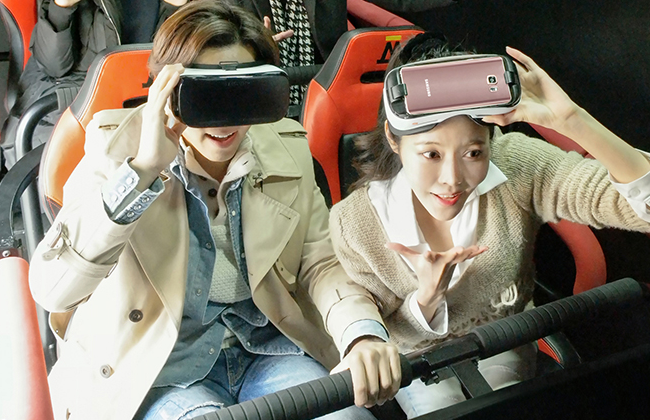
▲Samsung Electronics introducing the VR' 4D virtual reality experience event held in November last year.
Virtual Reality (VR), which displays virtual spaces and objects on a computer graphics screen, and Augmented Reality (AR), which displays the real world and virtual information together, are entering our daily lives through combination with smartphones or commercialized HMDs.
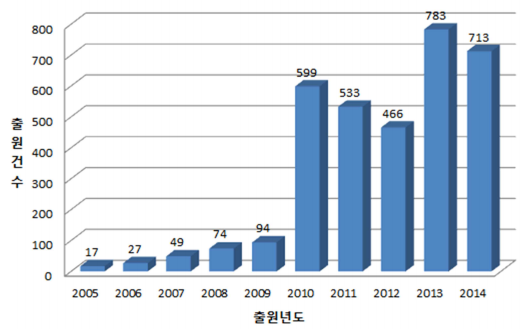
▲AR technology patent application trends (2005-2014, unit: cases)
The devices that implement AR have also changed with the development of new technologies. In 2010, approximately 71.6% (429 cases) of AR patent applications were found to implement AR on mobile devices, which is interpreted as the popularization of smartphones with graphical user interfaces (GUIs) and powerful hardware. In 2013, AR using mobile devices slowed down, and instead, commercialized HMDs and wearable devices such as Google Glass were released, and patent applications for AR using these devices increased by up to 35.9% (256 cases).
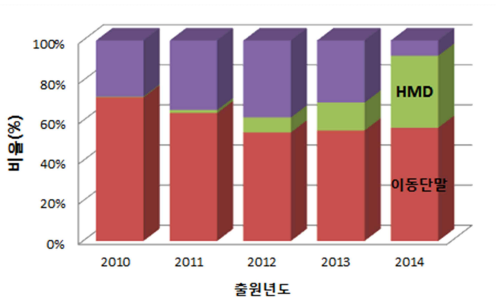
▲Patent application trends and application proportion for mobile terminals and HMDs implementing AR (2010-2014)
Patent applications for AR, which combines with the real world to implement direct interaction, were mostly in the fields of education (13.4%), medicine (11.6%), culture (9.0%), sports (8.0%), and broadcasting and advertising (8.6%). On the other hand, the number of patent applications for VR, which requires interaction with the virtual world and immersion using 3D modeling, was found to be higher than that for AR in the industrial (18.0%), game (17.0%), and military (5.2%) fields.
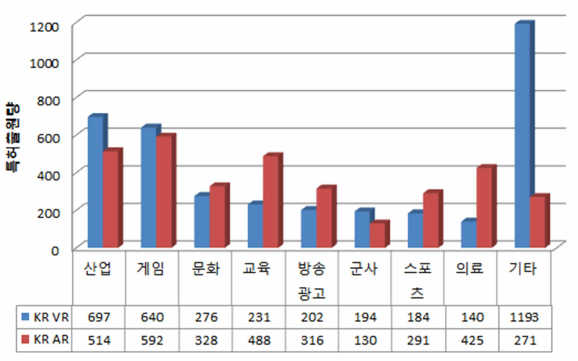
▲Patent application rate by field of AR and VR (2005-2014)
Technologies that combine real-time information using IoT with AR had 436 patent applications between 2010 and 2014, of which 148 cases (approximately 40%) were patent applications for the combination of AR and IoT applicable to smart cars, 107 cases (24.5%) were patent applications related to smart homes that control home appliances, 39 cases (8.9%) were patent applications for artificial intelligence (AI) to control AR and IoT, and 142 cases (32.6%) were others.
The IoT of smart cars will combine the V2V (Vehicle to Vehicle) function, in which cars communicate with each other, and the V2M (Vehicle to Machine) function, in which cars communicate with peripheral devices such as traffic lights, with AR to provide drivers with intuitive road and traffic conditions by displaying them on the car's head-up display (HUD) or transparent display on the front.
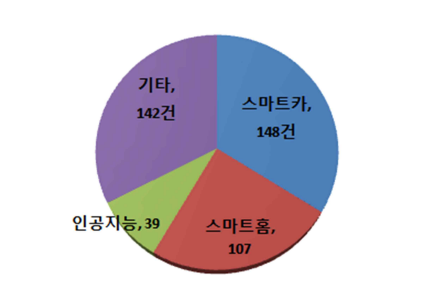
▲Patent application rate related to IoT combined with AR (2010-2014)
Kim Hee-tae, head of the Processing System Examination Division of the Korean Intellectual Property Office, said, “VR or AR technologies are likely to be developed into next-generation platforms that provide intelligent services that provide content according to situations in combination with IoT, AI, and big data in the future, or that provide users with adaptive data in real time according to the changing environment. Therefore, efforts are needed to develop integrated technologies and secure intellectual property rights in this field.”
Comments
Related news
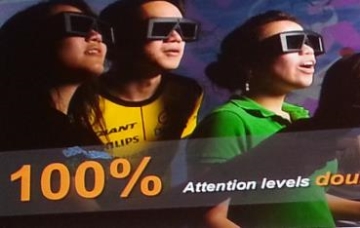
The future of virtual reality (VR) is quickly becoming the present.
Anderson's CTO stated, "Our focus areas include industry, education, and entertainment, and last year we particularly concentrated on the education sector," adding, "By utilizing our VR prototype solutions in actual industrial sites, we have achieved dramatic improvements in safety and accuracy, resulting in cost reduction effects, and the learning effectiveness demonstrated in educational settings shows a retention rate of over 80% compared to traditional education methods."
2015.09.09by 신윤오 기자
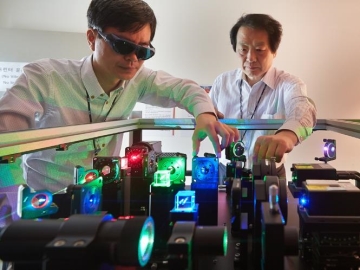
Development of 360-degree color hologram display, a step forward in virtual reality technology
The tabletop holographic display developed by ETRI is one of the intermediate results of technology being developed through the Giga Korea project, and it is a technology capable of reproducing color hologram images in all 360-degree directions above the table display.
2015.12.03by 명세환 기자
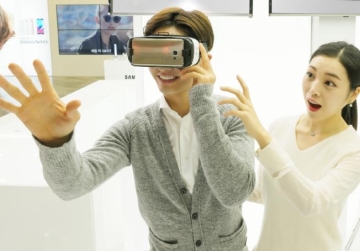
Artificial intelligence, virtual reality, sensing homes… consumers consider them the near future
According to this report, consumers expect to be able to interact with objects without looking at smartphone screens in the not-too-distant future through the use of artificial intelligence (AI). Approximately half of smartphone users anticipate that smartphones will become outdated devices within the next five years.
2015.12.22by 신윤오 기자
To Avoid Repeating the Failure of 3D TV in the Virtual Reality (VR) Industry...
Virtual reality (VR) technology, which creates a realistic experience through real-time interaction with humans in a three-dimensional virtual space built using computers, is gaining significant attention. As VR becomes more mainstream, there is growing recognition that lessons from the problems encountered with 3D TV should be heeded. VR is a user interface technology that uses specialized glasses and gloves to enable humans to experience simulated scenarios realistically through their senses such as vision and hearing, based on what is possible within computer software programs. It allows users to view and manipulate environments as if they have entered spaces that are difficult to experience in everyday life. Consequently, VR is being utilized across diverse fields including military, entertainment, medical, education, film, and tourism.
2016.02.22by 신윤오 기자
AMD Supports Supercomputing-Class Performance for Virtual Reality Content
AMD has unveiled a high-performance virtual reality (VR[i]) platform that delivers exceptional performance to virtual reality content producers and consumers. The AMD Radeon™ Pro Duo, equipped with the LiquidVR™ SDK, is a product developed to suit diverse virtual reality content production environments including entertainment, education, journalism, healthcare, and film.
2016.03.24by 명세환 기자











