


Will TI accelerate its automotive business by combining ADAS and infotainment?
 Published2016.04.26 17:20
Accounting for 15% of last year's sales, the product line doubled, focusing on business
“Automotive is a strategic business.”
Texas Instruments (TI) has chosen "automotive" as its future strategic business area. The company describes itself as "a semiconductor design manufacturer leading the development of analog ICs and embedded processors," and this suggests it intends to focus its accumulated capabilities on automotive applications.
It's not just words. A look at the company's various figures reveals TI's significant commitment to the automotive industry. TI's revenue last year was $13 billion, of which $8.3 billion came from analog, $2.8 billion from embedded processing, and $1.9 billion from other areas. When broken down by sector, the automotive sector accounts for 15% of total sales at 1.95 billion, a figure that has been increasing by 1-2% annually since 2013.
“TI invested 22% of its R&D in the automotive sector, and the number of new automotive products more than doubled from 2013 to 2014,” said Sang-Kyun Kang, director of TI Korea.
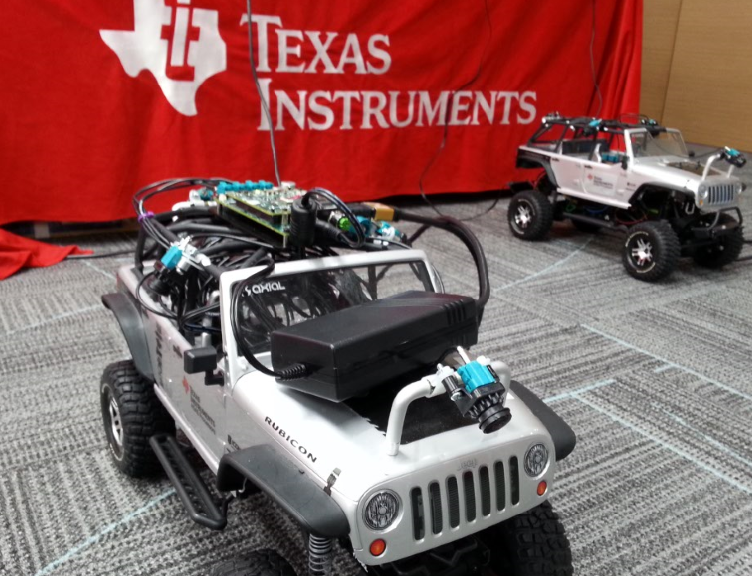
▲Surround view technology was demonstrated on a model car at TI Info & ADAS Day.
In fact, TI's focus on the automotive sector lasted only five or six years, but its product development dates back to 1980. Therefore, the turning point for significant sales growth is considered to be 2010. Regarding this, Director Kang stated, "In terms of automotive sales, it took 30 years to reach $1 billion by 2010, but it only took five years, by 2015, to reach another $1 billion." He emphasized the importance of this, saying that given the current focus on automotive, that period could become even shorter in the future.
So, how and what are you going to focus on automotive? TI has divided the automotive market into five innovative areas: ADAS, Passive Safety, Hybrid/electric and Powertrain Systems, Body Electronics & Lighting, and Infotainment & Cluster. It has combined ADAS and infotainment into the umbrella term "Informational ADAS." In other words, TI aims to bring ADAS concepts to the infotainment sector to realize a "smart car PC."
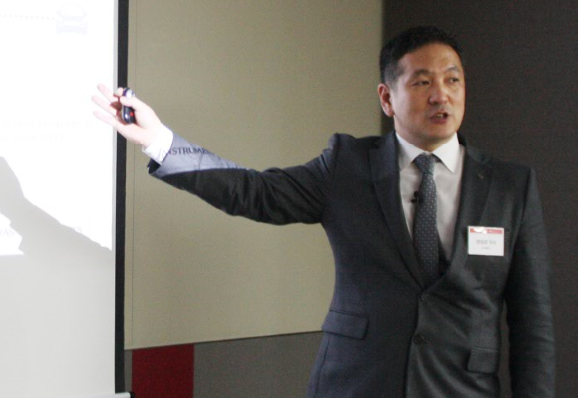
▲TI Korea Director Sang-Kyun Kang introduces TI's automotive business.
Informational ADAS includes driver seats with interior cameras, more visual dashboards, surround-view systems that monitor all angles, vision systems that act as eyes on the road, and 3D navigation with head-up displays. The forecast that the number of ADAS features per vehicle will more than double between 2013 and 2021 also brightens the outlook for this sector.
TI's representative solutions in the ADAS and infotainment fields are the TDA series and Jacinto processors. Director Kang also said that the Informational ADAS concept “goes beyond marketing terminology to become a functional integrated technology. Simply put, it can be thought of as the integration of TDA and Jacinto solutions.”
The TDA SoC is the latest addition to TI's scalable, highly integrated automotive processor family, a scalable family of devices designed to meet the demands of advanced ADAS. The TDAxx family enables a wide range of ADAS applications in modern vehicles by integrating an optimal combination of performance, low power, and ADAS image analytics processing to facilitate enhanced autonomous driving and a crash-free driving experience.
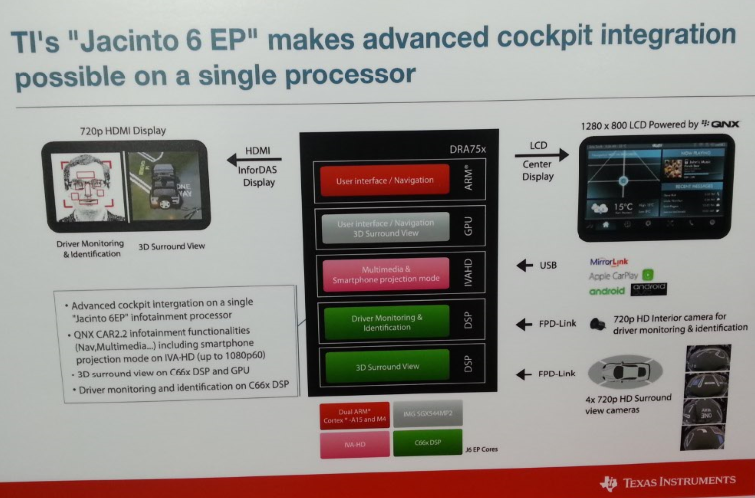
▲ When ADAS and Infotainment Meet - TI's Jacinto 6 EP processor enhances digital cockpit integration by enhancing DSP and vision processing performance. This processor features 3D surround view, powered by the C66x DSP and GPU. A 720p HDMI display enables driver monitoring and recognition, helping prevent drowsy driving.
The Jacinto family of processors is ideal for entry-level infotainment systems. It offers rich infotainment and telematics features suitable for entry-level and mid-size vehicles, and can also be applied to mainstream infotainment applications and head units. There are also families of processors that enhance "digital cockpit" integration by enhancing DSP and vision processing performance. In February, the company also added the 'Jacinto 6' product line (DRA71x) for next-generation entry-level and display audio products.
Regarding TI's automotive processors, Director Kang said, "TI has shipped more than 120 million automotive SoCs to date," and "80 to 90 million cars are expected to be produced this year, and one-third of them will use TI processors."
High-speed CAN transceiver attracts much attention as a CAN FD compatible product
In particular, TI recently attracted attention by announcing a family of high-speed CAN transceivers supporting CAN (controller area network) FD with speeds up to 5 Mb/s. The company said that the new TCAN1042 and TCAN1051 CAN transceiver families, which meet all EMC industry standards required by automotive manufacturers in the U.S. and Europe, support high-level bus fault protection, fast CAN FD, and the industry's shortest loop delay.
As such, automotive is clearly poised to be TI's fastest-growing business segment for the foreseeable future. This is because the company's strategy of increasing investment and expanding its product line to meet the ever-growing automotive market is paying off.
So, will a differentiated Informational ADAS strategy propel TI's automotive business forward? It's hard to say for sure, but if we add processors, analog, and TI's strength in wireless technology, TI will have even more to do in the automotive market.
Comments
Related news
TI's Processor Mounted on Volkswagen Infotainment System
TI announced that it is collaborating with Volkswagen to provide a new infotainment platform with enhanced performance, flexibility, and adaptability. Volkswagen's MIB II infotainment platform adopts TI's 'Jacinto' processor, power management IC, FPD-Link III serializer and deserializer. TI's devices provide enhanced processing performance, platform scalability, and responsive user interfaces on this platform.
2016.02.26by
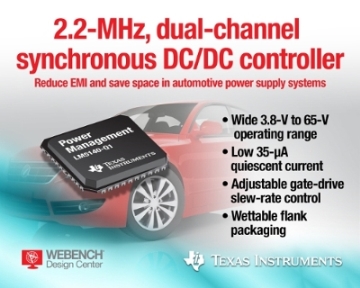
TI Launches Wide Input Voltage Range DC/DC Controller IC with 65V Operation
TI (CEO Kent Chun) announced the launch of a dual-channel synchronous buck converter IC operating at 2.2MHz that integrates proprietary features capable of significantly reducing EMI (electromagnetic interference) and high-frequency noise in high-voltage DC/DC step-down applications such as automotive infotainment and high-end cluster power supply systems.
2016.03.22by 명세환 기자
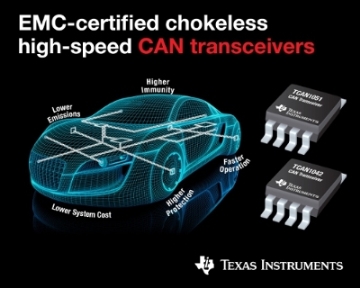
TI Launches Chokeless High-Speed CAN Transceiver Family Providing Superior EMC Performance
TI Korea (CEO Kent Jeon) announced the launch of two CAN (controller area network) transceiver product families that meet all industry standards for EMC (electromagnetic compatibility) required by automotive manufacturers in the United States and European regions. The new TCAN1042 and TCAN1051 CAN transceiver product families provide optimal protection and high performance for various automotive and industrial applications by supporting high-level bus fault protection capabilities, fast CAN flexible data rate (FD), and the industry's shortest loop delay time.
2016.04.06by 명세환 기자
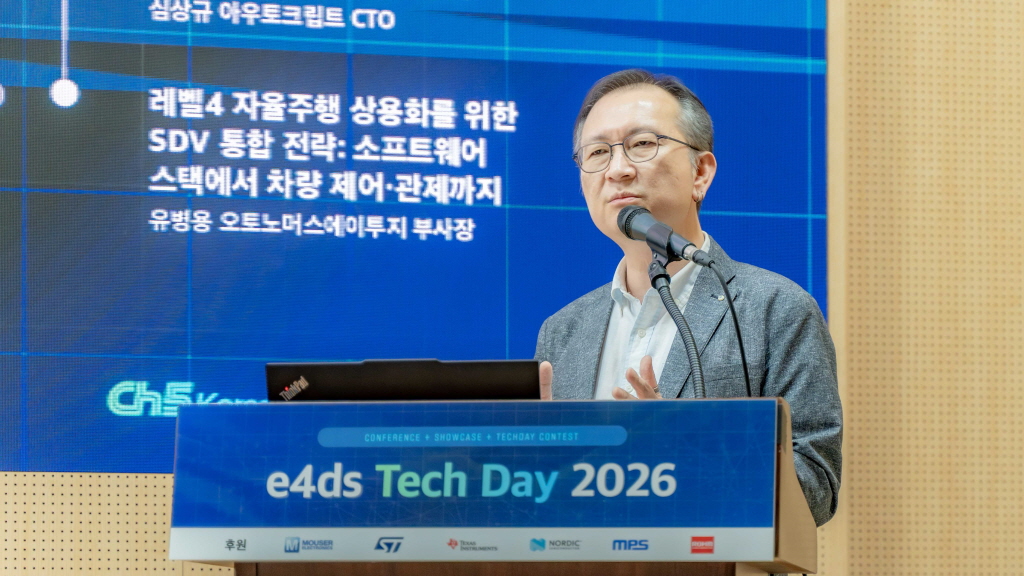
[e4ds Tech Day 2026 ⑨] Sim Sang-gyu, Autocrypt CTO: "In the Physical AI Era, Automotive Security Must Extend Beyond the Vehicle"
At e4ds Tech Day 2026, Sim Sang-gyu, CTO of Autocrypt, explained automotive cybersecurity strategies in the era of Physical AI and SDV (Software-Defined Vehicle). Automobiles are evolving as part of an ecosystem connected to AI, cloud, chargers, IoT, and robots, and he emphasized that the scope of security must expand beyond the vehicle interior to the entire connected environment. In particular, AI model tampering, adversarial attacks, OTA updates, and EV charger hacking were identified as major threats. He explained that response measures require zero trust, AI model integrity protection, intrusion detection, Security by Design and Default, and full lifecycle security management, and that proactive security system establishment beyond regulatory compliance is critical for securing future mobility competitiveness.
2026.10.12by 배종인 기자

Practical HIL Construction Strategy for Automotive and Off-Highway Controller Validation
As vehicle E/E architecture transitions to zonal structures and shifts to software-defined vehicles (SDV), the number of controllers (ECUs) requiring validation and software complexity are surging dramatically. Meanwhile, real vehicle testing cannot provide repeated verification under identical conditions and entails lead time and safety concerns. This white paper explains the principles of HIL (Hardware-in-the-Loop) validation and the structure of the NI platform composed of PXI, SLSC, and VeriStand, and through two actual implementation cases—Camera Record & Replay HIL for In-Cabin Monitoring Controller (ICMU) and Forklift Controller (VCU) HILS—describes how controller-level regression testing becomes possible. Additionally, it explicitly states application boundaries and limitations, such as lack of A2B support.
2026.10.12by 편집부











