



Changing the Sensor Paradigm with Ion Channel-Based Pressure Sensors
 Published2016.05.02 15:10
Applicable to various fields such as displays, medical devices, fuel cells, and the fabrication of various sensors.
While contemplating the various problems found in existing sensors, I observed subtle, accurate, and stable responses to diverse external forces in living organisms. I began this research with the expectation that mimicking or imitating this could lead to the development of a sensor representing a new paradigm.
Professor Han Chang-soo's team at Korea University, which developed an ultra-sensitive soft pressure sensor that operates with low power or without power depending on pressure intensity by deeply mimicking 'human skin sensory organs' down to the cellular level, explained the background of their research as follows.
This research, conducted with support from the Ministry of Science, ICT and Future Planning and the Global Frontier Nano-based Soft Electronics Research Group (Director: Gil-Won Cho), utilizes an ion channel-based pressure sensor, unlike conventional electrical circuit-based pressure sensors. Consequently, it does not require electrical circuits or other auxiliary devices and can operate with low driving power or without a power source.
The ion channel sensor, which is the core of this technology, is an artificial sensor that mimics the mechanism of biological cells in human sensory organs. It is a new concept wearable pressure device that utilizes the kinetic energy of ionic liquids, does not require a large energy source (low power or no power), can be used semi-permanently, does not require many electronic components such as electronic circuits and amplifiers, and is flexible, enabling pressure detection on curved parts of the human body and various shapes.
Ion channels are pore-shaped proteins located in the cell membrane that play a role in transporting ions or water molecules into and out of the cell. Human sensory organs also have a structure in which stimuli-receiving parts are combined with ion channels, and the brain perceives the signals generated when ions move within the ion channels through nerves.
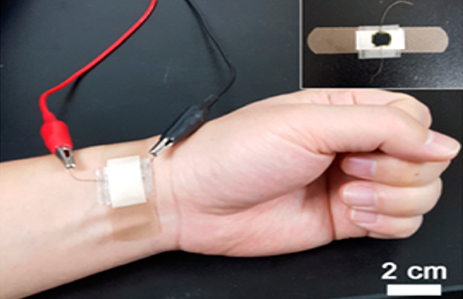
▲ A view of human blood pressure being monitored in real time using this sensor
Through this research, the implementation of a pressure sensor that mimics the cell membrane ion channel system of sensory organs has enabled high-sensitivity pressure sensing across a wide range of motions and pressures by appropriately configuring the three elements of receptors, electrolytes, and ion channels. Therefore, the research team stated that developing sensors based on this ion channel system for various external stimuli, not just pressure sensing, will serve as a fundamental technology for creating diverse sensors based on new concepts.
Furthermore, artificial ion channel systems are expected to have a significant ripple effect on related industries by being utilized not only as sensors but also in ion generators, ion batteries, and electrolyte membranes for fuel cells, and by aligning with the national policy to foster green energy. In particular, as this area requires interdisciplinary convergence across various fields such as bio, nano, mechanics, and electronics, it is expected to contribute to the creation of new forms of convergent academic disciplines.
In the sensor field, it appears that this can be utilized as an additional or alternative device, particularly for the elderly and many people with disabilities, and it can serve as a core element technology for this purpose. Furthermore, by providing a new type of sensor with excellent performance and high selectivity for various sensors such as heat, flow, pressure, weight, and odor, and contributing to the creation of a new concept sensor capable of miniaturization and high sensitivity, as well as by developing technology capable of simultaneously measuring diverse and complex sensor information for sensor implementation, it is expected to play a significant role in realizing sensor networks suitable for ubiquitous computing.
Officials from the Ministry of Science, ICT and Future Planning and the research institute explained the significance of the study, stating, “This research represents a completely new type of sensor distinct from existing concepts. It can be applied to various industrial fields where power consumption is a concern, including IoT, machinery, electronics, energy, and the environment. It is expected to become a core source technology for creating diverse sensors based on new concepts, such as the development of sensors that mimic animal sensory organs.”
Professor Chang-Su Han's research team (Korea University) is conducting research with support from the Ministry of Science, ICT and Future Planning's Global Frontier Project Soft Electronics Research Group, and this research was published online on April 12 in ACS Nano, a world-renowned journal in the field of nanotechnology.

Comments
Related news
Environmental sensors that meet IoT are expanding in all directions, including “indoor car environments, mobile, and smart homes”
As Internet of Things (IoT) technology spreads, demand for environmental sensors such as temperature/humidity sensors, gas sensors, and pressure sensors is rapidly increasing. This is because demand for sensors that meet requirements such as ultra-miniaturization and low power consumption is surging in order to collect object information across various IoT application fields. In particular, smart environmental sensors are high-functionality, high-precision, high-convenience, and high-value-added sensors that combine sensing elements with intelligent signal processing to perform data processing, automatic calibration, self-diagnosis, and decision-making functions. Environmental sensors include temperature/humidity sensors, gas/pressure sensors, as well as dust sensors, ultraviolet sensors, and water quality sensors, and these sensors support real-time environmental monitoring regarding the effects of environmental pollutants in environmental media such as water and atmosphere, humans, and ecosystems.
2016.03.21by 신윤오 기자
LG Innotek Develops Ultra-Slim Pulse Sensor Module Suitable for Wearable Devices
LG Innotek (CEO Park Jong-seok) announced that it has successfully developed an ultra-slim pulse sensor module at world-leading levels. Pulse sensors are primarily used in wearable devices and smartphones to measure heart rate, stress index, and blood oxygen saturation. The newly developed pulse sensor module achieves a thin profile while reducing power consumption and enhancing measurement performance. Users of IT devices equipped with this module can now receive more accurate health information from smaller and lighter products.
2016.03.31by 신윤오 기자

Analog Devices acquires Swiss company Snap Sensor to bolster IoT sensing capabilities.
Analog Devices (www.analog.com, NASDAQ: ADI) announced that it will acquire SNAP Sensor SA, a privately-held Swiss company with highly innovative vision sensing technology. The acquisition is expected to further strengthen Analog Devices' leading position in the sensing and signal processing fields, and platform-level Internet of Things (IoT) solutions such as ADI's award-winning BLiP (Blackfin Low Power Imaging Platform) are anticipated to be developed.
2016.04.06by 신윤오 기자

ESP32 Development Environment Selection and GPS Application Implementation
The ESP32 is a microcontroller that integrates Wi-Fi, Bluetooth, 12-bit ADC, capacitive touch, PWM, DAC, and UART in a single SoC. However, the abundance of features does not by itself solve the designer's problems. The real challenges lie in selecting the appropriate development environment, determining which pins can be used and which must be avoided, and converting raw data from modules into usable information. This document addresses ESP32 peripheral constraints (ADC2 and Wi-Fi coexistence limitation, UART1 occupancy, ADC non-linear regions), the trade-offs between Arduino IDE and ESP-IDF, and the process from connecting NEO-6M/NEO-M8N GPS modules to UART2, parsing NMEA sentences, and visualizing routes in Google Earth, all organized based on documented references.
2026.10.12by 편집부

MIPI CSI-2, DSI-2, C-PHY, D-PHY Test Solution Technical White Paper
The MIPI interface adopts a burst mode that transitions between low-power (LP) and high-speed (HS) states for low-power consumption, and in return, strict timing rules are imposed on state transitions. Additionally, the high-speed section operates as a packet-based protocol with headers, ECC, and CRC, so verification engineers must handle waveforms and protocols simultaneously. Traditional configurations combining general-purpose oscilloscopes and AWGs reveal limitations in setup complexity, measurement uncertainty, and lack of reproducibility when faced with these requirements. This white paper, based on webinar materials, organizes the structure of this problem and describes how the SV5C-DPTXCPTX generator for receiver testing and SV5C-DPRXCPRX analyzer for transmitter testing integrate state transition testing, stressed eye testing, and protocol analysis into a single bench, along with their application boundaries.
2026.10.12by 편집부











