



Security issues becoming visible due to the spread of industrial automation and the Internet of Things (IoT)
 Published2016.05.03 17:16
Felix Baum, Mentor Graphics
As the growth of the Internet of Things (IoT) and the Internet of Everything (IoE) accelerates, unprecedented developments and technological innovations are taking place across numerous industrial and consumer sectors. One of the fields experiencing such tremendous growth is industrial automation.
Through the recent wave of industrial automation known as 'Industrial Revolution 4.0,' major industrial automation manufacturers such as Siemens and General Electric are realizing a future of interoperability not only between devices but also between facilities and operations scattered across the globe. Communication between devices now extends from end nodes to enterprises and the cloud. Industry 4.0 presents some perplexing challenges, the main of which is how to apply secure protection layers to industrial automation networks. More specifically, how can any device be protected from malicious malware and cyber attacks (Figure 1)?
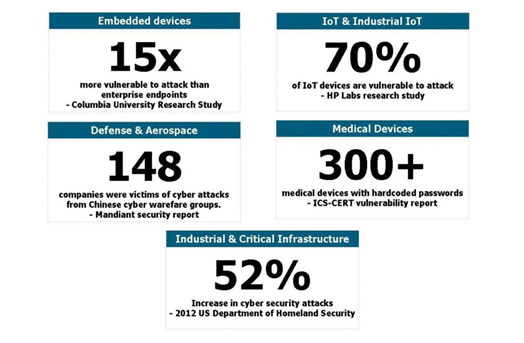
Figure 1 : As the adoption of the Internet of Things (IoT) expands, the risk of cyber attacks is increasing not only in the industrial infrastructure sector but also in other industrial sectors.
Source: Icon Labs
The primary reason many companies add security features is to comply with regulations.
In some U.S. markets, such as the power grid, only companies that meet specific regulatory compliance standards can sell equipment. Examining regulatory and security standards reveals that numerous standards target different markets and regions.
EDSA Certification for Equipment Security 'Attracts Attention'
One of the major industrial automation standards in the United States is the ISA/IEC-62443 standard. When this standard is implemented, it is referred to as EDSA (Embedded Device Security Assurance) certification. The ESA/IEC-62443 organization oversees manufacturers to undergo a rigorous certification compliance process, which includes numerous independent tests, procedures, and reports. For example, robustness testing is intended to ensure robust implementation. The functional security assessment involves specific functions and features implemented to ensure security. Another test, the evaluation of the software development lifecycle, ensures that software development is completed in a way that maximizes the device's security. As device manufacturers progress through the certification process, the requirements for each of these tests become stricter to guarantee stronger in-device security at every level of execution.
Increased security threats render existing security systems ineffective
A popular security approach in the past was to erect extensive fences around the enterprise. Since devices were concealed within these defense lines, users did not need to worry about security issues at individual nodes. Most companies used to have large IT departments monitor the security posture by building barriers and maintaining the robustness of the network or the enterprise.
However, today we can no longer rely on such defense line control. This is because the embedded devices we manufacture are ubiquitous and connected to everything. This is why endpoint protection is so critical. Let's take the laptop you are currently using at work as an example. While it is, of course, connected to a secure corporate network, it also likely has endpoint protection enabled and is running McAfee or Symantec software.
The endpoint protection approach used in your laptop should also be applied to industrial automation devices. Unfortunately, however, embedded devices used today are rarely protected in this way. There are almost no defensive features built into devices to slow down hacker attacks, and to make matters worse, threats or breaches are frequently not detected or reported.
Basic considerations for manufacturing safe devices
To understand what is needed to build a secure device, it is best to take a step back and reflect on the features that provide its foundation. One of these features is identity management, which ensures that the device is not a counterfeit. In other words, it guarantees that no one has manufactured a counterfeit device and introduced it into the network. Mutual authentication is another key feature that prevents individuals from impersonating others or arbitrary machines from pretending to be others. Several other features, such as audit logs, are also important for regulatory compliance.
Another important consideration is understanding the environment in which the device will be deployed. The device must be designed not only to be safe but also to support the functions required for the environment in which it operates. Within an industrial automation environment, embedded devices may need to communicate with sensors, actuators, human-machine interfaces (HMIs), and other devices within the network. Therefore, they must be able to authenticate with each of these devices. The key point here is that while security can be analyzed independently of the device we manufacture, it is never implemented in a vacuum.
When implementing a device, you must consider mutual authentication that takes place within the context of the network. To whom should device authentication be permitted? Or, if authorization is considered, which individuals should be authorized to communicate with the device, and how should this be implemented?
The Need for a Complete Security Framework
Security features should not be embedded solely in the device itself, but must also be implemented in the enterprise where the device is deployed. Mentor Graphics recently announced an architecture for a fully secure framework in collaboration with key industry partners. This architecture not only facilitates the realization of security layers but also enables the development of enterprise-wide networks and individual devices for automation and industrial control systems. Called the Mentor Embedded Solution for Industrial Automation (Figure 2), this fully secure architecture encompasses a broad range of embedded system technology solutions that enable the development of power-efficient, connected, and secure industrial automation systems.
For example, partner company Icon Labs provided an embedded firewall equipped with rule and threshold-based filtering capabilities, along with packet inspection capabilities that can track network connection status to contribute to network security. In addition, partner Wurldtech provided Achilles test infrastructure and certification services to protect systems and enterprises from cyber attacks.
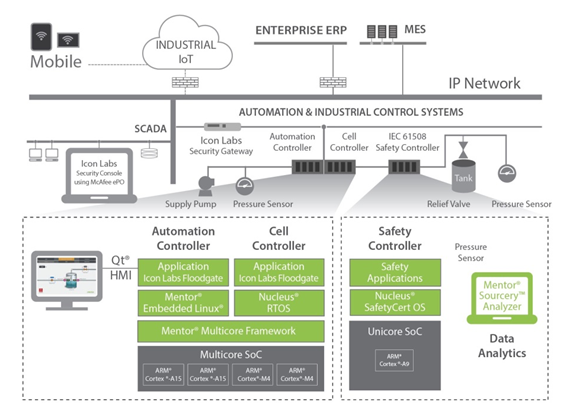
Figure 2: Mentor Embedded Solution for Industrial Automation, introduced by Mentor to meet the need for a complete security framework, is a multi-platform approach that covers communication between devices from end nodes to industrial enterprises as well as the cloud.
Corporate Security Management
Examining this comprehensive security framework reveals numerous important security features. One such feature is the ability to monitor and manage devices. Device manufacturers must design embedded devices to function like PCs within a network. This means that security policy management systems or security information and event management systems must be integrated into these devices for management. Security policy management systems are used to control security policies and enforce them across devices throughout the network.
Typically, this type of management system is equipped with the ability to report events and review event logs. One of the key benefits of policy management support is that when new threats emerge or network configurations change, only the security policies for the devices need to be modified. Security information and event management systems serve as large-scale analytics engines that collect data from numerous devices across the network, identifying trends and detecting anomalies. Event management systems provide powerful tools for enterprise security management.
Establishing this type of security management system is critical for realizing IoT convergence. IoT convergence refers to operational assets or embedded devices converging with IT assets and operating within the same network under similar management technologies. Security devices must support functions such as event reporting. This enables the reporting of security events, such as invalid login attempts or when the device is discovered. Reporting these types of activity back to the management system helps ensure the security of the entire network.
Enhanced hardware security for the secure execution of authenticated software
If the hardware supports password aggregation features to process passwords more quickly for your company's security protocols, be sure to use them.
It is also extremely important to ensure that only trusted and authenticated software runs on the device by incorporating anti-tamper support, secure booting, and secure firmware update capabilities. This is best realized when the given hardware includes built-in features such as a trusted execution environment or a trusted platform module. Furthermore, this provides the highest layer of security by guaranteeing secure booting at the silicon level.
The Importance of Firewalls
Another element of the complete security framework is the firewall (Figure 3). Integrating the firewall into the endpoint device allows you to set and enforce communication policies. This includes a couple of different modules or layers. One is static-based filtering, which allows communication policies to be set and enforced through IP addresses, ports, protocols, and other variables. A packet filtering engine capable of tracking network connection states supports protection against attacks such as TCP SYN flood attacks or Christmas tree attacks, as well as other malicious attacks that cause anomalous behavior in the device by utilizing state information within TCP packets.
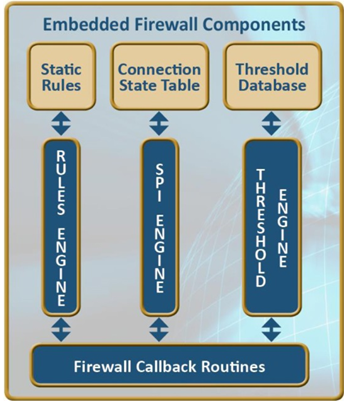
Figure 3: Various components configuring endpoint firewall protection for operating systems running on embedded devices. Source: Icon Labs
Furthermore, if your device needs to communicate with the outside of a protected enterprise, it is recommended to use security protocols. Various different protocols can be used to conceal or protect transmitted content through data encryption. It is also a good idea to include authentication features using protocols such as X509, Kerberos, and Radius. These protocols enable mutual authentication between both ends of the tunnel by establishing a tunnel before data transmission and authenticating and verifying both the sender and the receiver.
conclusion
In the industrial automation security sector, it is important to integrate security functions into the device itself. We can no longer rely solely on the security features of the defense line. We must not forget that hackers are highly intelligent and do not give up. There is no way to perfectly protect a device with a single solution. What is more important today is not only to add layers of safety across enterprises in the industrial automation sector but also to add security features to individual embedded devices.
Author's Biography
Felix Baum oversees virtualization, multi-OS, and multi-core technologies within the Product Management team of Mentor Graphics’ Embedded Systems business unit. He has worked in the embedded industry for nearly 20 years as both a developer and manager in the embedded sector, leading product marketing and management for various real-time operating system technologies and silicon architectures over the past several years. Prior to that, he managed the technical needs of global strategic alliance partners in the Business Development division, helping them solve challenges in integrating and promoting joint solutions for their shared customers. Before that, he served as a Field Technical Engineer (FAE) in the Los Angeles metropolitan area, providing customer consulting on the development of highly optimized devices across a wide range of industries, including aerospace, networking, industrial, medical, automotive, and consumer. He began his career at NASA’s Jet Propulsion Laboratory (JPL) at the California Institute of Technology, where he developed flight software for various spacecraft and managed launch preparations for the GRACE mission. He holds a Master of Science degree in Computer Science from the University of California, Northridge, and an MBA from the University of California, Los Angeles.

Comments
Related news
Wind River partners with IBM in industrial IoT business.
Wind River announced today that it has collaborated with IBM to release a customer guide titled "edge-to-cloud" recipe, designed to enable industrial customers to develop smart connected devices more quickly and easily in support of IoT deployment.
2016.02.12by 신윤오 기자
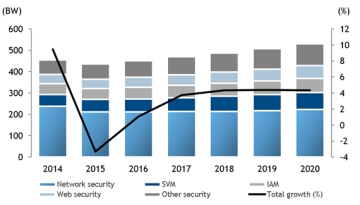
The domestic IT security market contracted by 4.1% last year compared to the previous year, but the future outlook is bright.
According to a recent domestic IT security product market outlook report published by Korea IDC (CEO Hong Yu-suk), the domestic IT security product market last year was tallied at 437 billion won, a 4.1% decrease compared to the previous year. The network security segment, which includes firewalls and UTM equipment, is analyzed to have led the overall IT security product market decline, falling approximately 10% year-over-year due to market saturation. The domestic IT security product market is projected to grow at a compound annual growth rate (CAGR) of 3.2% over the next five years, exceeding 500 billion won by 2019 and reaching a scale of 530 billion won in 2020.
2016.04.07by 신윤오 기자

[Reporter's Notebook] What will short-range wireless communication be that will take over IoT homes?
As short-range communication networks such as WiFi and Bluetooth have come into the spotlight as necessary communication means for home automation applications to be connected, competition between different communication technologies has become inevitable. The main short-range communications currently applied to IoT devices for home automation include WiFi, Bluetooth, ZigBee, and THREAD. Each of these communication technologies has advantages and disadvantages in terms of power consumption, range, and scalability, and is expanding its domain.
2016.04.25by 신윤오 기자
Korea Instrument, KOLAS Accredited Calibration Agency First to Simultaneously Acquire ISO/IEC 27,001·27,701
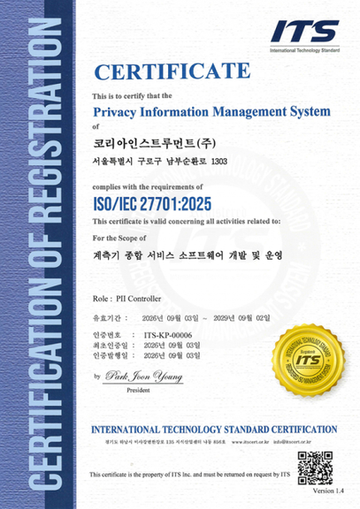
Korea Instrument has become the first among KOLAS accredited calibration agencies to simultaneously acquire ISO/IEC 27,001 and ISO/IEC 27,701 certifications. Through its proprietary platforms CWIZ Enterprise and CWIZ Partners, the company has embedded information security and personal data protection requirements across all business processes including customer information, equipment data, and calibration reports, with plans to continuously advance its management system through regular audits and security inspections.
2026.10.12by 배종인 기자

TeamViewer One, IT Incident Automation Workflow and Resolution Center Enhanced
TeamViewer has added IT incident automation capabilities and an advanced Resolution Center to its integrated digital workplace management platform 'TeamViewer ONE'. Recurrent service disruptions, configuration errors, and capacity shortages are automatically handled according to preset policies, and device status verification through script deployment can be managed in a unified interface, significantly reducing repetitive tasks for IT teams.
2026.10.12by 배종인 기자











