


Notable Increase in Patent Applications Related to Disaster Response Robots
 Published2016.05.10 12:07
Complex technologies such as kinematic design technology, self-localization technology, and object and environment recognition technology
The strong earthquakes that struck Japan and Ecuador in succession last April caused numerous casualties and property damage, but recovery is still requiring a lot of time and manpower. With small-scale earthquakes occurring frequently in Korea recently, public concern is growing that we are no longer safe from natural disasters such as earthquakes; consequently, interest in robot technology that can be deployed for rescue operations and disaster recovery is on the rise.
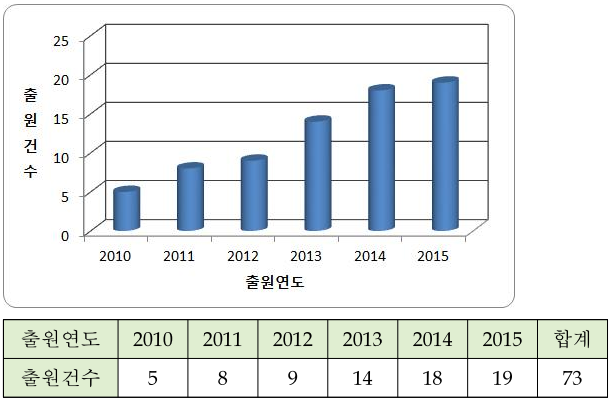
▲ Annual patent application status for disaster response robots
A disaster response robot refers to a robot deployed in place of humans in extreme environmental conditions, such as natural disasters like earthquakes and tsunamis, as well as nuclear power plant leaks and large building collapses.
According to the Korean Intellectual Property Office (Commissioner Choi Dong-gyu), domestic patent applications related to disaster response robots (based on the filing date) showed a continuous increase since 2010, with 22 applications filed between 2010 and 2012 and 51 applications filed between 2013 and 2015, whereas previously the annual average was only 2 to 3 cases.
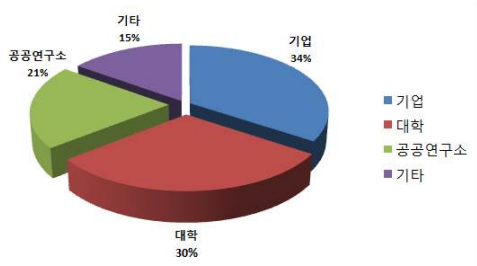
▲ Patent application status by applicant for disaster response robots
Looking at the application rates related to disaster response robots, companies accounted for the highest proportion at 34%, followed by universities at 30%, public research institutes at 21%, and other individuals at 15%; however, since there is no significant difference in the proportion of patent applications among companies, universities, and public research institutes, research in this fieldIt shows that the initiative is proceeding in a balanced manner across industry, academia, and research.
Looking at the technology trends of patent applications filed since 2010, firefighting-related fields such as fire suppression accounted for 32%, and disaster environment deployment and rescue fields accounted for 30%, while detection and surveillance fields accounted for 23%, surface and underwater fields for 10%, and other fields for 5%, and patents related to surface and underwater fields concerning maritime accidents are also being filed steadily.
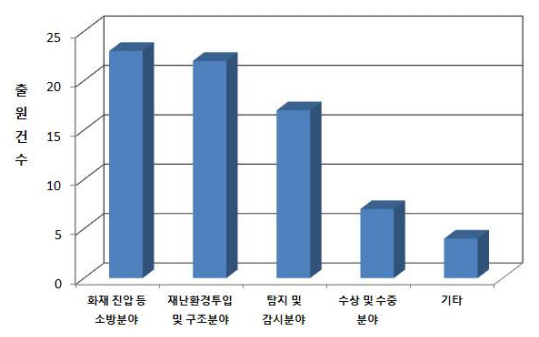
▲ Patent application status by technology trend related to disaster response robots
Korea's disaster response robot technology has been recognized as being of a world-class level, with the KAIST team winning the '2015 DARPA Robotics Challenge,' a global disaster response robot competition, with their 'DRC-HUBO' robot.
Kwon Young-ho, Head of the Robot Automation Examination Division at the Korean Intellectual Property Office, stated, “With natural disasters occurring frequently worldwide recently, there is an increasingly urgent need for the technological development of disaster response robots. As disaster response robots are a complex integration of technologies such as kinematic design, self-localization, object and environment recognition, information and communication technology, autonomous mobility, and battery performance enhancement, they have a significant ripple effect on related industries. Moving forward, we anticipate the development of disaster response robots that surpass actual humans by combining humanoid robot technology, which further mimics human behavior, with disaster response technology.”

Comments
Related news
[it-Movie] The Present and Future of Wearable Robots in Movies. 'Iron Man' Can't Protect Me?'
On February 3rd, the Defense Acquisition Program Administration announced a plan with the Ministry of Public Safety to develop 'wearable exoskeleton robot' technology by 2020. The exoskeleton robot is one type of wearable robot that amplifies force by detecting the user's movement intent. When it comes to wearable robots, the film that comes to mind is 'Iron Man,' famous for the line "I'm Iron Man," so news articles about exoskeleton robots have been featured with headlines such as 'Iron Man suit from the movies coming?' (Donga Ilbo), 'Korean Iron Man appears' (Korea Ilbo), and 'Korean military to wear Iron Man suit in 4 years' (Yonhapnews).
2016.03.14by
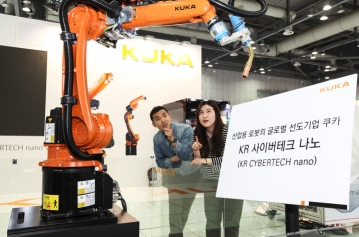
KUKA Demonstrates Total Automation Solutions, Including Industrial Robots, at SIMTOS 2016
Kuka Robotics Korea Co., Ltd. will participate in the 17th SIMTOS 2016 exhibition, an international machine tool fair being held at KINTEX in Ilsan for five days starting from the 13th, and will showcase the new product 'KR CYBERTECH nano' series in the low payload robot segment. The KR CYBERTECH nano series, optimized for the metal working machine field, will demonstrate welding operations together with Kuka's industrial robots and present a total automation solution. Kuka's multi-joint compact robot KR AGILUS will secure the workpiece and perform precise position adjustment, while the KR CYBERTECH nano will execute 360-degree welding operations requiring high precision.
2016.04.14by 명세환 기자
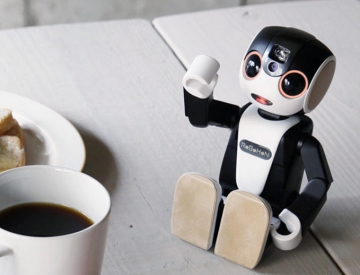
[Reporter's Notebook] Intelligent Robot Industry, Step Up to Build an Ecosystem
After the "match of the century" between human and machine came to an end, the government was thrown into confusion for a while. It was as if they had only then recognized the importance of "artificial intelligence," and they would have retrieved future growth engine documents again, highlighting artificial intelligence-related technologies in fluorescent color. Artificial intelligence discourse was also unavoidable at the recently held future growth engine intelligent robot seminar. Robots are recognized as the most representative industrial field of artificial intelligence, with technology integrating high-performance sensor technology and actuator technology together with big data and software. This is because intelligent technology plays a critical role in the core functions of robots, such as perception and decision-making.
2016.05.02by 신윤오 기자
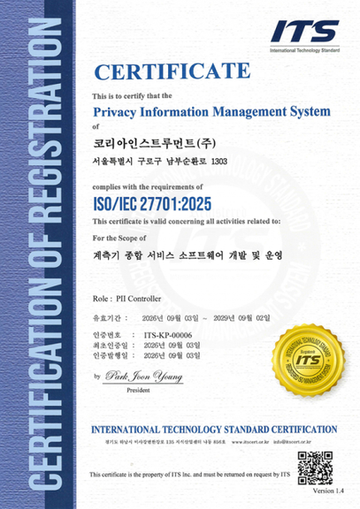
Korea Instrument, KOLAS Accredited Calibration Agency First to Simultaneously Acquire ISO/IEC 27,001·27,701
Korea Instrument has become the first among KOLAS accredited calibration agencies to simultaneously acquire ISO/IEC 27,001 and ISO/IEC 27,701 certifications. Through its proprietary platforms CWIZ Enterprise and CWIZ Partners, the company has embedded information security and personal data protection requirements across all business processes including customer information, equipment data, and calibration reports, with plans to continuously advance its management system through regular audits and security inspections.
2026.10.12by 배종인 기자

TeamViewer One, IT Incident Automation Workflow and Resolution Center Enhanced
TeamViewer has added IT incident automation capabilities and an advanced Resolution Center to its integrated digital workplace management platform 'TeamViewer ONE'. Recurrent service disruptions, configuration errors, and capacity shortages are automatically handled according to preset policies, and device status verification through script deployment can be managed in a unified interface, significantly reducing repetitive tasks for IT teams.
2026.10.12by 배종인 기자











