


Domestic PC shipments in the first quarter remain at last year's levels; recovery expected in public and education markets
 Published2016.05.18 13:42
Shifting the focus of open markets to sales and offline channels to profit.
According to a recent analysis of the domestic PC market by IDC Korea, domestic PC shipments in the first quarter of 2016 were 1.53 million units, maintaining the level of the previous year.
Compared to the 12.5% decline in the global PC market in the first quarter, the domestic market is analyzed to be relatively robust due to the expansion of ultra-slim laptops with a thickness of 21mm or less and increased demand in the education sector. On the other hand, PC shipments in the enterprise sector decreased by 9.0% year-on-year due to reduced IT investment resulting from weakening export conditions, and desktops still account for over 70% of the market share in terms of cost and security.
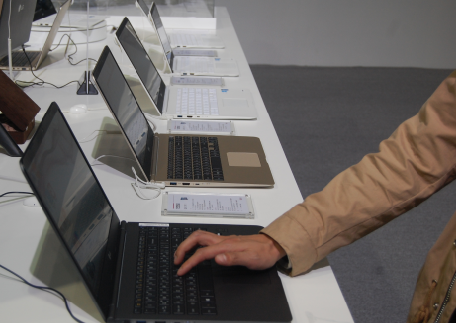
Looking at the breakdown by product type, 520,000 ultra-slim laptops were shipped, a 28.1% increase year-over-year, reaching an all-time high with 57.3% of the total laptop market share. 11-inch models featured eMMC to lower prices and enhanced portability through cloud connectivity, while products 12 inches and larger focused on improving computing performance by primarily equipping them with SSDs.
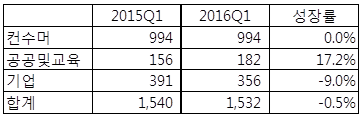
▲ PC shipments by domestic market, 2015Q1 vs. 2016Q1 (thousands)
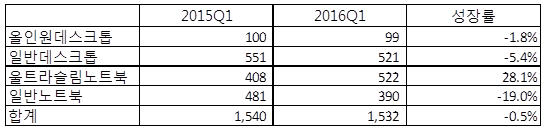
▲ Domestic PC Shipments by Product, 2015Q1 vs. 2016Q1 (thousands of units)
For ultra-slim models, the 13-inch segment accounted for the largest share at 42.3%, while 15-inch products with improved design and reduced weight also grew rapidly, expanding their share to 37.6%. On the other hand, while all-in-one desktops shifted to larger screens ranging from 21 inches to 23 inches, shipments decreased by 1.8% year-on-year due to the absence of Microsoft's Bing products.
It is important to increase value by bundling hardware and services.
By market, the public and education sectors saw shipments fall by 16.2% to 530,000 units in 2015 due to early replacements resulting from XP migration in 2014, but demand is expected to recover somewhat this year. Following the first quarter, outdated PCs in schools are scheduled to continue being replaced in the second quarter, and demand from local governments and military units is expected to arise, with a steady increase in demand for laptops in particular.
Open markets are driving sales and volume in conjunction with mobile shopping, while offline retail channels are focusing on the sale of mainstream and premium products with a focus on profitability. To strengthen sales for small and medium-sized enterprises, collaboration and strategy with channel partners are becoming increasingly important, and as the profitability of hardware itself decreases, there is a need to transition to a method of bundling services together and proposing them.
"As PC demand declines and competition among companies intensifies, hardware revenue is bound to decrease," explained Sang-Jun Kwon, a senior researcher at IDC Korea. "It will become increasingly important to enhance value by bundling hardware and services and to defend or enter the market through collaboration with channel partners."
Comments
Related news

The domestic PC market is also showing a clear decline, with ultra-slim PCs gaining traction.
According to Korea IDC's recent domestic PC market survey, PC shipments in Korea last year totaled 4.48 million units, representing a 7.8% decline compared to 4.86 million units in 2014. While 2014 maintained commercial demand driven by XP migration replacement, both consumer and commercial segments declined in 2015, with consumer down 5.0% and commercial down 11.2%. Desktop shipments decreased 13.7% year-over-year to 2.22 million units, while notebook shipments declined 1.2% to 2.26 million units, with notebooks slightly surpassing desktop shipments. Commercial notebook shipments reached 400,000 units, representing 4.6% growth compared to the previous year, with particularly notable adoption of notebooks in the public education market.
2016.02.18by 신윤오 기자
PC Shipments Continue to Decline Year-on-Year; When Will Demand for Windows 10 Replacements Rise?
According to preliminary results announced by Gartner Inc., global PC shipments in the first quarter of 2016 declined 9.6% year-over-year to 64.8 million units, marking six consecutive quarters of decline. This is the first time global PC shipments have fallen below 65 million units since 2007.
2016.04.12by 명세환 기자
Lenovo Maintains Status as Leading PC Company, Recording a 20.1% Market Share in Q1
Lenovo (www.lenovo.com/kr) announced that it maintained its position as the world's No. 1 PC company for 12 consecutive quarters, recording a 20.1% global PC market share in the first quarter of 2016 based on IDC standards. According to the global PC market share for the first quarter of 2016 announced by both IDC and Gartner, Lenovo maintained its position as the world's No. 1 PC market leader. Based on IDC standards, Lenovo recorded 12 consecutive quarters of the No. 1 position with a 20.1% PC market share globally. Despite the global PC market showing weakness, Lenovo continues to achieve sustained growth by expanding its market share.
2016.04.14by 명세환 기자
.jpg)
SalePoint Signs Multi-Year Partnership Agreement with AWS… Promoting Identity Security that Integrates Even AI Agents
Sailpoint has entered into a multi-year strategic partnership agreement with AWS and is moving forward with establishing an integrated governance system that manages both human and non-human identities together. The plan is to consistently manage access permissions in an environment where AI agents are increasing as work execution entities, while applying the principle of least privilege and automated policy enforcement. The two companies plan to jointly expand capabilities to manage the identities of various entities, including AI agents, within a single layer in the AWS environment. This collaboration is interpreted as a move to design security and governance together in corporate environments where AI adoption is expanding.
2026.03.26by 배종인 기자
.png)
Databricks Unveils Open AI Security Monitoring 'Lakewatch'
Databricks entered the security market on March 24 by unveiling LakeWatch, an open-source agentic SIEM. The core functionality of this product is to integrate and analyze security, IT, and business data in a single environment to support AI-based threat detection and investigation. The company explained that it reduces the limitations of existing security operations centers, which have had to forgo some data due to high cost structures, and enables large-scale data analysis and automation based on open formats and ecosystems. LakeWatch is currently offered as a private preview, with Adobe and Dropbox mentioned as early customers. Databricks also announced an expanded partnership with Anthropic as well as the acquisition of Antimatter and SiftD.ai.
2026.03.26by 배종인 기자











