


Smart factories become even smarter as ‘industrial Ethernet’ spreads rapidly
 Published2016.06.21 10:31
Wireless communication is increasingly being introduced for monitoring purposes based on 802.11 technology.
As smart factories become an issue due to innovation in manufacturing, interest in industrial network technology is also increasing.
In terms of industrial network technology, industrial Ethernet is rapidly expanding in wired communications, and in the wireless communications field, it is mainly used for monitoring purposes rather than control purposes based on 802.11 technology.
First of all, industrial wired communication is spreading industrial Ethernet technology that takes into account the strengths of existing fieldbus and general Ethernet. Fieldbus is an industrial communication technology that is widely used because it is excellent in wiring convenience and small data processing capability, and above all, it is a proven technology with price competitiveness. However, it had the disadvantages of lacking communication media and compatibility, not being able to respond to increasing application demands, and above all, having limited speed (12-16 Mbps) and poor implementation of redundancy functions.
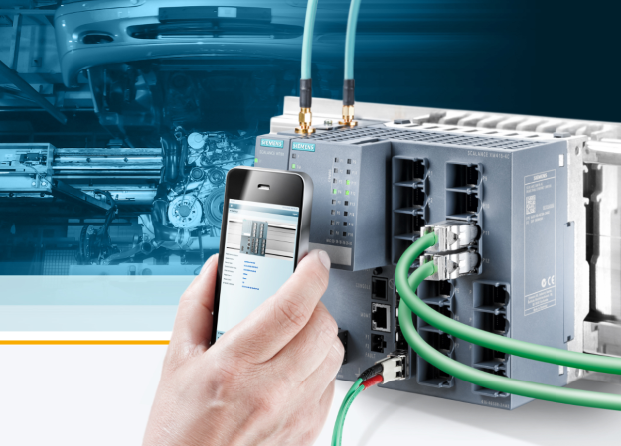
▲Siemens industrial Ethernet switch
In contrast, Ethernet has the advantage of being a mainstream technology that is familiar to the general public, with high-speed transmission speeds (10M to 10Gbps), communication media compatibility, but has the disadvantages of having a vulnerable topology, being non-deterministic, and requiring external switches and hubs.
“Fieldbuses have been used for a long time in industrial networks because they only needed to process small amounts of data, but now that video data is increasing in factories, transmission speeds need to be faster,” said Kwon Dae-hyun, a senior researcher at LS Industrial Systems. “General Ethernet also has problems. It is price competitive, but if one switch breaks down, the entire system can have problems.”
Industrial Ethernet Market Continues to Grow at 20% Annually
Accordingly, industrial Ethernet, which has the advantages of these wired communication standards, is the trend. Industrial Ethernet has supplemented topology vulnerabilities with linear/ring/mesh structure topologies as well as communication media compatibility with high-speed transmission speeds. In particular, it complements its shortcomings with powerful redundancy functions, real-time communication at the 1ms level, and time synchronization at the 1us level.
The industrial Ethernet market is growing at a rate of 20% per year and is integrating existing networks into Ethernet. If this is expressed in numbers, the market size of about 4 trillion won in 2013 is expected to form a 7 trillion won market in 2016 and exceed 10 trillion won in 2018. In terms of technology, the real-time performance of Ethernet is increasing and the commonization of cables and connectors is leading the integration of existing 3-level networks into one. Furthermore, it is expected that its influence will be maximized in the future as it can be applied to tens of millions of devices.
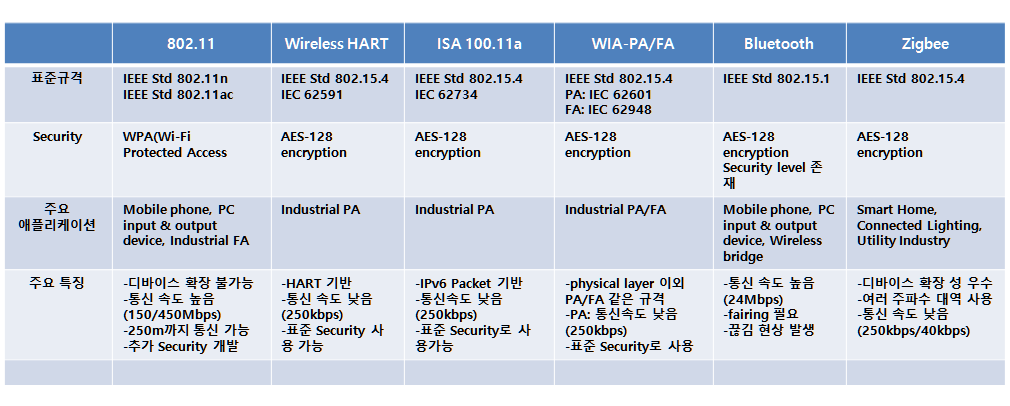
▲ Comparison of industrial wireless communication standards
Accordingly, it is expanding from the existing serial communication base to the industrial Ethernet base. The basic Ethernet technology that is convenient for development and considers compatibility is also moving to technology that considers performance, redundancy, and safety. In contrast, the EtherCAT technology that was growing rapidly is limited to the motion field and its importance is slightly decreasing.
It is also noteworthy that Siemens is expanding its territory by utilizing Profinet technology, and Mitsubishi's CC-Link is strong in Asia. These companies are expanding industrial control networks to include lower-level device communications. Siemens is expanding its overall measurement through Profinet, and Mitsubishi is promoting a unified network for control and device measurement with Ethernet-based CC-Link IE. Domestic LS Industrial Systems is expanding its RAPIEnet expansion strategy by securing various communication modules. American company Rockwell standardized the upper layer with EtherNet/IP and the lower with DeviceNet, and expanded its Ethernet solution to the device area.
Industrial wireless communication is centered on Wi-Fi technology and 802.15.4-based technology.
The remarkable growth of industrial wireless communication is also noteworthy. Wireless communication can be classified by system. Cross Plant Wireless Network is a wireless network for remote maintenance and control, and Plant Wide is a wireless network for various plant applications. Sensor/Actuator Wireless Network monitors sensor actuator nodes operating at the field level through gateways. The industrial wireless network market is expanding centered on Emerson, GE, and Honeywell, and is being developed mainly based on individual standards and WirelessHART/ISA 100.11a.
The need for industrial wireless communications is centered around six use cases: ▲ worker safety around operating equipment ▲ level monitoring and alarms in oil tank assembly areas ▲ field worker support with mobile wireless equipment ▲ vibration monitoring and analysis of rotating equipment ▲ oil well monitoring and control ▲ several applications for factory automation with many nodes.
In the wireless communications field, there are Wi-Fi technologies based on 802.11 and technologies based on 802.15.4. IEC is reviewing the bandwidth (80MHz) and frequency (1.4GHz~6GHz) considering the industrial environment. Looking at the application technologies of specialized companies such as Siemens, Rockwell, Mitsubishi, and Schneider, WLAN and Bluetooth account for a significant proportion. These wireless technologies were mainly used for monitoring purposes rather than control purposes.
“What makes industrial communications different from general communications is that it requires real-time communication and deterministic recovery times in the event of an error,” said Kwon Dae-hyun, head of LS Industrial Systems. “High availability, functional safety, and security are also important considerations when applied to the industrial sector.”
Comments
Related news
How to build a smart factory? 'Ask' the Industrial Internet of Things
As the government decided to establish 10,000 smart factories by 2020 as part of "Manufacturing Innovation 3.0," interest in Industrial IoT has been sharply increasing. While the Internet of Things (IoT), which has recently attracted significant attention, is primarily discussed in the context of consumer products such as homes and automobiles, Industrial IoT (IIoT), which will serve as the core foundation of smart factories, is expected to outpace the consumer IoT market in terms of market size and deployment timeline.
2016.02.15by 신윤오 기자

Siemens PLM Software Signs Industry-Academic Cooperation Agreement for Smart Factory Education and Training
Siemens PLM Software Korea announced that it has concluded an industry-academia cooperation agreement with design software company AUCOTEC and Daejeon University for smart factory education and training. This cooperation was established for the purpose of fostering specialized talent in smart factories, strengthening the smart factory education system, and promoting the development of the smart factory industry. The government is actively working to accelerate smart factory construction as part of its Manufacturing 3.0 strategy. According to the Ministry of Trade, Industry and Energy, a total of 963 smart factories had been constructed by October 2015. The government plans to convert approximately 10,000 small and medium-sized manufacturing plants into smart factories by 2020. Additionally, the government is actively engaged in cultivating software specialists with expertise in design, engineering, and related fields needed in key sectors such as smart factories, in order to address youth unemployment and the shortage of specialized personnel in small and medium-sized enterprises.
2016.05.19by 명세환 기자
Urgent need to embrace changes in smart production through the utilization of industrial IoT
In the utilization of Industrial Internet of Things (IIoT), which serves as the foundation for realizing smart factories, manufacturers' preparedness has been insufficient, indicating that a paradigm shift in awareness regarding smart production is urgently needed. Industrial Internet of Things is being utilized in the manufacturing industry for process optimization and production efficiency improvement, and is expanding to other industries overseas. With the digitalization of manufacturing, IoT technology is being integrated into traditional production processes, with cost reduction and productivity improvement becoming increasingly evident. Industrial Internet of Things, which connects various physical and virtual objects based on the Internet, refers to the collective infrastructure that is utilized in equipment, manufacturing, logistics, and distribution to support intelligent supply chains from a manufacturing perspective and demand-driven production from a sales perspective, and provides various services to enhance industrial efficiency accordingly. Accordingly, it comprises services, devices, and platforms, and through the provision of connectivity among each component, all elements of equipment, manufacturing, distribution/logistics, and services interoperate with one another, providing high value-added creation in the smart manufacturing sector based on this foundation.
2016.06.07by 신윤오 기자
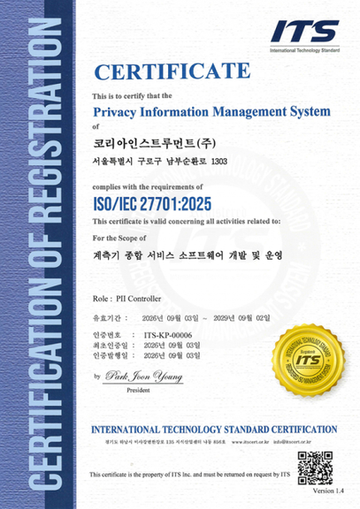
Korea Instrument, KOLAS Accredited Calibration Agency First to Simultaneously Acquire ISO/IEC 27,001·27,701
Korea Instrument has become the first among KOLAS accredited calibration agencies to simultaneously acquire ISO/IEC 27,001 and ISO/IEC 27,701 certifications. Through its proprietary platforms CWIZ Enterprise and CWIZ Partners, the company has embedded information security and personal data protection requirements across all business processes including customer information, equipment data, and calibration reports, with plans to continuously advance its management system through regular audits and security inspections.
2026.10.12by 배종인 기자

TeamViewer One, IT Incident Automation Workflow and Resolution Center Enhanced
TeamViewer has added IT incident automation capabilities and an advanced Resolution Center to its integrated digital workplace management platform 'TeamViewer ONE'. Recurrent service disruptions, configuration errors, and capacity shortages are automatically handled according to preset policies, and device status verification through script deployment can be managed in a unified interface, significantly reducing repetitive tasks for IT teams.
2026.10.12by 배종인 기자











