


Running robot industry, crawling parts technology 'Localization rate less than 20%'
 Published2016.06.27 15:38
Development of robot-specific components such as sensors, controllers, and actuators is necessary
The domestic production rate of parts in the robotics field, which was triggered by interest in artificial intelligence technology, has been less than 50% in recent three-year statistics, and in particular, the rate for key core parts has been less than 20%.
Robots are largely divided into manufacturing, professional service, and personal service. According to the 2014 announcement, manufacturing robots accounted for 9.5B (64%), professional service robots accounted for 3.6B (24%), and personal service robots accounted for 1.7B (12%). The domestic parts market size for these robots was 396.2 billion won in total sales, accounting for 13.9% of all parts, but 50.1% of parts imports were dependent on imports. In other words, half of the core parts, such as image sensors, were imported.
This is consistent with the reason why there are not many companies in Korea that manufacture core robot parts, which are divided into sensor, controller, and actuator parts. This situation is clearly revealed when looking at the technology level and domestic production rate for each part.
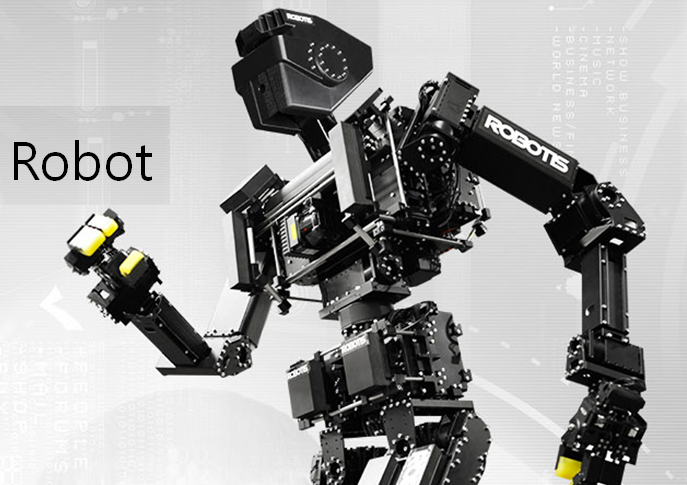
▲ THORMANG 3 by Robotis Co., Ltd. Robotis is a robot company that leads the domestic and international markets with educational robots and professional actuators as its two axes. The actuator 'Dynamixel' developed by Robotis is ranked first in the global actuator market and has also been selected as a world-class product.
First, there are sensors for robots, such as vision sensors, range sensors, force/torque sensors, and inertial sensors. Vision sensors are core sensors that recognize objects, people, and locations, and the Electronic Components Research Institute has developed an embedded vision module. Range sensors are sensors that recognize obstacles and the environment, and there are sensors that use ultrasound or lasers. Force/torque sensors detect arm/hand operating power, and inertial sensors detect movement acceleration and posture.
The domestic technology level of robot sensors is at 72% of that of Japan, and the technology gap is reported to be over 20 years. In the robot sensor industry, which is showing a steady growth rate of 3-5% every year, the domestic market is completely dependent on imports, except for some sensors such as inertia and distance sensors.
What about the robot controller sector? The motion controller, which commonly controls real-time multi-axis robots, is at 78% of the US technology, and the technology gap is estimated at two years. The global robot motion controller market grew 22.1% year-on-year in 2010 to $45.3 billion, while the domestic market grew 36.7% year-on-year to $4 billion.
Actuators for robots, which mainly feature motors, include robot joint drives (motors), high-deceleration, high-torque drives (reducers), and joints with built-in actuator reducer sensors (joint modules), and are in the highest demand in the robot parts sector. Domestic technology is 76% of Japan's, and is worth 8.5 billion dollars in 2010. The domestic market is worth 80 billion won, maintaining a high annual average growth rate of about 23.5%.
Kim Young-wook, a senior researcher at the Electronics and Telecommunications Research Institute (KETI), said, “If you look at the domestic robot industry ecosystem, you can see that there are not many parts companies in terms of the value chain, and they are mainly concentrated in the product sector.” He added, “Since the robot industry, which is centered on technology and products, is not growing quickly, the growth of the parts and service industries is necessary.”
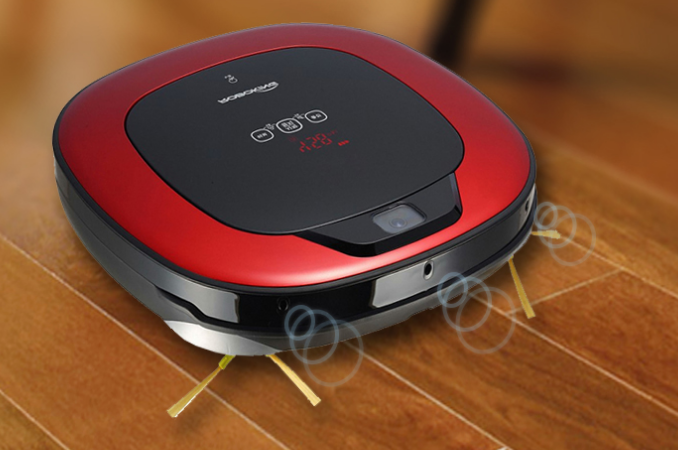
▲ Sensortech Co., Ltd. developed an ultrasonic sensor for cleaning robots using ultrasonic sensor components and sensor modules.
According to the survey, the domestic production rate of parts by robot type is 32.6%, with manufacturing robots accounting for 27.4%, personal service robots accounting for 45.9%, and professional service robots accounting for 28.7%. Looking into more detail, the domestic production rate of drive units (13.0%) and software (8.8%) is low even for manufacturing robots, and the low domestic production rate of sensor units (14.0%) is noticeable in professional service robots. In addition, it was found that the domestic production of drive parts (21.4%) in personal service robots was insufficient.
Regarding the competitiveness of robot products, Senior Kim said, “The price level of a robot is determined by the level of intelligence (SW) operation, but the competitiveness of a product is determined by the price,” and “Robot parts are an important industrial field that accounts for most of the cost of a finished product.”
Robot parts account for most of the cost of the finished product.
Accordingly, there are growing voices saying that manufacturing robots should strengthen their price competitiveness by internalizing core components, that specialized service robots should induce the participation of technology beneficiaries from companies utilizing robots in other industries, and that specialized service robots should be utilized in each field, such as livestock robots, surgical robots, and logistics robots, and that personal service robots should also discover cleaning and educational robots and attract parts companies from other industries.
In particular, many point out that robot parts need to be specialized or serialized because it is not easy to apply general parts to robots due to the nature of the robot system. For example, Universal Robot's UR series has developed a series of high-volume, high-power density actuators, lightweight brakes with reduced manufacturing costs, and low-cost relative/absolute position sensors. In addition, in Korea, Sensortech Co., Ltd. has developed an ultrasonic sensor for cleaning robots using ultrasonic sensor components and sensor modules.
The government is also making continuous investments to foster the robot industry. We are investing in next-generation fields such as intelligent manufacturing robots, mass-market manufacturing robots through demand linkage and component cost reduction, and are also focusing on securing competitiveness in medical, safety, and social robots and artificial intelligence-based functionalization technologies to create new markets for the future.
Lee Heon-doo, director of the Ministry of Trade, Industry and Energy’s Machinery and Robot Division, said, “It has been found that 93.4% of domestic robot companies are small and medium-sized enterprises, and 89.4% have robot sales of less than 10 billion won,” and “In order to secure commercialization technology for original parts centered on the next-generation manufacturing service sector, we will focus our investment on developing core intelligent technologies and developing core parts such as reducers, controllers, and motors.”
Comments
Related news
[Reporter's Notebook] Intelligent Robot Industry, Step Up to Build an Ecosystem
After the "match of the century" between human and machine came to an end, the government was thrown into confusion for a while. It was as if they had only then recognized the importance of "artificial intelligence," and they would have retrieved future growth engine documents again, highlighting artificial intelligence-related technologies in fluorescent color. Artificial intelligence discourse was also unavoidable at the recently held future growth engine intelligent robot seminar. Robots are recognized as the most representative industrial field of artificial intelligence, with technology integrating high-performance sensor technology and actuator technology together with big data and software. This is because intelligent technology plays a critical role in the core functions of robots, such as perception and decision-making.
2016.05.02by 신윤오 기자
Notable Increase in Patent Applications Related to Disaster Response Robots
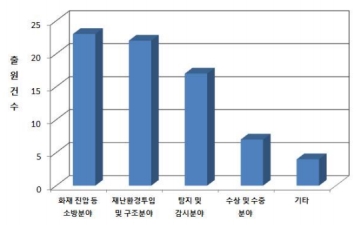
According to the Korean Intellectual Property Office (Commissioner Choi Dong-gyu), domestic patent applications related to disaster response robots (based on application date) have shown continuous growth since 2010, whereas previously there were only 2-3 applications per year on average, with 22 applications filed during 2010-2012 and 51 applications during 2013-2015. Disaster response robots are a technology that integrates multiple technologies, including kinematic design technology, self-localization technology, object and environment recognition technology, information and communication technology, autonomous mobility technology, and battery performance improvement technology.
2016.05.10by 명세환 기자
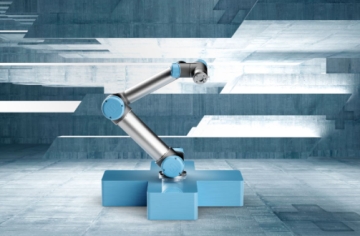
Universal Robots Launches Robot Plus, Ready to Use Upon Connecting to the Robot Body
Universal Robots announced today (the 22nd) that it unveiled Universal Robots+ at the AUTOMATICA exhibition held in Munich, Germany on the 21st (local time), which will bring innovation to the automation industry. Universal Robots+ is a showroom of Plug & Play application solutions that can be used immediately when connected to the robot body, providing new convenience to companies that want to install UR robot applications and use them right away. Distributors and consumers can select accessories, End Effectors, and software solutions from Universal Robots+, which not only ensures high security levels but also allows them to predict the operability of new applications to be applied to UR collaborative robots, thereby saving considerable time.
2016.06.22by 김수지 기자
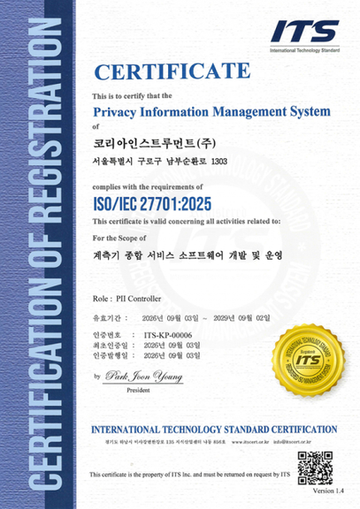
Korea Instrument, KOLAS Accredited Calibration Agency First to Simultaneously Acquire ISO/IEC 27,001·27,701
Korea Instrument has become the first among KOLAS accredited calibration agencies to simultaneously acquire ISO/IEC 27,001 and ISO/IEC 27,701 certifications. Through its proprietary platforms CWIZ Enterprise and CWIZ Partners, the company has embedded information security and personal data protection requirements across all business processes including customer information, equipment data, and calibration reports, with plans to continuously advance its management system through regular audits and security inspections.
2026.10.12by 배종인 기자

TeamViewer One, IT Incident Automation Workflow and Resolution Center Enhanced
TeamViewer has added IT incident automation capabilities and an advanced Resolution Center to its integrated digital workplace management platform 'TeamViewer ONE'. Recurrent service disruptions, configuration errors, and capacity shortages are automatically handled according to preset policies, and device status verification through script deployment can be managed in a unified interface, significantly reducing repetitive tasks for IT teams.
2026.10.12by 배종인 기자











