



[Reporter's Notebook] If we don't dominate the public drone market, it will all be lost to China.
 Published2016.06.27 17:36
The global civil and public sector market is expected to reach $4.9 billion.
“There is no market”
A representative from a company that makes commercial unmanned aerial vehicles (drones) said, "What does that mean? It's literal. They're constantly developing and developing products to improve the aircraft's functionality, but there's little demand."
As the word "drone" has become synonymous with unmanned aerial vehicles, the market is expanding to the point where even children want to own one (as a toy), but this means that the commercial civilian market, which requires technological prowess and application skills, has not yet opened.
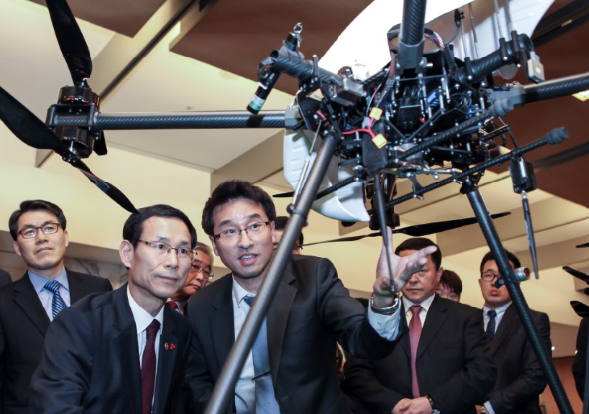
▲ In January, Vice Minister Choi Jeong-ho attended the MOU signing ceremony for the unmanned aerial vehicle (drone) pilot project and inspected the drone.
The growing share of drones in the overall aircraft market is confirmed by figures. The overall drone market is projected to reach $12.5 billion by 2025, growing at a CAGR of 10%. The domestic drone market is projected to reach $525 million by 2022, growing at a CAGR of 22%. While the majority of the drone market is military, the civilian market is also growing.
Military drones are expected to grow to $11.59 billion by 2023 (9% CAGR), while civilian drones are projected to grow to $880 million by 2023, a whopping 35% CAGR. In particular, demand for small, civilian commercial drones is expected to surge in the mid- to long-term due to the enactment of legislation to stimulate the market.
A closer look at the civilian drone market reveals an even more rosy picture. According to the Institute of Oriental Economic Research in Japan, the civilian drone market in 2015 was worth $4.4 billion, with $3 billion in the hobby market and $1.4 billion in the civil and public sectors. This figure is projected to grow to $10.6 billion by 2020, with the hobby market reaching $5.7 billion and the civilian and public sector reaching $4.9 billion. Focusing on domestic agricultural drones, the market is expected to grow from KRW 90 billion in 2015 (KRW 20 billion in hobby drones and KRW 70 billion in civilian and public sectors) to KRW 270 billion in 2020 (KRW 60 billion in hobby drones and KRW 210 billion in civilian and public sectors).
The number of drone businesses licensed by the U.S. FAA has surpassed 3,000, and there are reportedly 300,000 registered drone owners in the U.S. The share of civil/public use areas approved by this agency is as follows: aerial photography (38.6%), agriculture (16%), construction (11.3%), infrastructure management (10.5%), filming (10%), environment (6.4%), emergency response (3.7%), and search and rescue (3.5%).
Let's listen to the story of the CEO of a drone company again. "In order for the commercial drone market to grow, regulations need to be relaxed and R&D development support is needed, but the most difficult part is that even if the product is made, there are not many places to sell it yet." He said, "It is said that low-priced Chinese drones have taken over the domestic market, but that is only referring to some general-purpose drones. The industrial market that requires customization is a market with many opportunities for domestic companies."
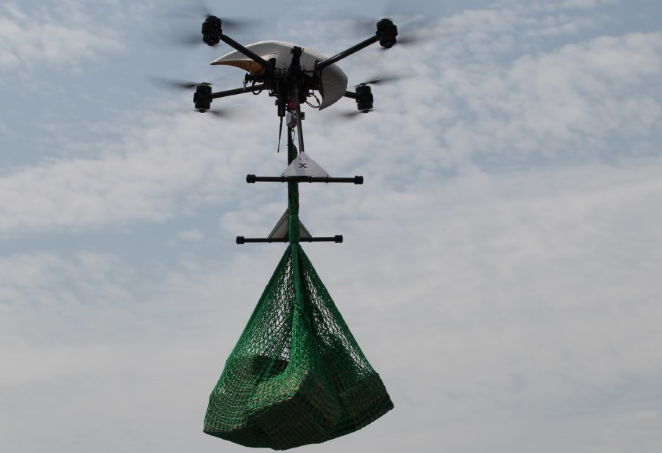
▲Drone demonstration transporting supplies (Ministry of Land, Infrastructure and Transport)
The company, which supplies products to the fields of aerial photography, surveying, and agriculture, said that the key to industrial drones is optimal design for their intended purpose, and that in the future, domestic companies will face the challenge of expanding beyond the limited domestic market and exploring overseas markets.
Of course, drones still face many technological limitations. To extend their flight time from the current 20-30 minutes to over an hour, next-generation batteries will need to be developed, and their communication range will also need to be extended from the current 1-2 km to 5-10 km. Additionally, drones must be capable of autonomous flight through their own judgment, and advanced technologies such as collision avoidance technology and autonomous flight in congested areas must be developed.
Efforts are needed to connect drone companies with public demand.
However, demand also drives supply. Only when the demand market expands can products and technologies be developed to meet that demand. In that sense, expanding the civilian commercial drone market could also be a quick way to enhance the competitiveness of domestic small and medium-sized enterprises.
Fortunately, a demand survey targeting government officials revealed a positive outlook for drone adoption. For example, most respondents indicated they would be willing to purchase drones if they were developed for their specific needs, such as preemptive fire detection, precision agriculture, industrial infrastructure management, and rescue operations. These public-use drones, priced at 30 to 50 million won each, are expected to play a significant role in expanding the market for related companies.
Accordingly, agencies and officials responsible for government drone projects will likely need to make efforts to connect these companies with potential buyers. They should heed the warning from officials: if they don't quickly prepare for technology development for public demand, they will all be taken over by China, just like with general-purpose drones.
Comments
Related news
Policies to revitalize the unmanned aerial vehicle and drone industry will be established
The domestic unmanned aircraft market is also seeing intensified competition among domestic companies as the commercial drone market has recently become active, with small and medium-sized enterprises armed with innovative ideas emerging in succession and large corporations actively investing in drone technology. Currently, drones are mainly used for purposes beyond traditional military applications, such as photography by various media companies or delivery of small items. However, in the future, specialized drone markets suited to service sectors such as agriculture and disaster scenes could be formed, making how companies can develop novel and distinctive business models an important factor for success.
2015.07.28by 명세환 기자
The reason why domestic researchers are actively developing drone collision avoidance technology
According to the Korean Intellectual Property Office (Commissioner Choi Dong-gyu), patent applications related to drone collision avoidance technology were only 8 cases over the past three years (2009-2011), but have surged to 21 cases over the recent three years (2012-2014) as drone commercialization has accelerated, representing an application growth rate of 163%.
2015.07.29by 명세환 기자
Let's seize the future drone market, patent applications surge
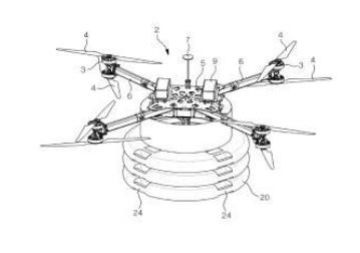
The Korean Intellectual Property Office (headed by Commissioner Choi Dong-gyu) announced that a total of 389 drone-related patents were filed in 2015, representing a sharp increase of 161% compared to the previous year. Drone patent filings have been rapidly increasing in recent years, from only around 30 applications per year before 2012, to 126 in 2013, 149 in 2014, and reaching 389 last year.
2016.02.16by 신윤오 기자
[WIS 2016] Drone Wireless Charging System Application Expands Spatial Wireless Charging
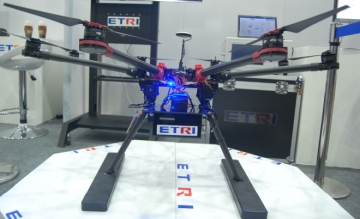
The Electronics and Telecommunications Research Institute (ETRI) introduced a drone wireless charging system at the World IT Show (WIS 2016). The Wireless Charging System for Drone applies magnetic resonance-based wireless energy transfer technology to provide convenient and safe charging services. By applying single transmitter/dual receiver charging technology, the degree of freedom in wireless charging has been expanded. The research team stated that it optimized transmission efficiency uniformity and overcame the energy supply limitations of drones, thereby expanding their operational range.
2016.05.20by 명세환 기자
Maxim Announces Standalone Battery Level Monitor Suitable for Wearables, Drones, and IoT Devices
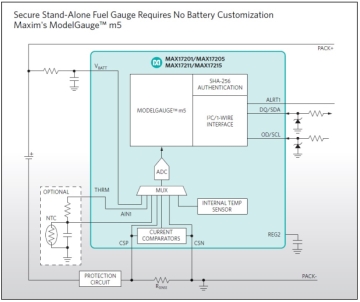
Maxim Integrated Products Korea (CEO Kim Hyun-sik) has launched the 'ModelGauge m5' portfolio, which easily and safely measures remaining battery capacity in portable devices. The Maxim ModelGauge m5 battery gauge (MAX17201/MAX17205, MAX17211/MAX17215) integrates SHA-256 security authentication for the first time in the industry and combines a 160-bit secret key to prevent battery pack counterfeiting. Since battery voltage changes with temperature and load, measuring battery capacity is challenging, and sophisticated calibration is required to eliminate cumulative offset errors in coulomb-counting. Through sophisticated algorithms, the Maxim ModelGauge m5 accurately converts raw measurement values of battery voltage, current, and temperature into state of charge (SOC%), absolute capacity (mAhr), time-to-empty, and time-to-full during charging, enabling users to use their devices more conveniently and for longer periods.
2016.06.08by 명세환 기자











