


[ICT R&D Overview] ① Digital content, VR/AR realistic content development is vital
 Published2016.08.01 11:16
Weaknesses include lack of core intellectual property rights such as VR and AR and lack of creative device development
The Ministry of Science and ICT has released the Technology Roadmap 2022 (draft) that includes the 10 major ICT R&D technology fields and artificial intelligence fields. The 10 major ICT R&D technologies selected by the Ministry of Science and ICT to strengthen the interconnection of science and technology ICT and discover new industries are ▲digital content ▲convergence service ▲mobile communication ▲network ▲broadcasting/smart media ▲radio, satellite ▲basic SW computing ▲software ▲information protection ▲ICT devices, etc. Accordingly, e4ds News will introduce the R&D strategies of these fields in order and present a future technology development roadmap. [Reporter Shin Yun-oh]
Can we lead the realistic content technology that is the core of virtual reality and augmented reality technology?
As realistic and emotional intelligent content emerges as a future trend in the digital content industry, attention is focused on related industries.
Digital content refers to the software and hardware technologies required to plan, produce/produce, and utilize data information knowledge databases expressed in electronic form, such as codes, letters, voices, sounds, images, and videos, combined with ICT technology, in the form of services or products. This includes ▲realistic content ▲interactive content ▲emotional content ▲content distribution and services.
First, realistic content technology is evolving into 360 video devices, real-time processing technology, and broadcasting technology, and the goal is to commercialize multi-focus video technology and multi-faceted video technology.
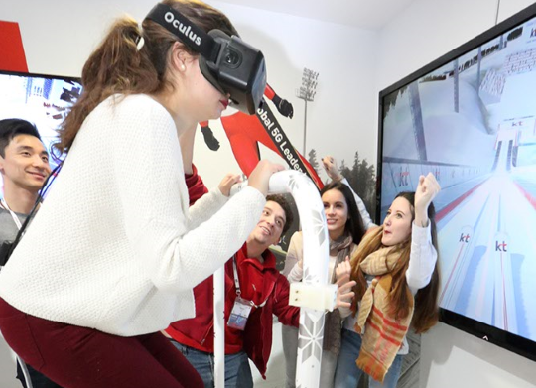
▲ The digital content industry is expected to grow from a market of $96.3 billion in 2014 to about $154 billion in 2020. The photo shows KT's VR demonstration showcasing a ski resort experience.
Interaction content technology includes content such as VR and AR, which have recently become issues. In virtual reality (VR), competition on VR platforms is intensifying, various VR fusions are being attempted, and the emergence of five-sensory devices and VR simulators are expected to become active. In addition, transparent glass-type devices are expected to be released in augmented reality (AR), and NUI/NUX technology using multimodal input data is rapidly increasing. NUI (Natural User Interface) element technology refers to motion recognition and facial recognition, while NUX (Natural User Experience) refers to a human-centered smart content environment.
Emotional content technology is developing into sensing and reproduction technologies for the five senses, such as digital olfactory and tactile technologies, and is evolving into emotional recognition technologies using bio-signals of the five senses.
Content distribution and service technology are key to expanding competition in VR ecosystem platforms and improving real-time service quality. Examples include Oculus Share, Samsung Milli VR, and Google Day Dream.
The digital content industry is expected to grow from $96.3 billion in 2014 to approximately $154 billion in 2020. The global virtual reality/augmented reality market is expected to grow from $3 billion and $1 billion in 2016 to $30 billion and $120 billion in 2020.
There are no software and content companies that can lead the global market.
SWOT analysis of the digital content industry shows the reality of the domestic industry. The domestic digital content industry has the world's best network infrastructure and device manufacturing technology as strengths (S), and has large-scale content production/service/business experience in online games. It also has content for global expansion using the spread of K-culture. However, as weaknesses (W), it does not have core intellectual property rights for new technologies such as planoptics, VR, and AR, and lacks international success experience in platform business. In addition, there is a lack of creative device development due to device manufacturing centered on large corporations, and there are no software and content companies that can lead the global market.
Accordingly, there is a threat (T) factor. The dependence on foreign products for content creation tools is high, and the country has lost its leadership by failing to participate in global alliances/collaborations that overcome industry barriers. In particular, it is unable to respond to low-price policies, large-scale markets, and rapid technological pursuit by latecomer countries such as China, and there are concerns about Chinese capital preemptively acquiring and absorbing excellent Korean companies.
However, there are also opportunities (O). New ICT technology paradigms are changing with HMD/transparent devices, and demand for new forms of content such as VR convergence and multi-screen screening is increasing. There are market opportunities due to the explosive growth of the Chinese content market, and Chinese capital investment in Korean content companies is also acting as a factor of expectation.
Accordingly, the government is moving to preempt the global new market by building a digital content ecosystem. The goal is to achieve a technological gap with advanced countries within one year by 2022 and foster more than 20 digital content technology powerhouses (annual sales of 10 billion won or more) to achieve sales of 65 trillion won in the digital content industry by 2022.
To this end, we have presented key research and development areas for each field. For realistic content, we plan to develop a tracker for real-time image synthesis in arbitrary space and a real-time ultra-high-resolution image segmentation transmission server.
Supporting promising VR convergence new industries, creating new markets, and building ecosystems
Interaction contents include ▲See Through type display-based augmented reality platform ▲multi-party Tele-Immersion VR system ▲human factor control system for virtual reality content, etc. In addition, in the field of emotional content, we will develop realistic content that recognizes five senses information and reproduces senses, and in the field of content distribution and service, we will focus on ▲HMD-Free VR/AR/MR content services ▲Cloud-based VR content production and transmission services for general users ▲Development of VR convergence application services, etc. For these R&D, the government will invest a similar budget every year starting with KRW 54 billion in 2017, and will invest KRW 327 billion by 2022.
CP Lee Jeong-jun said, “The digital content industry will strengthen the development of challenging original technologies, support promising VR convergence new industries, and create new markets and build ecosystems.” He added, “We plan to secure competitiveness by standardizing technologies and securing standard patents in new industrial fields, and foster personnel for VR/AR-based technology and advanced application development.”
Comments
Related news
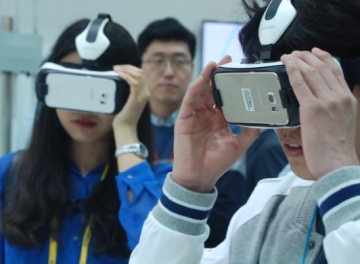
The Ministry of Science, ICT and Future Planning supports promising VR companies in moving into Growth Support Centers and waives rent.
The Ministry of Science, ICT and Future Planning, the Ministry of Strategy and Finance, the Ministry of Culture, Sports and Tourism, and other related government agencies, along with major domestic and international VR companies, held a virtual reality (VR) discussion meeting on the 3rd at Nuridream Square in Sangam, presided over by Choi Sang-mok, First Vice Minister of the Ministry of Strategy and Finance. During this discussion meeting, the current status of global technological development was reviewed through the Digital Pavilion, which is the country's largest ICT experience exhibition hall, and experiences with VR devices and content from domestic and international companies. Through discussions with various companies in VR-related device manufacturing, content, telecommunications, and broadcasting sectors, the government listened to industry challenges and explained government support policies.
2016.05.09by 명세환 기자
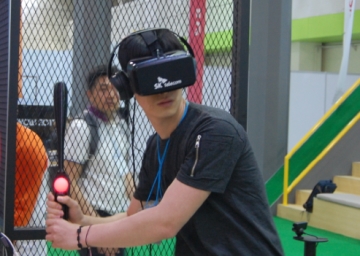
[Reporter's Notebook] VR Industry, Is There Any Good Content?
This was several years ago during the height of 3D TV competition. A major device manufacturer came forward with plans to create an ecosystem in the 3D TV field on its own, and even blocked its partner companies from collaborating with competing firms. Naturally, inter-company exchanges became closed-off, and technological development and content production failed to materialize properly, leaving 3D TV facing fundamental limitations. The lessons learned from 3D TV can be summarized into several points. First, ecosystem building is necessary for a specific market and technology to develop. Second, ecosystem building cannot be achieved through unilateral leadership by any single party. Third, a shortage of content ultimately brings about limitations in market expansion.
2016.07.04by 신윤오 기자

If you view the 'Pokémon GO' AR game in 3D, SK Telecom embarks on '3D AR VR' development
Moving forward, it is expected that 2D AR games such as "Pokémon Go" will be enjoyed in more immersive 3D. SK Telecom (CEO and President Jang Dong-hyun, www.sktelecom.com) announced on the 27th that it has signed a memorandum of understanding (MoU) with Inuitive, an Israeli sensor and image processor developer (CEO Shlomo Gadot), for the development of 3D immersive AR/VR solutions. The signing ceremony, held at SK Telecom's headquarters on Euljiro in Seoul on that day, was attended by SK Telecom's Choi Jin-sung, CTO (Chief Technology Officer), and Inuitive CEO Shlomo Gadot.
2016.07.27by 신윤오 기자

ESP32 Development Environment Selection and GPS Application Implementation
The ESP32 is a microcontroller that integrates Wi-Fi, Bluetooth, 12-bit ADC, capacitive touch, PWM, DAC, and UART in a single SoC. However, the abundance of features does not by itself solve the designer's problems. The real challenges lie in selecting the appropriate development environment, determining which pins can be used and which must be avoided, and converting raw data from modules into usable information. This document addresses ESP32 peripheral constraints (ADC2 and Wi-Fi coexistence limitation, UART1 occupancy, ADC non-linear regions), the trade-offs between Arduino IDE and ESP-IDF, and the process from connecting NEO-6M/NEO-M8N GPS modules to UART2, parsing NMEA sentences, and visualizing routes in Google Earth, all organized based on documented references.
2026.10.12by 편집부
MIPI CSI-2, DSI-2, C-PHY, D-PHY Test Solution Technical White Paper
The MIPI interface adopts a burst mode that transitions between low-power (LP) and high-speed (HS) states for low-power consumption, and in return, strict timing rules are imposed on state transitions. Additionally, the high-speed section operates as a packet-based protocol with headers, ECC, and CRC, so verification engineers must handle waveforms and protocols simultaneously. Traditional configurations combining general-purpose oscilloscopes and AWGs reveal limitations in setup complexity, measurement uncertainty, and lack of reproducibility when faced with these requirements. This white paper, based on webinar materials, organizes the structure of this problem and describes how the SV5C-DPTXCPTX generator for receiver testing and SV5C-DPRXCPRX analyzer for transmitter testing integrate state transition testing, stressed eye testing, and protocol analysis into a single bench, along with their application boundaries.
2026.10.12by 편집부











