



SK Telecom Develops 'Backpack-Type LTE Equipment' Unaffected by Base Station Damage
 Published2016.08.04 18:13
The smallest communication system currently in existence, including 'base station + switch' functions.
Communication networks were cut off due to a large-scale landslide caused by heavy rain in the mountainous region of Jeongseon, Gangwon Province. As a result, the situation room at the Ministry of Public Safety and Security faced difficulties in assessing the extent of the damage as it was unable to properly process reports for civilian rescue.
Communication facilities were restored as firefighters and police personnel arrived at the disaster site midway up the mountain wearing backpack-style LTE equipment and turned on the power. Reports from the stranded individuals began to be received smoothly, and the personnel commenced rescue operations using dedicated terminals equipped with real-time sharing technology. The central control room received real-time video and photos from the scene and was able to issue prompt rescue instructions to field personnel.
SK Telecom (CEO and President Jang Dong-hyun, www.sktelecom.com) and global network equipment manufacturer Nokia (President Rajeev Suri, www.nokia.com) announced that they have successfully developed the world's first portable communication system capable of building an independent communication network and equipped with a disaster safety communication solution.
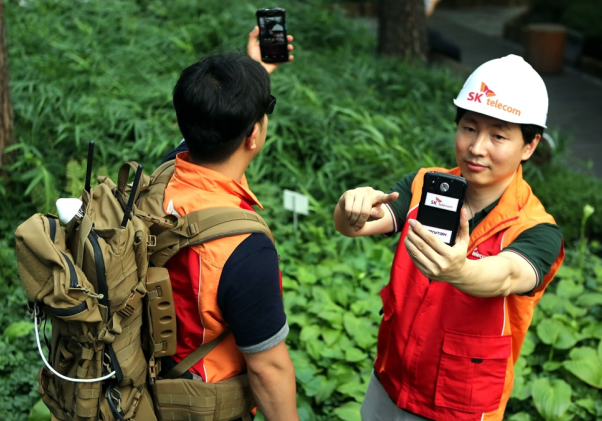
The 'backpack-type LTE equipment' unveiled by the two companies on this day is the smallest portable communication system currently in existence, small and light enough to be carried in a backpack.
In particular, this system is equipped with all the functions necessary for communication during a disaster, including not only base stations and switches essential for communication but also 'Group Communication Technology,' a core solution for disaster networks. Personnel deployed to the disaster site can use 'Group Communication Technology' to exchange not only voice but also video and photos in real time, enabling more accurate sharing of on-site situations. It also ensures scalability to accommodate specialized services required by various organizations.
Since existing portable communication systems only served as simple base stations, actual communication required a separate connection to a remote switch or central control center via satellite or wired networks. This caused inconveniences, such as the inability of the portable communication system to perform base station functions in case of poor weather or a disconnection of the wired network. The maximum number of people who could use it was also around 20, making it difficult to utilize in actual disaster situations.
The 'backpack-type LTE equipment' enables independent communication separate from existing base station networks, so it can provide complete communication services even if the existing communication network is disconnected due to a disaster. The service range provided by the system is a radius of 5 km and accommodates up to 400 people.
Real-time group communication of 400 people within a 5km radius is possible.
SK Telecom and Nokia signed an agreement last October for the joint development of disaster safety communication technology and have been accelerating the development of portable communication systems and disaster network technology. As a result, the two companies succeeded in developing the world's first 'Group Communication Technology,' 'GCSE,' and demonstrated it to major international telecommunications companies at 'MWC 2016' held in Spain last February.
SK Telecom unveiled the system to the Ministry of Public Safety and Security on August 1 and successfully completed outdoor environmental quality measurements on nearby hiking trails, including Namsan. SK Telecom plans to complete pilot testing within the year and utilize this system for projects scheduled for next year, such as the disaster network expansion project and the maritime LTE network construction project.
Lee Jong-bong, Head of Infrastructure at SK Telecom, said, “Portable LTE equipment is a groundbreaking solution that can provide independent communication services even if existing communication networks are disconnected due to disasters,” adding, “SK Telecom will not only utilize this for domestic disaster network projects but also share its know-how with overseas disaster network operators.”
"Portable LTE equipment is the most essential system on-site for responding to emergencies amidst various disaster situations," said Andrew Cope, CEO of Nokia Korea. "We are pleased to be able to introduce this for the first time in the world with SK Telecom, and we plan to continue our efforts to provide the most advanced disaster network solutions."
Comments
Related news
LTE-M or LoRa? The War to Build 'Commercial Networks' for the Internet of Things Within the Year
As IoT dedicated networks specialized for Internet of small Things (IoST) are being rapidly built, related IoT services are expanding accordingly. Internet of small Things (IoST) is a transmission technology characterized by low cost, low power consumption, and low capacity, capable of operating on batteries alone without requiring small data transfers and constant power supply. This is because not all things exchanging data through the internet necessarily require expensive ultra-high-speed networks. Accordingly, major domestic telecommunications providers are expanding their IoST network construction and successively launching IoT services based on these networks. IoT dedicated networks specialized for IoST initially highlighted LTE-M technology utilizing existing networks, but low-power long-distance communication technology (LPWA) for the IoT field is also gaining attention. LPWA technologies such as LoRa, NB-IoT, and SigFox are competing in this space.
2016.06.21by 신윤오 기자
KT Develops 'Super-Horizontal Antenna Array System' to Expand LTE Coverage to 200km
KT (Chairman Hwang Chang-gyu) declared at KT Square in Gwanghwamun that it will create a safer Republic of Korea through ICT technology, with the attendance of government agencies including the Ministry of Oceans and Fisheries and companies such as Corelon and NOKIA. On this day, KT unveiled LTE coverage expansion technology to prepare for maritime disasters and resolve issues in marine accident response, as well as KT's differentiated maritime safety solution, following the mountain area disaster safety communication solution showcased in PyeongChang in November 2015.
2016.07.06by 정기자
'Vehicle Control' Service Launched for Real-Time Monitoring via LTE
With the emergence of LTE-based vehicle management services, corporate fleet management is expected to become more convenient. LG U+ (Vice Chairman Kwon Young-soo) announced on the 24th that it has launched a 'vehicle management' service that allows users to check vehicle ▲location ▲status information ▲driving information ▲usage details and other data in real-time on PCs and smartphones by installing LTE communication terminals equipped with GPS in vehicles. LG U+'s 'vehicle management' service stores various vehicle operation-related information in second-by-second intervals and transmits them in real-time to a cloud-based vehicle management platform through LG U+'s LTE communication network. Vehicle managers can simply log into the vehicle management platform from PCs and smartphones to check and comprehensively manage ▲driving status and routes ▲vehicle condition ▲safe driving status and other information of corporate fleet vehicles in real-time.
2016.07.26by 신윤오 기자
ESP32 Development Environment Selection and GPS Application Implementation
The ESP32 is a microcontroller that integrates Wi-Fi, Bluetooth, 12-bit ADC, capacitive touch, PWM, DAC, and UART in a single SoC. However, the abundance of features does not by itself solve the designer's problems. The real challenges lie in selecting the appropriate development environment, determining which pins can be used and which must be avoided, and converting raw data from modules into usable information. This document addresses ESP32 peripheral constraints (ADC2 and Wi-Fi coexistence limitation, UART1 occupancy, ADC non-linear regions), the trade-offs between Arduino IDE and ESP-IDF, and the process from connecting NEO-6M/NEO-M8N GPS modules to UART2, parsing NMEA sentences, and visualizing routes in Google Earth, all organized based on documented references.
2026.10.12by 편집부
MIPI CSI-2, DSI-2, C-PHY, D-PHY Test Solution Technical White Paper
The MIPI interface adopts a burst mode that transitions between low-power (LP) and high-speed (HS) states for low-power consumption, and in return, strict timing rules are imposed on state transitions. Additionally, the high-speed section operates as a packet-based protocol with headers, ECC, and CRC, so verification engineers must handle waveforms and protocols simultaneously. Traditional configurations combining general-purpose oscilloscopes and AWGs reveal limitations in setup complexity, measurement uncertainty, and lack of reproducibility when faced with these requirements. This white paper, based on webinar materials, organizes the structure of this problem and describes how the SV5C-DPTXCPTX generator for receiver testing and SV5C-DPRXCPRX analyzer for transmitter testing integrate state transition testing, stressed eye testing, and protocol analysis into a single bench, along with their application boundaries.
2026.10.12by 편집부











