



[ICT R&D Overview] ② Convergence Services: Deregulation and an Ecosystem Needed
 Published2016.08.05 16:48
Service-centric intelligent solution service is the key
The Ministry of Science, ICT and Future Planning (MSIP) has released its Technology Roadmap 2022 (draft), which includes 10 key ICT R&D technology areas and artificial intelligence. The 10 ICT R&D technologies selected by MSIP to strengthen the interconnectivity of science and technology (ICT) and discover new industries include: digital content, convergence services, mobile communications, networks, broadcasting/smart media, radio waves and satellites, basic SW computing, software, information security, and ICT devices. e4ds News will present the R&D strategies for these areas in turn, presenting a roadmap for future technology development. [Reporter Shin Yun-oh]
Convergence services are technologies that provide services by building an Internet of Things infrastructure to realize a hyper-connected society and combining ICT, such as the Internet of Things and intelligent information technology, in each field of industrial convergence, public convergence, and smart life.
Prior to 2015, convergence technologies were characterized by technology-centric terminals (H/W) and connectivity (N/W), with sensor and ICT utilization and intra-industry convergence as key issues. However, after 2016, convergence technologies will be characterized by service-centric intelligent solution services and applications (S/W). Building ecosystems leveraging ICBMs and intelligent information technology-based standard platforms and activating cross-industry convergence will likely become key issues. In other words, initially, it will be divided into representative platforms for each service, and later, it will be utilized in an inter-industry integration/linkage manner centered on the Winning Platform.
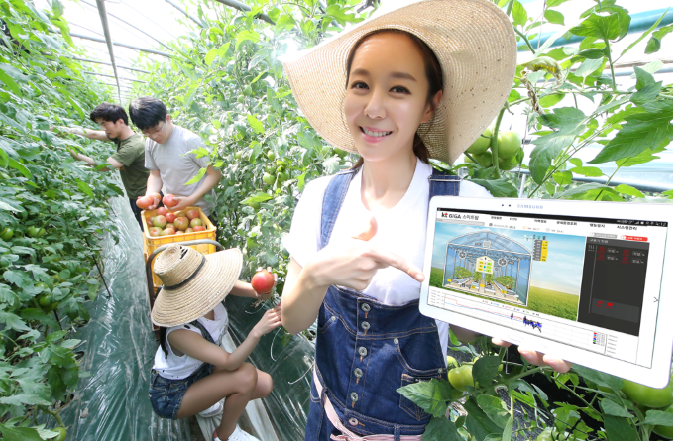
▲ Agricultural and livestock ICT, a type of industrial convergence ICT, includes production convergence technologies such as smart farms. A demonstration of KT GiGA Smart Farm, which controls greenhouse facilities using Internet of Things (IoT) devices.
The market outlook is positive. For example, the global u-health market is expected to grow from $143.1 billion in 2009 to $498.7 billion in 2018, and the global mobile payment market is projected to grow from $235.4 billion in 2013 to $720 billion in 2017. The emergence and growth of new internet-based convergence services are driving new industries and companies to become key drivers of growth.
So, what is the current state of the domestic industry in this convergence service market? A SWOT analysis reveals that strengths (S) include the establishment of an excellent ICT infrastructure for implementing convergence services, a world-class network, strong competitiveness in related industries such as semiconductors and displays, and outstanding terminal manufacturing capabilities.
Absence of a groundbreaking business model
However, it has the following weaknesses (W): the absence of a groundbreaking business model that can bring about disruptive innovation, the market being inactive due to strong regulations, the lack of an ecosystem for corporate coexistence and industrial revitalization, and the lack of competitiveness in software and platform development. The threat factors (T) include the excessive initial costs due to the lack of standardization of related technologies, the fierce competition among leading companies such as Google and Apple to secure the platform, and the difficulty in achieving economies of scale and scope due to the active policy support from advanced countries such as the US, Germany, the UK, and Japan and the absence of policies for mutually beneficial cooperation between companies.
Still, there's hope in the sense that opportunities clearly exist. Various new industries and business opportunities exist due to ICT convergence. Government policy support will lead to active market participation by many companies, lower hardware module prices, and enhanced software industry competitiveness. Furthermore, expectations are high given the ease of developing differentiated services by combining terminal manufacturing capabilities with superior infrastructure.
Accordingly, the government plans to create new markets (domestic market valued at KRW 40 trillion) and secure technologies (90% technology level) with the goal of advancing industries and enhancing public convenience through the creation of a hyper-connected social convergence service ecosystem. The IoT R&D investment areas include IoT services, IoT platforms, IoT networks, IoT devices, and cyber-physical systems (CPS). For industrial convergence ICT, R&D will focus on agricultural and livestock ICT, manufacturing ICT, and energy ICT.
Public convergence ICT targets public safety/disaster prevention ICT and medical ICT. In the smart life sector, R&D investment will focus on smart homes, smart cities, and wellness care ICT. Starting with KRW 73.1 billion in 2017, investment in these areas will increase to KRW 92.1 billion in 2019 and KRW 107.1 billion in 2021, for a total investment of KRW 573.6 billion by 2022.
Looking at some specific details of these investment areas, IoT services develop core technologies for creating domain-specific Internet of Things services and providing customized services to users, and apply and verify new technologies for convergence services based on cross-domain utilization. We plan to secure standard service models to secure a leading position in the global market for IoT services. A total of 37.5 billion won will be invested in these projects by 2022.
The need for convergence between IoT infrastructure technology and ICT technology
The agricultural and livestock ICT sector will pursue the development of common platform technologies (distribution, facility horticulture, and livestock farming) and intelligent growth modeling technologies. A total of KRW 39 billion will be invested by 2022 to complete standardization through corporate verification and commercialize and disseminate certification standards. The medical welfare ICT sector will develop technologies that enable the easy measurement of various healthcare-related information and personal health information analysis technologies. KRW 46.2 billion will be invested by 2022 to develop standards for information storage, transmission, and cohort data for data-based services such as convergent medicine.
The smart home and city sector will also receive KRW 24.5 billion in support by 2022 to address heterogeneity, security, and privacy issues, which are major obstacles to industrialization, secure AI-based smart home city information analysis source technologies, and secure a cloud-based, distributed smart home and city platform.
Park Hyun-jae, CP in charge of convergence service R&D, said, “The convergence service industry will encompass strengthening the future national industrial competitiveness, improving the quality of life of citizens, and building an ecosystem of advanced services in the relevant field to solve social issues through the convergence of IoT infrastructure technology and ICT technology.”
Comments
Related news
KEA Decides to Pursue Key Projects in 'Automotive Convergence, VR, and IoT Convergence Fields'
The Korea Electronics Information and Communications Industry Association (Chairman Kwon Oh-hyun, hereinafter KEA) is accelerating the convergence of automobiles and IT. The Association announced at its 40th regular general meeting held on the 26th at the Electronics Hall in Sangam-dong that it will designate the promotion of convergence between automobiles and IT, VR (virtual reality), and IoT (Internet of Things) as its main business initiative and plans to actively pursue this throughout the year. To this end, KEA will establish a new Automobile-IT Convergence Support Center within the organization and create an ecosystem for mutual collaboration with domestic vehicle manufacturers, parts suppliers, and other automotive industry players as well as the electronics and IT industry, with the goal of discovering new business models for automobile-IT convergence and supporting smartization including autonomous driving.
2016.02.26by 신윤오 기자
SK Telecom Selects Lotte Department Store for ICT-Based Smart Department Store Development
SK Telecom (CEO and President Jang Dong-hyun, www.sktelecom.com) announced that it has signed a Memorandum of Understanding (MoU) with Lotte Department Store on the 24th to establish a next-generation smart department store applying ICT. Through this partnership agreement, both companies will build a smart store enabling convenient and enjoyable shopping, and will also pursue smart signage construction utilizing the exterior walls of the department store as media, as well as cooperation in energy efficiency projects.
2016.03.24by 명세환 기자
[ICT R&D Overview] ① Digital content, VR/AR realistic content development is vital
Can we lead in immersive content technology, the core of virtual reality and augmented reality? As immersive and emotional intelligence-based content emerges as a future trend in the digital content industry, attention is concentrating on related industries. Digital content refers to the software and hardware technologies necessary for planning, producing/manufacturing, and utilizing databases of materials, information, knowledge, and data expressed in electronic form through the combination of codes, text, voice, sound, audio, images, video, and other elements with ICT technology in the form of services or products. This includes ▲immersive content ▲interactive content ▲emotional content ▲content distribution and services.
2016.08.01by 신윤오 기자
Korea Instrument, KOLAS Accredited Calibration Agency First to Simultaneously Acquire ISO/IEC 27,001·27,701
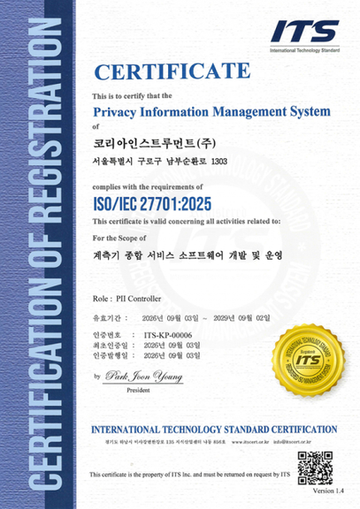
Korea Instrument has become the first among KOLAS accredited calibration agencies to simultaneously acquire ISO/IEC 27,001 and ISO/IEC 27,701 certifications. Through its proprietary platforms CWIZ Enterprise and CWIZ Partners, the company has embedded information security and personal data protection requirements across all business processes including customer information, equipment data, and calibration reports, with plans to continuously advance its management system through regular audits and security inspections.
2026.10.12by 배종인 기자
TeamViewer One, IT Incident Automation Workflow and Resolution Center Enhanced
TeamViewer has added IT incident automation capabilities and an advanced Resolution Center to its integrated digital workplace management platform 'TeamViewer ONE'. Recurrent service disruptions, configuration errors, and capacity shortages are automatically handled according to preset policies, and device status verification through script deployment can be managed in a unified interface, significantly reducing repetitive tasks for IT teams.
2026.10.12by 배종인 기자











