


[A Close Look at ICT R&D] ④ The Rapidly Growing Convergence Security Industry: How to Avoid Being Caught in the Sandwich
 Published2016.08.22 13:38
The global information security market will grow at an average annual rate of 10.8% until 2022.
The Ministry of Science, ICT and Future Planning (MSIT) has unveiled the draft Technology Roadmap 2022, which adds artificial intelligence to the 10 major ICT R&D technology fields. The 10 major ICT R&D technologies selected by the MSIT to strengthen the interconnectedness of science and technology and ICT and to discover new industries are: digital content, convergence services, ICT devices, information security, mobile communications, networks, broadcasting/smart media, radio waves and satellites, foundational SW computing, and software. Accordingly, e4ds News plans to present the future technology development roadmap by introducing the R&D strategies for these fields in sequence. [Reporter Shin Yun-oh]
Fostering the convergence security industry, including IoT and cloud
Information security refers to services that guarantee the safety and trust of individuals, businesses, and nations by producing products incorporating security technologies such as encryption, authentication, recognition, and analysis/monitoring, or by utilizing related security technologies. It includes network system-based information security, physical security for a safe and secure life, and convergence security created through the integration of security technologies with traditional industries.
The global information security market is projected to grow at an average annual rate of 10.8% from $161.2 billion in 2016 to $297.5 billion in 2022. Demand for information security is continuously increasing due to changes in the ICT environment, such as cloud computing, big data, and IoT; while the converged security market is not yet large, it is expected to grow rapidly by 31.7% as a promising future sector.
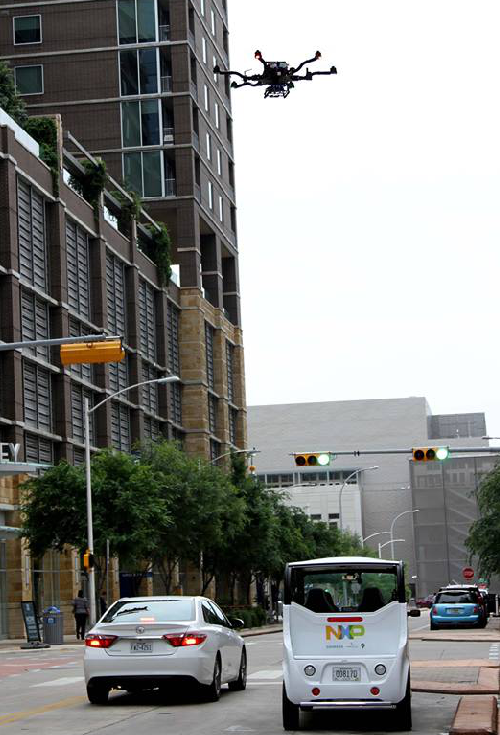
In the case of convergence security, which is considered a promising technology in the information security industry, security for the automotive and drone industries has emerged as a critical factor.
The photo shows a demonstration of NXP Semiconductors' smart mobility based on V2X technology in Austin, Texas, last May .
The outlook for the domestic market is also favorable. The domestic information security industry, projected to grow at an annual average rate of 10.4% from 8.7 trillion won in 2015 to 15.7 trillion won in 2022, is expected to grow primarily through information security (14.18%). Similar to the global market, the market is not large, but the domestic market for converged security is expected to grow significantly by 34.2%.
Lack of preliminary research on next-generation security technologies such as big data and cloud computing
The domestic information security market possesses experience in international standard cryptography and world-class cryptographic development, as well as extensive experience and case studies in responding to various internet security incidents. Furthermore, it has the advantage of enhancing the utilization of PKI for authentication services across diverse fields and possesses world-class infrastructure in the areas of video surveillance and biometric recognition.
However, a disadvantage is the reality where physical security companies prioritize short-term operating profits over long-term R&D investment, in addition to limitations in new business development due to a lack of preliminary research on next-generation security technologies such as big data and cloud computing and an inadequate domestic security industry ecosystem. This is because it is difficult to secure stable revenue sources related to converged security technologies with long lifecycles.
Consequently, global competitiveness is declining due to the insufficient rapid application of security vulnerability response technologies in security products, while pseudo-intelligence threats are increasing as the convergence of industry and ICT becomes more active. In particular, low-end markets such as the physical security industry are facing challenges from China and Taiwan, while high-end markets are falling behind the technological capabilities of developed nations.
In response, Lee Jae-il, CP in charge of information security R&D, stated, “With the possession of leading network infrastructure, the convergence market encompassing IoT, cloud, and big data is expanding, and awareness of its importance is growing.” He added, “The domestic industry, possessing the world’s highest penetration rate of smart devices and a rapid new product market, has the opportunity to meet the increasing demand for physical security and convergence security products.”
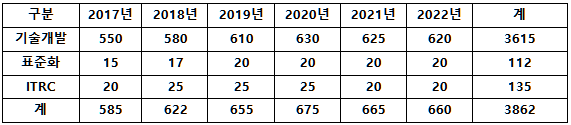
▲ Information Security R&D Budget (2017–2022, Unit: 100 million KRW)
Accordingly, the government set an R&D goal to secure new growth engines for the information security industry through information security technology innovation. The plan is to reduce the technology gap with developed countries from 0.8 years in 2017 to 0.1 years in 2022 and increase sales from 10 trillion won in 2017 to 15 trillion won in 2022.
The directions for promoting information security R&D include security vulnerabilities and software development security, data-centric security and privacy protection, next-generation communication network security, response to intelligent security threats, cloud security, mobile IoT device security, fintech security, comprehensive social safety security, autonomous vehicles/infrastructure security, healthcare/medical security, and smart industrial control system security.
To introduce a few of these initiatives, first, the security vulnerability and software development security sector develops vulnerability analysis technologies to resolve security vulnerabilities that may be inherent during hardware and software development and to ensure safety and reliability. A total budget of 26.5 billion won will be invested by 2020 to establish inspection criteria for security vulnerabilities that may be inherent during hardware and software development and to train personnel for security vulnerability analysis.
We are also preparing security technologies for autonomous vehicles, drones, and healthcare.
The mobile IoT device security sector promotes technology development to ensure the reliability of IoT networks and enhance security in response to various security threats in the IoT environment. A total of 20.1 billion won will be invested in this project by 2022. In the autonomous vehicle/infrastructure security sector, security technologies are being developed to control the safe utilization of services related to autonomous vehicles, such as automobiles and drones. For example, 4.5 billion won is being invested in integrated security technology for V2X services for autonomous vehicles, and a budget of 4.5 billion won has been allocated for technology to respond to abnormal drone flights. In addition, 20.1 billion won and 16.5 billion won will be invested in convergence security, such as healthcare/medical security and industrial security (smart industrial control systems), respectively.
In the R&D strategy report, CP Lee Jae-il stated, “Information security must secure response technologies to potential security threats in the new ICT environment and foster the ICT convergence security industry, including IoT and cloud, to preempt the new convergence security market,” adding, “We will focus on securing core technologies for future security technologies and creating a related ecosystem.”
Comments
Related news
[ICT R&D Overview] ① Digital content, VR/AR realistic content development is vital
Can we lead in immersive content technology, the core of virtual reality and augmented reality? As immersive and emotional intelligence-based content emerges as a future trend in the digital content industry, attention is concentrating on related industries. Digital content refers to the software and hardware technologies necessary for planning, producing/manufacturing, and utilizing databases of materials, information, knowledge, and data expressed in electronic form through the combination of codes, text, voice, sound, audio, images, video, and other elements with ICT technology in the form of services or products. This includes ▲immersive content ▲interactive content ▲emotional content ▲content distribution and services.
2016.08.01by 신윤오 기자

[ICT R&D Overview] ② Convergence Services: Deregulation and an Ecosystem Needed
Convergence services refer to technologies for providing services that combine Internet of Things infrastructure to realize a hyper-connected society and integrate IoT and intelligent information technologies such as ICT across the fields of industrial convergence, public convergence, and smart life. Prior to 2015, convergence technology was characterized by technology-driven terminals (H/W) and connectivity (N/W), with sensor utilization and ICT applications and intra-industry convergence being the main issues. However, post-2016 convergence technology is characterized by service-oriented intelligent solution services and applications (S/W), and it is anticipated that ecosystem building utilizing ICBM and intelligent information technology-based standard platforms, as well as the activation of inter-industry convergence, will become the main issues. In other words, in the early stage, services will be aggregated around representative platforms for each service, and in the later stage, they are expected to be utilized in an integrated and linked manner across industries centered on winning platforms.
2016.08.05by 신윤오 기자

[ICT R&D Overview] ③ Urgent Development of ICT Devices, Complex Sensors, and Intelligent Semiconductors
ICT devices comprehensively refer to intelligentized terminals and components that deliver information and communication technology and services between users and objects in IoT environments, extending beyond conventional terminals such as PCs and smartphones. Based on functions such as sensing, processing, and communication, the scope includes devices and related component technologies used in various fields including healthcare, transportation, safety, education, and convenience. ICT devices handled by the Ministry of Science and ICT include smart devices, wearable devices, unmanned mobile devices, intelligent semiconductors, smart vehicles, and 3D printing. As society enters into a hyper-connected era where all people, objects, and spaces are interconnected centered on ICT, the number of network-connected devices is increasing rapidly and numerous types of application products and services are emerging, generating high expectations for ICT devices.
2016.08.16by 신윤오 기자
Korea Instrument, KOLAS Accredited Calibration Agency First to Simultaneously Acquire ISO/IEC 27,001·27,701
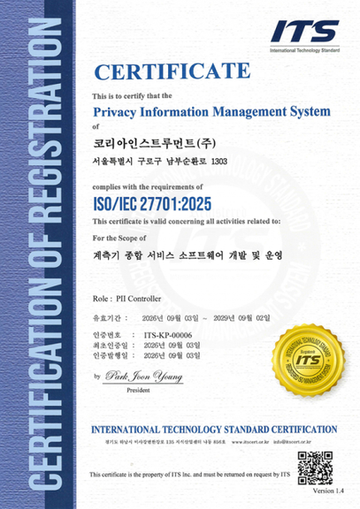
Korea Instrument has become the first among KOLAS accredited calibration agencies to simultaneously acquire ISO/IEC 27,001 and ISO/IEC 27,701 certifications. Through its proprietary platforms CWIZ Enterprise and CWIZ Partners, the company has embedded information security and personal data protection requirements across all business processes including customer information, equipment data, and calibration reports, with plans to continuously advance its management system through regular audits and security inspections.
2026.10.12by 배종인 기자
TeamViewer One, IT Incident Automation Workflow and Resolution Center Enhanced
TeamViewer has added IT incident automation capabilities and an advanced Resolution Center to its integrated digital workplace management platform 'TeamViewer ONE'. Recurrent service disruptions, configuration errors, and capacity shortages are automatically handled according to preset policies, and device status verification through script deployment can be managed in a unified interface, significantly reducing repetitive tasks for IT teams.
2026.10.12by 배종인 기자











