


[ICT R&D Overview] ⑥ Network: Build the World's Most Connected Network
 Published2016.09.05 14:04
The global market structure is changing, and the activation of open source projects is becoming an opportunity.
The Ministry of Science, ICT and Future Planning (MSIP) has unveiled its Technology Roadmap 2022 (draft), which includes 10 key ICT R&D technology areas and artificial intelligence. The 10 ICT R&D technologies selected by MSIP to strengthen the interconnectivity of science and technology (ICT) and discover new industries include: digital content, convergence services, ICT devices, information security, mobile communications, networks, broadcasting/smart media, radio waves and satellites, basic software computing, and software. e4ds News will present the R&D strategies for these areas in turn, presenting a roadmap for future technology development. [Reporter Shin Yun-oh]
As traffic explodes due to the proliferation of IoT and the cloud, interest in next-generation network technologies is growing.
With the advent of virtualization and intelligent infrastructure technologies and the advancement of all-optical-based, high-capacity, low-power, and low-cost solutions, new network technologies are also being demanded.
Networks are a general term for technologies that process large amounts of traffic in real time in response to new services, efficiently and flexibly respond to diverse service demands, and form a highly reliable and highly available Internet infrastructure in any situation.
The global network equipment market is expected to reach $114.1 billion in 2022, with Korea accounting for 1.3%.
The overall network equipment market is expected to grow at a rate of 3.52%, from $92.7 billion this year to $114.1 billion in 2022. According to Gartner's forecast, routers/switches and transmission equipment will grow to $38.9 billion (4.6%) by 2022, subscriber equipment to $15 billion (6.3%), enterprise equipment to $46.2 billion (1.4%), and SDN/NFV solutions to $18.8 billion and $11.6 billion, respectively.
The domestic network equipment market is projected to grow at a 4% rate, from $1.27 billion in 2016 to $1.61 billion in 2022. This represents 1.3% of the global market.
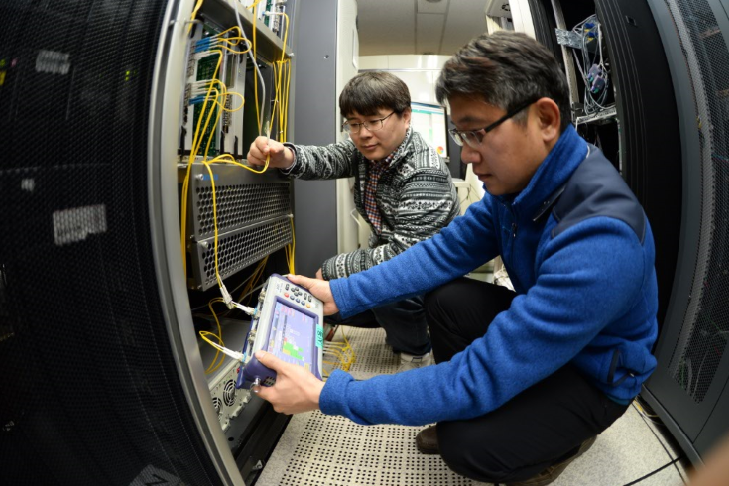
▲ETRI (Electronics and Telecommunications Research Institute) announced in February that its self-developed next-generation optical network equipment was applied to the research and development network KOREN, verifying its functions and performance, brightening the outlook for the optical communication equipment market.
The domestic network industry, with its world-class network infrastructure, is highly likely to secure a competitive edge in next-generation network fundamental technologies thanks to proactive government support for technology development. This is further supported by a world-leading R&D investment ratio.
However, domestic network equipment faces weaknesses, including low brand awareness and a heavy reliance on imported products for key components. Furthermore, the domestic market, a small 1.3% share of the global market, and the weak business foundations of domestic companies must be overcome.
A small number of global companies dominate the market, and low-priced Chinese products disrupt the domestic ecosystem.
Here, the declining profitability of major telecommunications companies is discouraging investment and exacerbating the situation where a small number of global companies are monopolizing the market. There are also threats such as the collapse of the domestic industrial ecosystem due to China's low-price policy and the high dependence on imported equipment, which poses inherent cybersecurity risks in emergencies.
“The surge in traffic is increasing the need and demand for the introduction of new technologies,” said Yoo Jae-hyung, CP, who is in charge of network R&D. “With the emergence of new technologies such as SDN/NFV and the future internet, the global market structure is changing from hardware to software, and network-related open source projects are becoming more active, so there are ample opportunities for growth.”
Accordingly, the government is pursuing the vision of implementing an open, hyper-connected ICT infrastructure, aiming to build and commercialize a world-class hyper-connected network. It will promote high-speed wired and wireless networks, increasing wired speeds from 1 Gbps to 10 Gbps and wireless speeds from 300 Mbps to 1 Gbps. Furthermore, it will shorten infrastructure setup time from several months to a matter of minutes and expand the adoption of cutting-edge technologies and equipment in the public sector.
More specific R&D focus areas can be divided into three categories: services, platforms and systems, and components. Services and platforms include ▲SDN-based open network operating systems ▲Edge computing technologies ▲Future Internet technology development, while systems include ▲switch/router systems ▲high-performance transport network technologies ▲optical access network technologies ▲wired/wireless convergence systems ▲quantum network systems. Components include ▲ultra-high-speed, low-power optical module technologies ▲high-capacity optical transceiver technologies.
The introduction of network virtualization technology is essential for achieving high-speed, low-power, and low-cost components.
Some of these key research and development technologies are introduced in detail as follows. First, SDN-based open network technology provides universal switches, operating systems, and application functions that support rapid development of various network appliances, and targets programmable, white-box, OCP switches, and IoT devices.
High-performance transport network technology involves developing commercial 10Tbps POTN systems and 100Tbps technology. Plans include securing microsecond-level TSN technology and space-division multiplexing optical transmission technology. Furthermore, ultra-high-speed, low-power optical module technology involves developing high-speed/low-power optical components and modules for data centers and mid- to long-distance applications, as well as optical integrated circuit-based optical transceivers and functional components for terabyte-scale optical communications.
CP Yoo Jae-hyung stated, “Our strategy is to introduce network virtualization technology that can be applied to create initial demand and build hyper-connected networks through leading applications in the public sector, develop high-function, high-performance network systems, and realize high-speed, low-power, and low-price components.”
Comments
Related news

[ICT R&D Overview] ③ Urgent Development of ICT Devices, Complex Sensors, and Intelligent Semiconductors
ICT devices comprehensively refer to intelligentized terminals and components that deliver information and communication technology and services between users and objects in IoT environments, extending beyond conventional terminals such as PCs and smartphones. Based on functions such as sensing, processing, and communication, the scope includes devices and related component technologies used in various fields including healthcare, transportation, safety, education, and convenience. ICT devices handled by the Ministry of Science and ICT include smart devices, wearable devices, unmanned mobile devices, intelligent semiconductors, smart vehicles, and 3D printing. As society enters into a hyper-connected era where all people, objects, and spaces are interconnected centered on ICT, the number of network-connected devices is increasing rapidly and numerous types of application products and services are emerging, generating high expectations for ICT devices.
2016.08.16by 신윤오 기자

[A Close Look at ICT R&D] ④ The Rapidly Growing Convergence Security Industry: How to Avoid Being Caught in the Sandwich
The global information security market is projected to grow at a compound annual growth rate of 10.8%, expanding from $161.2 billion in 2016 to $297.5 billion in 2022. Information security demand continues to increase due to changes in the ICT environment, including cloud, big data, and IoT. While the converged security market currently remains small, it is expected to experience rapid growth of 31.7% as a promising future sector. The domestic market outlook is also favorable. The domestic information security industry is expected to grow at a compound annual growth rate of 10.4%, expanding from 8.7 trillion won in 2015 to 15.7 trillion won in 2022, with growth centered on information security (14.18%). Similar to the global market, while the overall market size remains modest, the domestic converged security market is projected to experience significant growth of 34.2%.
2016.08.22by 신윤오 기자

[ICT R&D Review] ⑤Mobile Communications: Losing Leadership in Core Technologies and Mobile Ecosystem
Domestic mobile communications industry is a national strategic core industry with significant forward and backward linkage effects driving economic growth, accounting for 21.7% of total ICT production value (2014). In the terminal device sector, Samsung Electronics leads while Apple's pursuit and China's rapid growth stand out. In Q1 2016, global smartphone market share was Samsung Electronics (23.6%), Apple (15.3%), Huawei (8.5%), Xiaomi (4.7%), and Lenovo (4.4%). In 2015, domestic smartphone market share was Samsung Electronics (46%), Apple (33%), LG Electronics (14%), and others (7%). In the systems sector, three companies—Ericsson, Nokia, and Huawei—dominate the global market. Aside from Samsung, the industry consists of small and medium-sized enterprises with a domestic-focused structure, with domestic manufacturers holding 43.6% (2014) of the domestic mobile communications equipment market share. In the services sector, most global operators provide 4G services, with 360 operators supporting LTE services. As of 2015, service penetration rate stands at 11.5%.
2016.08.30by 홍보라 기자
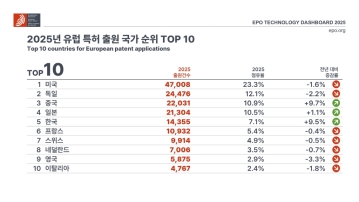
European Patent Applications Surpass 200,000 for the First Time… South Korea Maintains 5th Place, Led by Batteries and Telecommunications
According to the European Patent Office (EPO)'s 'Technology Dashboard 2025', European patent applications last year reached 201,974, surpassing 200,000 for the first time. Korean companies and inventors filed 14,355 applications, representing a 9.5% increase from the previous year and maintaining 5th place by country. Battery, digital communication, and semiconductor technologies led the growth, with Samsung ranking as the top EPO applicant for the second consecutive year and LG reaching 3rd place. The presence of major domestic cities such as Seoul, Suwon, and Yongin was also confirmed. It was also revealed that Korea's European patent strategy is expanding beyond individual technologies to span the entire industry.
2026.03.24by 명세환 기자

SK Telecom First Applies AI-Based Network Operations at Gwanghwamun K-Pop Concert
SK Telecom announced that it applied an AI-based network operation system for the first time at a large-scale K-pop concert held in the Gwanghwamun area of Seoul on March 21st, managing communication quality throughout the event. Mobile data usage during the three hours before and after the concert reached 12.15TB, approximately doubling compared to the same time slot the previous weekend. SK Telecom monitored traffic using the AI system 'A-One' in five-minute and 50-meter units to respond to potential overload situations, while also operating temporary communication facilities and on-site personnel in parallel. This case is interpreted as confirmation of the practical applicability of AI-based autonomous network operation in an environment where demand from dense events and foreign users increases simultaneously.
2026.03.23by 명세환 기자











