


Intel Realizing Computer Vision with RealSense Technology
 Published2016.09.08 09:42
Providing deep learning solutions and computer vision from devices to the cloud
Written by Josh Walden, Senior Vice President and General Manager of Intel's New Technology Group
An era has arrived where devices that are not smart or connected cannot survive. With the emergence of connected devices that understand their surroundings and react accordingly, new solutions unlike those of the past are also appearing one after another.
Intel has been able to secure a leading position in computer vision and cognitive computing by building core technologies based on RealSense™. Simply put, computer vision can be understood as a technology that enables machines to visually process and understand their surrounding environment. The camera acts as the device's 'eyes,' the central processing unit acts as the 'brain,' and the vision processor functions as the 'visual cortex' that processes visual information. Integrating all of these enables the implementation of features that are attracting significant interest in various emerging fields, such as navigation, mapping, collision avoidance, tracking, object recognition, and survey analysis.
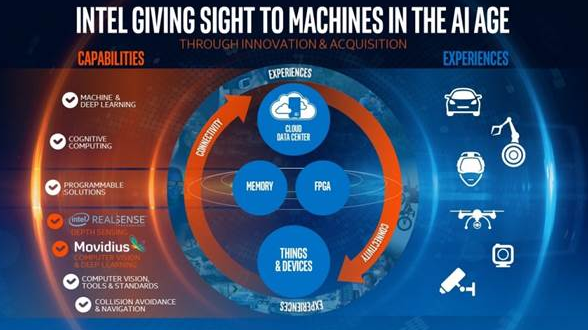
The introduction of RealSense-based depth-sensing cameras has brought about innovative technology that enables devices to 'see' the world in three dimensions. To support this paradigm shift, Intel has acquired companies in the fields of machine learning, deep learning, and cognitive computing, aiming to open up a world of amazing possibilities previously unimaginable, such as recognizing objects, understanding scenes, and performing authentication, tracking, and navigation. As devices become increasingly smarter and decentralized, and with the number of connected devices predicted to reach 50 billion by 2020, specific System on a Chip (SoC) attributes are expected to become even more critical to realizing human-like visual capabilities.
It is in this context that we would like to announce Intel’s ongoing acquisition of Movidius. By acquiring Movidius, Intel has secured a low-power, high-performance SoC platform, enabling it to accelerate the application of computer vision. Furthermore, through this acquisition, Intel will acquire algorithms suitable for deep learning, depth processing, navigation, mapping, and natural interaction, and will accumulate extensive knowledge in embedded computer vision and machine intelligence. Movidius technology will contribute to achieving results by enhancing and optimizing RealSense capabilities.
In particular, it appears that Movidius will play a significant role in the process of Intel implementing new technologies. With the ability to track, navigate, map, and recognize scenes and objects based on Movidius's low-power, high-performance SoC, new opportunities have been gained in fields where heat, battery life, and form factor are critical factors. Specifically, this technology will be applied to areas such as augmented, virtual, and mixed reality (AR/VR/MR), drones, robotics, and digital security cameras. Movidius's industry-leading computer vision SoC family is expected to complement not only Intel's existing diverse IPs and product roadmaps but also RealSense.
Computer vision will completely overturn the landscape of next-generation computing, and Intel will lead this change in computing based on its RealSense and cognitive computing technology product families through the acquisition of Movidius.
Comments
Related news

Why did Intel bring a virtual reality (VR) headset to the developer forum?
Intel has unveiled Project Alloy, a project that realizes future Merged Reality. Intel CEO Brian Krzanich introduced an all-in-one virtual reality (VR) solution at the opening keynote speech of the 2016 Intel Developer Forum (IDF) held in San Francisco, USA on Tuesday the 16th (local time). The Alloy platform is able to provide a variety of new immersive experiences thanks to Intel RealSense technology, a 3D depth sensing technology optimized for VR use. The key features are as follows.
2016.08.18by 신윤오 기자

[Intel Developer Forum] Announcement of IoT Development Platform Providing Human-like Senses
Intel announced the Intel® Joule™ platform at the 2016 Intel Developer Forum (IDF) currently underway in San Francisco, USA. The Intel Joule platform is a high-end computing platform that enables next-generation smart devices to possess human-like sensory capabilities. Developed for the IoT sector, the Intel Joule platform enables embedded developers and entrepreneurs to build embedded systems or accelerate product commercialization through prototyping while minimizing development costs.
2016.08.18by 김수지 기자
The Effect of Intel's Acquisition of Altera? FPGAs Play a Crucial Role Between Cloud and IoT
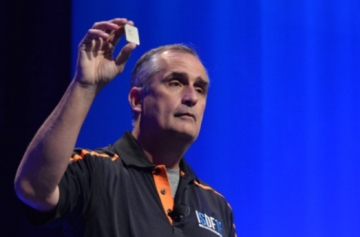
Intel held the inaugural Intel SoC FPGA (Field Programmable Gate Array) Developer Forum at the same venue during the 2016 Intel Developer Forum (IDF) event. The event focused on the newly established Intel Programmable Solutions Group created through the Altera acquisition and the SoC FPGA technology the group is developing. Intel CEO Brian Krzanich addressed various questions that many people have been curious about following the Altera acquisition through his keynote speech at the event, including: "What does the Altera acquisition mean for SoC FPGA users?" "What direction will Intel now move toward?" and most importantly, "What role will FPGA and SoC FPGA play for Intel going forward?"
2016.08.19by 신윤오 기자
.jpg)
SalePoint Signs Multi-Year Partnership Agreement with AWS… Promoting Identity Security that Integrates Even AI Agents
Sailpoint has entered into a multi-year strategic partnership agreement with AWS and is moving forward with establishing an integrated governance system that manages both human and non-human identities together. The plan is to consistently manage access permissions in an environment where AI agents are increasing as work execution entities, while applying the principle of least privilege and automated policy enforcement. The two companies plan to jointly expand capabilities to manage the identities of various entities, including AI agents, within a single layer in the AWS environment. This collaboration is interpreted as a move to design security and governance together in corporate environments where AI adoption is expanding.
2026.03.26by 배종인 기자
.png)
Databricks Unveils Open AI Security Monitoring 'Lakewatch'
Databricks entered the security market on March 24 by unveiling LakeWatch, an open-source agentic SIEM. The core functionality of this product is to integrate and analyze security, IT, and business data in a single environment to support AI-based threat detection and investigation. The company explained that it reduces the limitations of existing security operations centers, which have had to forgo some data due to high cost structures, and enables large-scale data analysis and automation based on open formats and ecosystems. LakeWatch is currently offered as a private preview, with Adobe and Dropbox mentioned as early customers. Databricks also announced an expanded partnership with Anthropic as well as the acquisition of Antimatter and SiftD.ai.
2026.03.26by 배종인 기자











