


Counterattack by Patent Trolls: Will Autonomous Vehicle Patent Disputes Intensify?
 Published2016.09.09 12:07
High likelihood of infringement and easy to prove… High potential for disputes with automakers within the next 2-3 years
In the field of autonomous vehicle patents, the movements of NPEs (patent management firms), known as so-called "patent trolls," are becoming alarming.
As NPEs have been acquiring a large number of patents related to autonomous vehicles in recent years, and lawsuits filed against major domestic companies have also increased, there are growing calls to closely monitor the movements of these NPEs and prepare countermeasures.
Patent litigation related to autonomous vehicles began to increase starting with patents in the early 2000s, when ICT technology was integrated into automobiles. The proportion of patents litigated by NPEs among all patents subject to litigation is gradually increasing. Analysis suggests that a large number of patents filed during this period are securing rights to core technologies of autonomous vehicles.
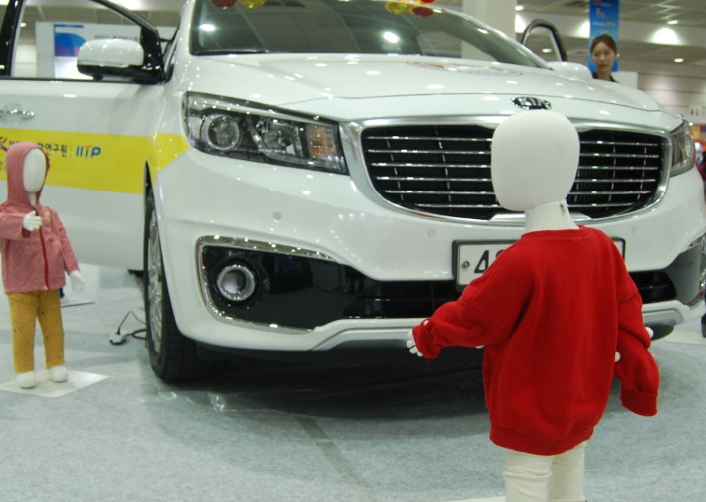
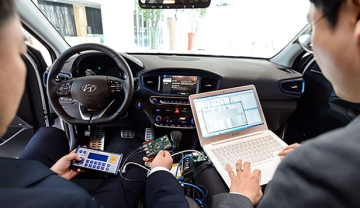
▲ NPEs have focused on acquiring patents related to vehicle condition monitoring systems and accident prevention/avoidance systems, as these two technologies have a high probability of infringement and are easy to prove. (The photo shows a demonstration of autonomous vehicle-related technology presented by an autonomous vehicle research institute at an exhibition.)
In particular, the period between 2002 and 2007 was a time of research boom for autonomous vehicles, and in 2002, 8 out of 15 patents subject to litigation were NPE litigation patents. In addition, 4 out of 13 cases in 2006 and 4 out of 11 cases in 2007 were NPE patent lawsuits. Although statistics for 2015 and 2016 are not yet available as they are in the undisclosed patent area, experts expect that NPE patent lawsuits have increased significantly.
The continuously increasing number of lawsuits filed by NPEs is having a direct impact on related domestic companies. Lawsuits targeting Korean companies, such as Hyundai and Kia Motors, are on the rise. While domestic automakers were rarely exposed to litigation until 2010, the number of cases filed against them has been increasing since 2011. According to the Korea Intellectual Property Strategy Institute, while 11 out of 73 total lawsuits in 2011 targeted Korean companies, 17 out of 121 total lawsuits in 2013 were NPE lawsuits against Korean companies.
So, in which areas of autonomous vehicles are NPEs focusing? It appears they are highly interested in accident prevention/avoidance systems and vehicle condition monitoring systems. The specific technologies with the most litigation patents were, in order: automotive SoC technology, vehicle condition monitoring systems, and accident prevention/avoidance systems. Among these, vehicle condition monitoring systems and accident prevention/avoidance systems were patents favored by NPEs because these two technologies have a high probability of infringement and are easy to prove.
The field with a high volume of NPE patent transactions is automotive wireless communication technology.
The fact that the filing dates of patents subject to litigation coincide with the timing of the increase in NPE patents clearly illustrates how they are utilizing the patents they have acquired. The high rate at which NPEs use acquired patents in litigation explains why the timing of the increase in litigation patents aligns with the timing of the increase in patents acquired by NPEs. The technology sectors that NPEs have recently been focusing on acquiring are automotive wireless communication systems and autonomous driving systems, which are expected to lead to disputes with automakers within the next two to three years.
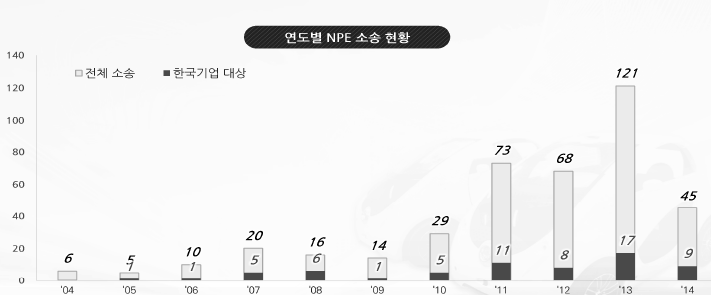
▲ Status of NPE lawsuits against Korean companies by year
The number of assigned patents (litigation patents) relative to patents held by NPEs was 10 out of 16 in 2002 and reached 14 out of 18 in 2006. This figure decreased until 2012, then increased to 7 out of 17 in 2013, and is expected to have continued to rise during the undisclosed period of 2015 and 2016. As such, NPEs filing lawsuits against automakers primarily utilize acquired patents. For example, the NPE Beacon Navigation had 8 litigation patents and 8 acquired patents out of a total of 64 lawsuits (2004–2014), resulting in a 100% ratio of acquired patents.
We must analyze patent acquisitions and rights transfers by NPEs, etc.
The average number of patent transactions for autonomous vehicles is 66, with above-average patent trading occurring in seven technology fields, including sensing systems, accident prevention/avoidance systems, and automotive SoCs. Among the traded patents, the proportion of patents where the final rights holder is an NPE was highest in the field of automotive wireless communication technology at 22.4%. Next, sensing systems accounted for 11.6%, accident prevention/avoidance systems for 13.3%, and automotive SoCs for 4.5%.
Major NPEs initiated lawsuits against Korean companies approximately 21 months after the patent assignment date. In response, Lee In-hee, a senior researcher at the Korea Institute of Intellectual Property Strategy (KISTA), stated, "Recently, major domestic companies have been frequently sued by NPEs." She added, "Therefore, we must examine the litigation areas of NPEs and analyze the characteristics of each sector to formulate our litigation response strategies. We should analyze patent acquisitions and rights transfers by NPEs to use as a reference for setting the future direction for domestic companies."
Comments
Related news
[Discussion] Autonomous Vehicles: "Overconfidence is dangerous, but there is no need to fear either"
Interest in autonomous vehicles shows no signs of cooling. Autonomous vehicles require extensive technological advancement starting from existing automotive technology itself, encompassing advanced component-related technologies, and extending to surrounding infrastructure technologies including roads. 'Automotive Innovation Day 2016,' hosted by Automotive Electronics, a representative automotive technology exhibition in Korea, was held on the 14th with the participation of approximately 700 people. The event addressed key issues for future automotive development including ADAS and autonomous vehicles, connected cars and IoC (Internet of Car), automotive security, and testing—hot topics in the automotive industry—and received enthusiastic response from participants. In the panel discussion concluding the conference, government and industry experts related to autonomous vehicles participated, providing insights into the latest industry trends. E4ds News presents a live coverage of the panel discussion on 'Core Technologies and Implementation Directions for Autonomous Vehicle Commercialization.' The panel discussion, moderated by Beom-jin Yoon (Automotive Electronics), included ▲Ui-kyung Jung, Section Chief (Ministry of Land, Infrastructure and Transport) ▲Jae-gon Shin, Team Leader (Korea Transportation Safety Authority Automotive Safety Research Institute) ▲Jae-gwan Lee, Director (Korea Automotive Technology Institute) ▲Lars Reger, CTO (NXP Semiconductors), and others.
2016.07.25by 신윤오 기자
Secure system semiconductor technology for autonomous vehicles by 2021
Nine national strategic projects have been announced to secure new growth drivers. The nine national strategic projects selected by the government are ① autonomous vehicles ② post-steel lightweight materials ③ smart cities ④ artificial intelligence ⑤ virtual and augmented reality ⑥ precision medicine ⑦ carbon resources ⑧ (ultra)fine dust ⑨ bio-pharmaceuticals. The government announced at the second presidential Science and Technology Strategy Meeting held on the 10th that it has decided to intensively foster the nine national strategic projects through concentrated investment at the national level and public-private collaboration.
2016.08.11by 신윤오 기자
Self-driving car patent applications are booming domestically, while overseas applications are plummeting.
According to the Korea Institute for Intellectual Property Strategy (KISTA), the leading autonomous vehicle countries—Japan, the United States, and Germany—hold an average of 41.8% of major market share, while Korea achieved only 7.9%. This is analyzed as being due to insufficient technology acquisition targeting overseas markets, given that Korea's autonomous vehicle development stage is still in its early phases. Overall patent applications related to autonomous vehicles have surged since 2002 as autonomous vehicle concept cars and R&D development plans have increased. Patent applications are primarily concentrated in the United States and Japan, with Japan focused mainly on a small number of completed vehicle manufacturers, while the United States showed diverse applicants including numerous component suppliers, internet companies, and completed vehicle manufacturers.
2016.09.05by 신윤오 기자

[e4ds Tech Day 2026 ⑨] Sim Sang-gyu, Autocrypt CTO: "In the Physical AI Era, Automotive Security Must Extend Beyond the Vehicle"
At e4ds Tech Day 2026, Sim Sang-gyu, CTO of Autocrypt, explained automotive cybersecurity strategies in the era of Physical AI and SDV (Software-Defined Vehicle). Automobiles are evolving as part of an ecosystem connected to AI, cloud, chargers, IoT, and robots, and he emphasized that the scope of security must expand beyond the vehicle interior to the entire connected environment. In particular, AI model tampering, adversarial attacks, OTA updates, and EV charger hacking were identified as major threats. He explained that response measures require zero trust, AI model integrity protection, intrusion detection, Security by Design and Default, and full lifecycle security management, and that proactive security system establishment beyond regulatory compliance is critical for securing future mobility competitiveness.
2026.10.12by 배종인 기자

Practical HIL Construction Strategy for Automotive and Off-Highway Controller Validation
As vehicle E/E architecture transitions to zonal structures and shifts to software-defined vehicles (SDV), the number of controllers (ECUs) requiring validation and software complexity are surging dramatically. Meanwhile, real vehicle testing cannot provide repeated verification under identical conditions and entails lead time and safety concerns. This white paper explains the principles of HIL (Hardware-in-the-Loop) validation and the structure of the NI platform composed of PXI, SLSC, and VeriStand, and through two actual implementation cases—Camera Record & Replay HIL for In-Cabin Monitoring Controller (ICMU) and Forklift Controller (VCU) HILS—describes how controller-level regression testing becomes possible. Additionally, it explicitly states application boundaries and limitations, such as lack of A2B support.
2026.10.12by 편집부











