


[A Close Look at ICT R&D] ⑦ Foster New Media Industries such as VR/AR
 Published2016.09.09 15:05
There are many challenges, such as the market dominance of leading overseas companies and the gap in core technologies.
The Ministry of Science, ICT and Future Planning (MSIT) has unveiled the draft Technology Roadmap 2022, which adds artificial intelligence to the 10 major ICT R&D technology fields. The 10 major ICT R&D technologies selected by the MSIT to strengthen the interconnectedness of science and technology and ICT and to discover new industries are: digital content, convergence services, ICT devices, information security, mobile communications, networks, broadcasting/smart media, radio waves and satellites, foundational SW computing, and software. Accordingly, e4ds News plans to present the future technology development roadmap by introducing the R&D strategies for these fields in sequence. [Reporter Shin Yun-oh]
Broadcasting and smart media services refer to a series of processes and forms in which content is produced targeting a large number of users, delivered via wired and wireless networks, and viewed and consumed by users through various receiving devices.
This includes broadcasting and smart media-related services, content, media infrastructure, consumer devices, mobile broadcasting, broadcasting and telecommunications convergence immersive broadcasting, platforms such as signage, public welfare, and disaster safety technologies.
Accordingly, the market size is also large. The broadcast smart media industry is projected to grow at an annual average rate of 11.5%, from $228.6 billion in 2016 to $439.2 billion in 2022. Specifically, services and content grow from $32.2 billion to $36.7 billion at an annual average rate of 2.2%, infrastructure and consumption (terminal) sectors grow from $75.3 billion to $226.3 billion at an annual average rate of 20.1%, and platform sectors grow from $120.4 billion to $175.1 billion at an annual average rate of 6.4%.
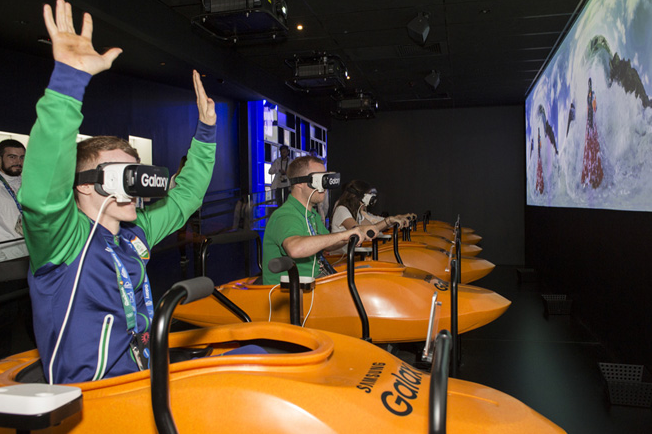
Future broadcasting smart media also includes 360-degree immersive broadcasting services.
(Reference photo shows Olympic athletes visiting the Galaxy Studio enjoying the thrill of a 4D roller coaster at the 'Gear VR Station')
With terminal growth leading the overall market due to the rapid increase in global UHDTV adoption, growth of 52.7% is expected in 2016, while the platform market, including smart broadcasting, social media, and digital signage, is projected to grow rapidly by 51.5% in 2022.
The domestic market is also strong. It is expected to grow by an annual average of 10.7% from 7.6 trillion won in 2016 to 15.2 trillion won in 2022, a figure comparable to the growth trend of the global market. Specifically, services and content are expected to grow from 2.5 trillion won to 3.1 trillion won at an annual average rate of 3.7%, infrastructure and consumption (terminal) sectors are expected to grow from 2.1 trillion won to 4.6 trillion won at an annual average rate of 16.1%, and platform sectors are expected to grow from 3.0 trillion won to 7.4 trillion won at an annual average rate of 14.6%.
The reason for this expected overall growth is the emergence of various new technologies such as big data, IoT, cloud computing, machine learning, and VR, as well as the acceleration of technological innovation through the utilization of contextual, user, and multi-sensory information. Additionally, the increasing demand for immersive media and the full-scale launch of the UHD market are also positive factors.
Accordingly, the domestic industry possesses strengths characterized by the excellent global competitiveness of Korean content, the global spread of the Korean Wave, superior domestic IT infrastructure, wired and wireless network environments, and competitive terminals. Furthermore, it is believed that competitiveness can be expanded by leveraging the proactive provision of immersive broadcasting and media services, such as UHD, and the rapid popularization of smart media devices.
However, the entry of leading overseas companies armed with new technologies poses a high possibility of shifts in market dominance, and the technological gap held by existing leaders, along with their superior source technology and intellectual property rights, is difficult to overcome. The rapid growth of UHDTV in China and the Japanese government's active support for UHD also act as threat factors.
Domestic market focusing on short-term commercialization technology development
Difficulty in securing source standard technology
It has been pointed out that the domestic market is struggling to secure core standard technologies due to a focus on short-term commercialization development, and that it lacks competitiveness in foundational platform technologies and an open ecosystem. Furthermore, the stagnation of the advertising market makes it difficult to discover new revenue streams in the broadcasting market, which is expected to hinder the expansion of broadcast media services.
Kang Dong-wook, CP in charge of R&D for the broadcasting smart media sector, stated, “We will promote new broadcasting media services based on our strengths, such as multi-terminal interoperability convergence services and content technologies, and actively develop core media technologies and application services that can utilize excellent network infrastructure.” He added, “It is important to identify new issues in the field of smart convergence broadcasting media first and secure source technologies through preemptive standardization.”
Accordingly, the government aims to establish a global leader in new concept broadcast media technology with the vision of becoming a global leader in new concept broadcast media technology, and sets goals such as: ▲ establishing a global highest quality UHD service environment (realizing the world's first terrestrial UHD broadcasting in 2018) ▲ revitalizing the new concept broadcast media industry (doubling the growth of the domestic market) ▲ securing global-level competitiveness in broadcast media technology (improving the technology level compared to the best).
Aiming to double the domestic market growth by revitalizing the new concept broadcasting and media industry
The R&D promotion strategy for each sector focuses on social personal broadcasting media services as a key area to secure intelligent media services integrated with IoM technology (strengthening government investment), and regarding immersive broadcasting media, it aims to secure core source technologies such as natural mixed reality (strengthening investment). In N-screen services, it secures multi-screen services that recognize the viewing environment (strengthening investment), and in intelligent UHD content production, it realizes a file-based production workflow (strengthening investment). In addition, in the augmented reality broadcast media domain, we will secure hybrid broadcast media technologies that enhance viewing immersion (strengthen investment), and in the UHD transmission and reception domain, we will develop technologies that improve advanced frequency efficiency (maintain investment). In the public service domain, we will expand media access and provide disaster warnings and information to the public (strengthen investment).
As such, a budget of 285.7 billion won has been invested in broadcast smart media R&D technology development by 2022, and 29.3 billion won has been allocated for standardization by 2022.
CP Kang Dong-wook said, “We will secure 4K UHD services across all media and core service technologies for this purpose, and foster global equipment companies by expanding corporate-led innovative technology development,” adding, “We will revitalize new concept media industries such as VR/AR and lead broadcast media technology through the development of core source technologies and standardization for rapid growth.”
Comments
Related news
[ICT R&D Overview] ① Digital content, VR/AR realistic content development is vital
Can we lead in immersive content technology, the core of virtual reality and augmented reality? As immersive and emotional intelligence-based content emerges as a future trend in the digital content industry, attention is concentrating on related industries. Digital content refers to the software and hardware technologies necessary for planning, producing/manufacturing, and utilizing databases of materials, information, knowledge, and data expressed in electronic form through the combination of codes, text, voice, sound, audio, images, video, and other elements with ICT technology in the form of services or products. This includes ▲immersive content ▲interactive content ▲emotional content ▲content distribution and services.
2016.08.01by 신윤오 기자
Why did Intel bring a virtual reality (VR) headset to the developer forum?
Intel has unveiled Project Alloy, a project that realizes future Merged Reality. Intel CEO Brian Krzanich introduced an all-in-one virtual reality (VR) solution at the opening keynote speech of the 2016 Intel Developer Forum (IDF) held in San Francisco, USA on Tuesday the 16th (local time). The Alloy platform is able to provide a variety of new immersive experiences thanks to Intel RealSense technology, a 3D depth sensing technology optimized for VR use. The key features are as follows.
2016.08.18by 신윤오 기자

Samsung Electronics Launches New 'Gear VR' for More Immersive Experience with Improved Field of View
Samsung Electronics will launch an upgraded virtual reality headset "Gear VR" in the domestic market on the 19th, with improved viewing angle, usability, and expanded compatibility. The new "Gear VR" model, unveiled alongside the "Galaxy Note7" in New York on the 2nd, provides consumers with a more convenient and stable virtual reality (VR) experience through upgraded features. The newly introduced "Gear VR" features an expanded lens diameter from the existing 38mm to 42mm, and a widened viewing angle from 96 degrees to 101 degrees, enabling users to enjoy more vivid and immersive virtual reality. Through reduced eye fatigue, users can experience virtual reality in a more comfortable environment.
2016.08.23by 신윤오 기자
ESP32 Development Environment Selection and GPS Application Implementation
The ESP32 is a microcontroller that integrates Wi-Fi, Bluetooth, 12-bit ADC, capacitive touch, PWM, DAC, and UART in a single SoC. However, the abundance of features does not by itself solve the designer's problems. The real challenges lie in selecting the appropriate development environment, determining which pins can be used and which must be avoided, and converting raw data from modules into usable information. This document addresses ESP32 peripheral constraints (ADC2 and Wi-Fi coexistence limitation, UART1 occupancy, ADC non-linear regions), the trade-offs between Arduino IDE and ESP-IDF, and the process from connecting NEO-6M/NEO-M8N GPS modules to UART2, parsing NMEA sentences, and visualizing routes in Google Earth, all organized based on documented references.
2026.10.12by 편집부
MIPI CSI-2, DSI-2, C-PHY, D-PHY Test Solution Technical White Paper
The MIPI interface adopts a burst mode that transitions between low-power (LP) and high-speed (HS) states for low-power consumption, and in return, strict timing rules are imposed on state transitions. Additionally, the high-speed section operates as a packet-based protocol with headers, ECC, and CRC, so verification engineers must handle waveforms and protocols simultaneously. Traditional configurations combining general-purpose oscilloscopes and AWGs reveal limitations in setup complexity, measurement uncertainty, and lack of reproducibility when faced with these requirements. This white paper, based on webinar materials, organizes the structure of this problem and describes how the SV5C-DPTXCPTX generator for receiver testing and SV5C-DPRXCPRX analyzer for transmitter testing integrate state transition testing, stressed eye testing, and protocol analysis into a single bench, along with their application boundaries.
2026.10.12by 편집부











