


The traditional PC business model has collapsed, making a complete overhaul of the PC business inevitable in 2020.
 Published2016.09.22 17:04
Gartner predicted that in 2020, business leaders at PC companies would face a critical decision regarding whether to completely overhaul their PC business or withdraw from the market.
Gartner stated that companies wishing to maintain their PC business divisions must promptly adopt appropriate alternatives or changes to adapt to the currently oversaturated PC market.
“The traditional PC business model as we knew it has collapsed,” said Tracy Tsai, Executive Vice President of Research at Gartner. “While the market share of the world’s top five PC vendors increased by 11% from 65% in 2011 to 76% in the first half of this year, revenue and profits decreased. This does not mean the end of the PC market, but as the number of PC installations worldwide steadily declines over the next five years, the revenue and profits of PC vendors will continue to shrink.”
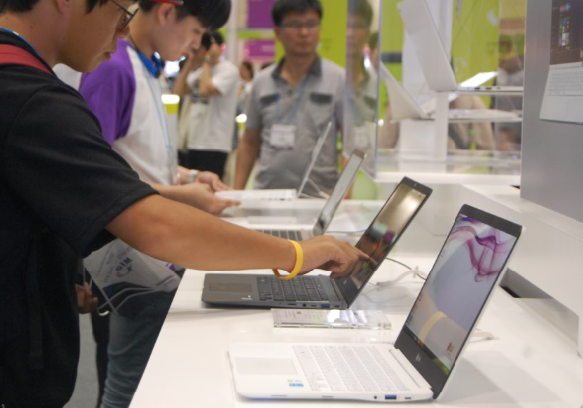
A visitor is examining a laptop PC on display at the exhibition.
Vice President Tracy Chai stated, “Over the next five years, the approach of increasing market share by stimulating demand through price competition is not expected to work in the PC market,” adding, “Existing PC companies must adapt to new trends shaping PC consumption.” For example, factors include the decreasing number of PC users who use their devices until the end of their lifespan, the shift from enterprise PC applications and storage to the cloud, reduced reliance on PC performance, and prices and specifications that make PC upgrades unsuitable. Ultimately, a new and enhanced consumer experience is the only way to provide differentiation,” they stated.
Gartner presented four response strategies for PC manufacturers to respond to the future PC market, based on corporate culture and assets, business operations and technological innovation, and comprehensive business restructuring.
1. Existing Products and Existing Business Models
This alternative represents the most conservative approach and can be applied by companies selling existing PC products while maintaining their current business operations. To cover business costs, sufficient cash flow must be generated, which requires significant volume. Therefore, mergers among companies are expected to be inevitable in the declining PC market. While the purpose of the mergers is to preserve the PC business, they entail significant risk, as Intel and Microsoft (MS) are shifting their strategies in new directions.
Vice President Tracy Chai stated, “To sustain their businesses in the long term, PC manufacturers must streamline operations and focus on increasing the sales proportion of mid-to-high-end products rather than market share.” She added, “Sales compensation systems are another key element that requires change. When operating incentive programs to promote sales activities by sales departments or distribution partners, PC manufacturers should pay more attention to margins and profitability rather than focusing solely on market share and sales volume.” He also added, “PC manufacturers must focus on the requirements of ‘users’ rather than the requirements of ‘distributors and resellers.’”
2. Existing Products and New Business Models
This involves a PC manufacturer establishing a team to test new business and revenue models for PC products, such as 'PC as a service.' The business model in this scenario is agile, risk-taking, and embraces failure. For example, it involves forming a collaborative relationship with a digital education content developer to package 2-in-1 devices loaded with digital content and offer them via a subscription model. In this case, the PC is provided to users free of charge through subsidies from the content provider.

Table 1. Number of PC installations worldwide, 2015–2019 (actual number). Source: Gartner (September 2016)
3. New Products and Existing Business Models
The third alternative is to take a more conservative approach to seeking new product lines and market access. Examples include transforming PCs into smarter devices through features such as sensors, voice output, emotions, and touch capabilities, or developing new products for connected homes or targeting vertical markets. This can serve as a gradual strategy for PC manufacturers to expand into new product areas while building upon their current business models.
4. New Products and New Business Models
The final alternative represents the most aggressive approach to change in terms of business operations and product innovation. In this scenario, PC manufacturers could establish new departments to manage business operations and seek new technological solutions to build entirely new product lines. This also includes collaborations with new channel partners, independent software vendors (ISVs), and startups, and the resources and revenue models involved may differ from the company's existing structure.
One example is personal assistant robots. Combining chatbots with voice-activated virtual personal assistant functions, PCs can act as 'information butlers' in the home and generate revenue from developers and third-party content and service providers in fields such as retail, healthcare, education, video, and music.
“PC business leaders need to consider business performance based on the four alternative strategies presented above. Some companies may need to completely overhaul their business and product strategies to change the landscape of the PC market,” explained Vice President Tracy Chai. “PC companies should identify their core competencies and evaluate their internal resources to adopt one or more alternative models for business and product innovation to maintain or divest their PC business.”
Comments
Related news
PC shipments have been declining for seven consecutive quarters, but signs of recovery are emerging.
According to preliminary results announced by Gartner Inc., global PC shipments in the second quarter of 2016 declined 5.2% year-over-year to 64.3 million units, marking seven consecutive quarters of decline. However, Gartner indicated that the PC market is showing some signs of recovering growth. Mikako Kitagawa, Principal Analyst at Gartner, stated, "PC prices are rising in some countries due to the depreciation of local currencies against the US dollar, which is one of the chronic issues currently facing the PC market. This price increase phenomenon affected Europe, Middle East, Africa (EMEA) and Latin America regions last year. However, the decline in PC shipments in the second quarter of this year has moderated compared to the same quarter last year, which suggests that the impact of exchange rates is diminishing."
2016.07.13by 홍보라 기자
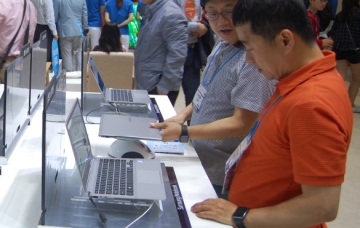
Demand for laptops outpaces demand for desktop PCs for two consecutive quarters
According to recent domestic PC market research analysis by Korea IDC (CEO Hong Yu-suk), domestic PC shipments in the second quarter of 2016 remained at 1 million units, maintaining the previous year's level. Desktop shipments totaled 490,000 units, declining 7.2% year-over-year, while notebooks increased 6.4% to 510,000 units, with notebook demand outpacing desktops for the second consecutive quarter. Desktops showed double-digit declines year-over-year in the home, public, and small-to-medium enterprise sectors. All-in-one desktops fell to 42,000 units, down 20,000 units from the previous year, with growth momentum weakening. However, the education sector recorded 58,000 units, an increase of over 80% year-over-year, driven by large-scale replacement of aging desktops in school practice rooms and similar facilities. Desktop replacement is expected to continue into the third quarter.
2016.08.19by 신윤오 기자

Negative impact on overall IT spending due to weakening demand for smartphones, tablets, and PCs
According to this report (Worldwide Semiannual IT Spending Guide: Vertical and Company Size), investment in the third platform (The 3rd Platform: an IT platform based on cloud, mobility, big data, and social) is expected to continue as part of digital transformation efforts in major industries such as financial services and manufacturing. In the telecommunications industry, while investment is expected to gradually improve compared to the downturn in recent years, the extent of improvement is anticipated to be relatively modest. During the forecast period, IT spending in key industries—banking, manufacturing, and telecommunications—is projected to account for one-third of total IT revenues.
2016.09.01by 김수지 기자

Intel Unveils Next-Generation 'Core Ultra Series 3' and vPro Platform for Enterprise PCs
Intel has officially unveiled the "Intel Core Ultra Series 3" for next-generation enterprise PCs and the latest vPro platform, addressing a wide range of demands from enterprise notebooks to high-performance workstations.
2026.03.26by 배종인 기자

ROHM Launches ESD Protection Diode Compatible with High-Speed Interfaces of 10Gbps or Higher
Semiconductor specialist ROHM has developed the 'RESDxVx series' of ESD (electrostatic discharge) protection diodes capable of responding to next-generation high-speed data communication environments exceeding 10Gbps, simultaneously enhancing both signal quality maintenance required in high-speed interfaces and IC protection performance.
2026.03.26by 배종인 기자











