


Tektronix Adds Features to Aurora Automated File-Based Quality Management Solution
 Published2016.09.29 14:56
High-quality video artifact detection, file-based QC in the Amazon cloud, and AS-10 PAD specification support
Tektronix announced new features added to the Tektronix Aurora automated file-based quality control (QC) solution, which is used by content creation, editing, and distribution companies and broadcasters to efficiently test and monitor the rapidly increasing volume of video content.
An innovative video quality measurement technology called PVQ (Perceived Video Quality) measurement has been added to Aurora. This feature allows for accurate assessment of summarized quality measurements for file-based content. Other enhanced features include support for Aurora on the AWS (Amazon Web Services) cloud and support for the AS-10 PAD transmission specification, which is currently a mandatory requirement in France.
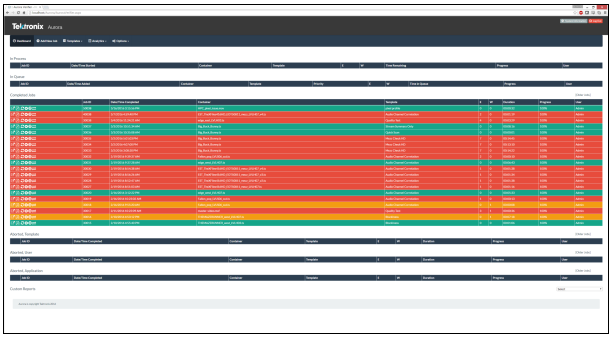
As the broadcasting industry moves toward a trend of transmitting all services based on files, and with the increasing adoption of multi-screen and OTT (Over-The-Top) media services, the volume of video content that needs to be tested and inspected is rapidly increasing. An efficient way to maintain the quality of all content is to use automated QC tools. While these tools offer advantages in terms of speed and cost compared to manual QC, automated tools can be a source of false positives because it is difficult to filter out errors that actually affect the viewer's perceived picture quality from those that do not.
Tektronix has solved this problem by adopting PVQ technology, proven through its Sentry product family of video network monitors, into the newly released Aurora version. This technology enables operators to closely integrate file-based and real-time stream monitoring technologies with accurate quality measurement methods evaluated over years in real-world environments. Like Sentry, Aurora can now analyze video content using proprietary algorithms designed to detect video compression artifacts that affect the viewer's perceived picture quality.
Aurora can also graphically display video quality using a format similar to MOS (Mean Score). MOS, a well-known industry metric, is a technique that quantifies the quality perceived by the viewer.
Charlie Dunn, General Manager of the Tektronix Video Product Family, commented on the newly added feature: “Maintaining the quality of file-based content is a never-ending task. This is becoming increasingly severe, especially as more content distributors transition to multi-screen and Adaptive Bitrate (ABR) delivery models. The new feature added to Aurora will play a crucial role in helping our customers maintain their leading position in the content industry. Until now, there has been no such feature as PVQ in automated tools. We believe this feature will provide long-term benefits in terms of improved efficiency, cost reduction, and ultimately, quality enhancement.”
Comments
Related news
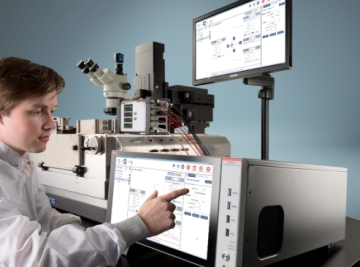
Tektronix Launches New Parameter Analyzer to Reduce Analysis Results Time
Tektronix has introduced a fully integrated Keithley 4200A-SCS parameter analyzer with customizable capabilities. The Keithley 4200A-SCS parameter analyzer provides straightforward test setup while delivering clear and precise results, reducing the effort that new users or customers seeking temporary use must devote to complex characterization, thereby facilitating understanding of semiconductor devices, materials, and processes.
2016.08.09by 신윤오 기자
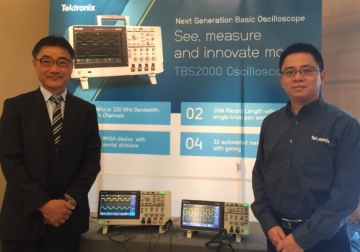
Tektronix Strengthens Oscilloscope Market with Entry-Level Launch Featuring Latest Probe Interface
Tektronix has unveiled the next-generation entry-level oscilloscope TBS2000. The company stated that the newly introduced oscilloscope features class-leading longest record length and large display capabilities for faster signal evaluation and troubleshooting. Additionally, through this new model added to Tektronix's portfolio, the application range of Tektronix probes expands further, enabling design engineers and educators to access expanded functionality within budget constraints, the company explained. The new models, featuring 70MHz or 100MHz bandwidth and configured with 2 or 4 channels, provide 15 horizontal divisions (timebase) through a 9-inch WVGA display screen, allowing users to observe 50% wider signal range compared to equivalent competitors' equipment.
2016.08.09by 명세환 기자
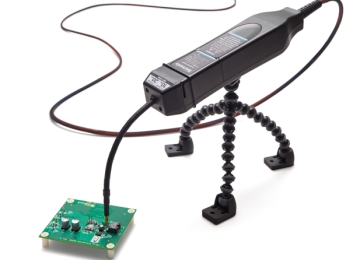
Tektronix begins supplying wideband optical isolation measurement systems
Tektronix announced that it will supply the IsoVu™ measurement system, which was showcased at the APEC2016 show this year, to customers worldwide. The IsoVu platform uses electro-optic sensors to convert input signals into optical modulation, electrically isolating the device under test from the Tektronix oscilloscope. The system is composed of four individual lasers, optical sensors, and five optical fibers, and incorporates sophisticated feedback and control technologies.
2016.08.17by 신윤오 기자
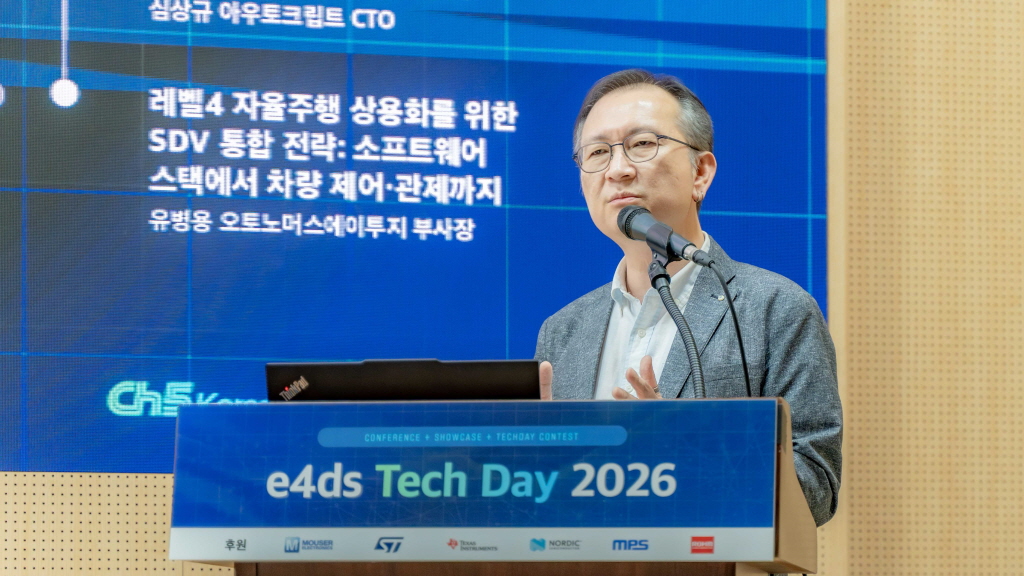
[e4ds Tech Day 2026 ⑨] Sim Sang-gyu, Autocrypt CTO: "In the Physical AI Era, Automotive Security Must Extend Beyond the Vehicle"
At e4ds Tech Day 2026, Sim Sang-gyu, CTO of Autocrypt, explained automotive cybersecurity strategies in the era of Physical AI and SDV (Software-Defined Vehicle). Automobiles are evolving as part of an ecosystem connected to AI, cloud, chargers, IoT, and robots, and he emphasized that the scope of security must expand beyond the vehicle interior to the entire connected environment. In particular, AI model tampering, adversarial attacks, OTA updates, and EV charger hacking were identified as major threats. He explained that response measures require zero trust, AI model integrity protection, intrusion detection, Security by Design and Default, and full lifecycle security management, and that proactive security system establishment beyond regulatory compliance is critical for securing future mobility competitiveness.
2026.10.12by 배종인 기자
Practical HIL Construction Strategy for Automotive and Off-Highway Controller Validation
As vehicle E/E architecture transitions to zonal structures and shifts to software-defined vehicles (SDV), the number of controllers (ECUs) requiring validation and software complexity are surging dramatically. Meanwhile, real vehicle testing cannot provide repeated verification under identical conditions and entails lead time and safety concerns. This white paper explains the principles of HIL (Hardware-in-the-Loop) validation and the structure of the NI platform composed of PXI, SLSC, and VeriStand, and through two actual implementation cases—Camera Record & Replay HIL for In-Cabin Monitoring Controller (ICMU) and Forklift Controller (VCU) HILS—describes how controller-level regression testing becomes possible. Additionally, it explicitly states application boundaries and limitations, such as lack of A2B support.
2026.10.12by 편집부











