



Accelerating the era of V2X autonomous vehicles with dedicated frequency supply.
 Published2016.10.04 09:46
The IoT and drone frequency supply is also expected to be finalized by early October.
The Ministry of Science, ICT and Future Planning and the National Radio Research Agency will complete the establishment of frequency supply and technical standards for next-generation intelligent transportation system communications.
This frequency supply and technical standards development is intended to prepare for the full-scale expansion of autonomous vehicles, and has been reviewed by the New Industry Investment Committee of the Office for Government Policy Coordination, which has been in operation since March to improve negative regulations related to investment in new industries.
The next-generation intelligent transportation system 'communication' frequency (5855-5925 MHz, 70 MHz width) being supplied this time plays a key role in the mutual communication of transportation system components (transportation means, facilities, and users).
Cooperative Intelligent Transport Systems (C-ITS) is an ICT convergence system that uses V2X (Vehicle to everything) technology to enable safe and smooth transportation activities through real-time interconnection of transportation system components.
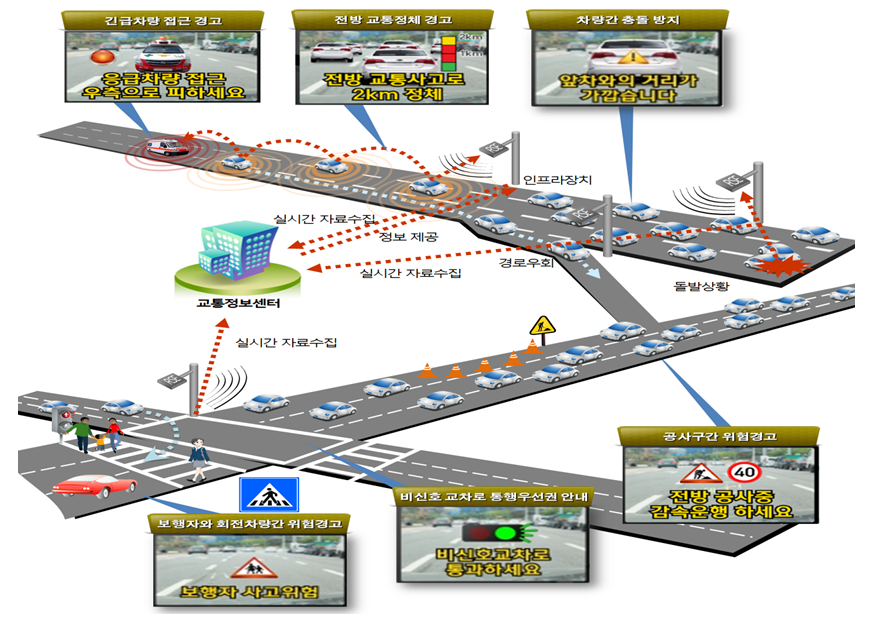
The Ministry of Land, Infrastructure and Transport has been promoting a C-ITS pilot project on the Sejong-Daejeon road since July 2014, and plans to establish C-ITS on all expressways nationwide by 2020.
It uses radio frequency to inform drivers of potential hazards ahead that are not visible to the driver, thereby preventing collisions between vehicles, securing roads for emergency vehicles such as ambulances, and preventing danger in construction zones.
Base stations using the next-generation intelligent transportation system's 'communication' frequency (5855-5925 MHz, 70 MHz width) can be used with a radio station permit with a maximum output of 2 W, and terminals can be installed in vehicles and used without a separate permit.
The technical standards are established through revisions to the Ministry of Science and ICT's notice on "Wireless equipment for wireless stations that can be established without reporting" and the National Radio Research Agency's notice on "Technical standards for wireless equipment for simple wireless stations, space stations, earth stations, radio wave detection, and other business wireless equipment."
Once the autonomous vehicle system is in place, it is expected that highway fatalities will be reduced by 50% and traffic accident costs will be reduced by approximately 500 billion won by 2025.
The Ministry of Science, ICT and Future Planning is allocating a total of 6,859 MHz of new frequencies, including frequencies for IoT and drones to foster new ICT convergence industries, in addition to frequencies for autonomous vehicles.
The new frequency allocation for new industries such as IoT and drones has passed the frequency deliberation committee of the Office for Government Policy Coordination and regulatory review, and will be finalized in early October after the promulgation process.
Comments
Related news
Secure system semiconductor technology for autonomous vehicles by 2021
Nine national strategic projects have been announced to secure new growth drivers. The nine national strategic projects selected by the government are ① autonomous vehicles ② post-steel lightweight materials ③ smart cities ④ artificial intelligence ⑤ virtual and augmented reality ⑥ precision medicine ⑦ carbon resources ⑧ (ultra)fine dust ⑨ bio-pharmaceuticals. The government announced at the second presidential Science and Technology Strategy Meeting held on the 10th that it has decided to intensively foster the nine national strategic projects through concentrated investment at the national level and public-private collaboration.
2016.08.11by 신윤오 기자
Self-driving car patent applications are booming domestically, while overseas applications are plummeting.
According to the Korea Institute for Intellectual Property Strategy (KISTA), the leading autonomous vehicle countries—Japan, the United States, and Germany—hold an average of 41.8% of major market share, while Korea achieved only 7.9%. This is analyzed as being due to insufficient technology acquisition targeting overseas markets, given that Korea's autonomous vehicle development stage is still in its early phases. Overall patent applications related to autonomous vehicles have surged since 2002 as autonomous vehicle concept cars and R&D development plans have increased. Patent applications are primarily concentrated in the United States and Japan, with Japan focused mainly on a small number of completed vehicle manufacturers, while the United States showed diverse applicants including numerous component suppliers, internet companies, and completed vehicle manufacturers.
2016.09.05by 신윤오 기자
Counterattack by Patent Trolls: Will Autonomous Vehicle Patent Disputes Intensify?
What fields of autonomous vehicles are NPEs focusing on? These entities have shown considerable interest in accident prevention/avoidance systems and vehicle state monitoring systems. The detailed technologies with the most litigation patents were automotive SoC technology, vehicle state monitoring systems, and accident prevention/avoidance systems, in that order. Among these, vehicle state monitoring systems and accident prevention/avoidance systems were patents favored by NPEs, which is because these two technologies have high infringement potential and are technologies where infringement is easy to prove.
2016.09.09by 신윤오 기자

[e4ds Tech Day 2026 ⑨] Sim Sang-gyu, Autocrypt CTO: "In the Physical AI Era, Automotive Security Must Extend Beyond the Vehicle"
At e4ds Tech Day 2026, Sim Sang-gyu, CTO of Autocrypt, explained automotive cybersecurity strategies in the era of Physical AI and SDV (Software-Defined Vehicle). Automobiles are evolving as part of an ecosystem connected to AI, cloud, chargers, IoT, and robots, and he emphasized that the scope of security must expand beyond the vehicle interior to the entire connected environment. In particular, AI model tampering, adversarial attacks, OTA updates, and EV charger hacking were identified as major threats. He explained that response measures require zero trust, AI model integrity protection, intrusion detection, Security by Design and Default, and full lifecycle security management, and that proactive security system establishment beyond regulatory compliance is critical for securing future mobility competitiveness.
2026.10.12by 배종인 기자

Practical HIL Construction Strategy for Automotive and Off-Highway Controller Validation
As vehicle E/E architecture transitions to zonal structures and shifts to software-defined vehicles (SDV), the number of controllers (ECUs) requiring validation and software complexity are surging dramatically. Meanwhile, real vehicle testing cannot provide repeated verification under identical conditions and entails lead time and safety concerns. This white paper explains the principles of HIL (Hardware-in-the-Loop) validation and the structure of the NI platform composed of PXI, SLSC, and VeriStand, and through two actual implementation cases—Camera Record & Replay HIL for In-Cabin Monitoring Controller (ICMU) and Forklift Controller (VCU) HILS—describes how controller-level regression testing becomes possible. Additionally, it explicitly states application boundaries and limitations, such as lack of A2B support.
2026.10.12by 편집부











