



SK Telecom Successfully Demonstrates Autonomous Vehicle with V2X Technology
 Published2016.10.07 17:57
Application of Vehicle-to-Vehicle Communication (V2X) and Image Recognition Technology, Verification of Improved Safety
SK Telecom has developed and unveiled autonomous driving technology that applies Vehicle-to-Vehicle Communication (V2X) to 'SNUver,' an autonomous vehicle currently being researched by Seoul National University, marking the first time a telecommunications company has done so.
SK Telecom and the Seoul National University Intelligent Automotive IT Research Center (IVIT Center, Director Professor Seung-Woo Seo) announced that they have jointly developed a technology to extend the detection range of autonomous vehicles through vehicle communication and image recognition, and demonstrated it on the Seoul National University campus.
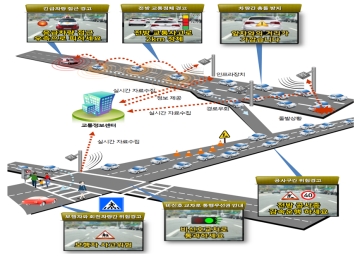
On this day, SK Telecom and Seoul National University installed and configured six traffic lights and sudden pedestrian crossing situations along a 5 km section of the Seoul National University Gwanak Campus, and verified vehicle communication technology (V2X) for transmitting road traffic information and video-based traffic light recognition technology.
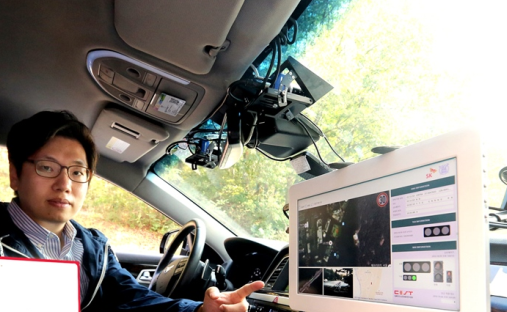
SK Telecom upgraded the autonomous driving capabilities of 'Snuver' by installing a dedicated vehicle communication network within the Seoul National University campus to implement V2X and transmitting traffic light control signals and video information captured by CCTVs to the vehicle based on this network.
The dedicated vehicle communication network utilized by SK Telecom this time uses the 5GHz band and is a type of short-range communication network technology similar to that applied to Hi-Pass, in which traffic information is received through the network when a vehicle approaches.
SK Telecom also developed image recognition technology based on deep learning that learns video information, such as traffic lights, secured through cameras mounted on vehicles, and installed it in 'Snuver'.High efficiency was checked.
While 'Snuver' previously showcased autonomous driving based on maps and object recognition technology (LiDAR) for vehicles and pedestrians, this time it is evaluated as having further enhanced driving stability by utilizing ICT infrastructure, such as communications and video, to identify the movements of traffic lights and pedestrians.
Safe driving demonstration on a 5km section of the Seoul National University campus involving 6 traffic lights and sudden pedestrian situations
In addition, Seoul National University developed and demonstrated a detection area expansion technology that enables autonomous vehicles to recognize blind spots by utilizing CCTV cameras fixed on the roadside, and experimented with a technology that generates an expanded local map using vehicle location information outside the detection area received via V2X communication.
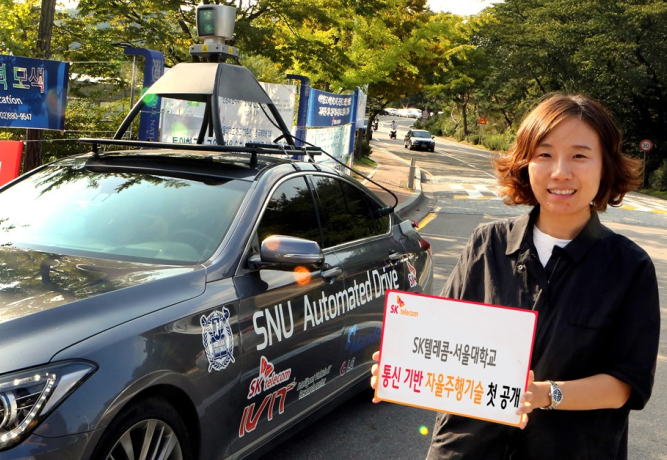
Vehicle communication technology is expected to accelerate further, with the Ministry of Science, ICT and Future Planning recently announcing plans to allocate new frequencies dedicated to vehicle communication. Additionally, the development of vehicle communication and image recognition technologies aimed at enhancing passenger safety and cognitive abilities is also expected to gain momentum.
Professor Seo Seung-woo of Seoul National University emphasized the importance of the convergence of autonomous driving and vehicle communication technologies, stating, “This research and demonstration is an example showing the importance of future cooperation with communication infrastructure to enhance the perception capabilities of autonomous vehicles.”
Choi Jin-sung, Head of SK Telecom’s R&D Center, stated, “Through this research, SK Telecom has developed the elemental technologies necessary for the gradual introduction of autonomous driving,” adding, “We are building an autonomous driving ecosystem through ICT-based collaboration with various vehicle partners based on vehicle communication technology.”"I expect it will happen," he stated.
Comments
Related news
Self-driving car patent applications are booming domestically, while overseas applications are plummeting.
According to the Korea Institute for Intellectual Property Strategy (KISTA), the leading autonomous vehicle countries—Japan, the United States, and Germany—hold an average of 41.8% of major market share, while Korea achieved only 7.9%. This is analyzed as being due to insufficient technology acquisition targeting overseas markets, given that Korea's autonomous vehicle development stage is still in its early phases. Overall patent applications related to autonomous vehicles have surged since 2002 as autonomous vehicle concept cars and R&D development plans have increased. Patent applications are primarily concentrated in the United States and Japan, with Japan focused mainly on a small number of completed vehicle manufacturers, while the United States showed diverse applicants including numerous component suppliers, internet companies, and completed vehicle manufacturers.
2016.09.05by 신윤오 기자
ARM Cortex-R52 Processor Unveiled, Accelerating the Era of Autonomous Vehicles
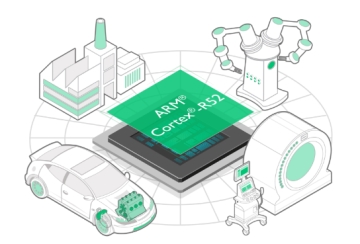
ARM announced the launch of a new real-time processor with enhanced safety features for autonomous vehicles, medical devices, and industrial robots. The ARM Cortex-R52 is designed to address functional safety in systems that must comply with ISO 26262 ASIL D and IEC 61508 SIL 3, the most stringent safety standards in the automotive and industrial sectors. The Cortex-R52 is ideal for systems that must execute with efficiency and fast response times while incorporating advanced safety features. This enables a variety of applications such as surgical automation, safety management, and vehicle drivetrain control. STMicroelectronics announced that it will license the Cortex-R52 processor to develop automotive high-integration SoCs as the first ARM partner to do so.
2016.09.21by 김수지 기자
Accelerating the era of V2X autonomous vehicles with dedicated frequency supply.
The Ministry of Science, ICT and Future Planning and the National Radio Research Agency will complete the supply of frequencies and establishment of technical standards for next-generation intelligent transportation system communications. This frequency supply and technical standards establishment are in preparation for the full-scale expansion of autonomous vehicles, and have undergone review by the Prime Minister's Coordination Office's New Industry Investment Committee, which has been operating since March to improve negative regulations related to new industry investment.
2016.10.04by 신윤오 기자

[e4ds Tech Day 2026 ⑨] Sim Sang-gyu, Autocrypt CTO: "In the Physical AI Era, Automotive Security Must Extend Beyond the Vehicle"
At e4ds Tech Day 2026, Sim Sang-gyu, CTO of Autocrypt, explained automotive cybersecurity strategies in the era of Physical AI and SDV (Software-Defined Vehicle). Automobiles are evolving as part of an ecosystem connected to AI, cloud, chargers, IoT, and robots, and he emphasized that the scope of security must expand beyond the vehicle interior to the entire connected environment. In particular, AI model tampering, adversarial attacks, OTA updates, and EV charger hacking were identified as major threats. He explained that response measures require zero trust, AI model integrity protection, intrusion detection, Security by Design and Default, and full lifecycle security management, and that proactive security system establishment beyond regulatory compliance is critical for securing future mobility competitiveness.
2026.10.12by 배종인 기자

Practical HIL Construction Strategy for Automotive and Off-Highway Controller Validation
As vehicle E/E architecture transitions to zonal structures and shifts to software-defined vehicles (SDV), the number of controllers (ECUs) requiring validation and software complexity are surging dramatically. Meanwhile, real vehicle testing cannot provide repeated verification under identical conditions and entails lead time and safety concerns. This white paper explains the principles of HIL (Hardware-in-the-Loop) validation and the structure of the NI platform composed of PXI, SLSC, and VeriStand, and through two actual implementation cases—Camera Record & Replay HIL for In-Cabin Monitoring Controller (ICMU) and Forklift Controller (VCU) HILS—describes how controller-level regression testing becomes possible. Additionally, it explicitly states application boundaries and limitations, such as lack of A2B support.
2026.10.12by 편집부











